Published on: 2025-12-26
Updated on: 2025-12-26
The Liberalised Remittance Scheme (LRS) is the main RBI-backed route that allows a resident Indian individual to legally send money abroad for personal spending and investments, within a single yearly cap.
It covers common needs such as foreign education fees, medical treatment, travel, gifts to relatives, and buying overseas assets.
Under LRS, a resident individual (including a minor) can remit up to US$250,000 per financial year for permissible current account or capital account transactions, or a mix of both. The scheme began on February 4, 2004 with a limit of US$25,000, and the limit has been revised over time. [1]

LRS is available only to resident individuals, including minors (the declaration must be countersigned by a natural guardian). It is not available to corporates, partnership firms, HUFs, trusts, and similar entities. [1]
This is the first filter banks apply. If the applicant is not a resident individual under FEMA rules, LRS is not the right route.
The LRS limit is US$250,000 per financial year (April–March) per resident individual. There is no restriction on frequency, but the total foreign exchange bought or remitted through all sources in India must stay within the cumulative limit. [1]
Once a person uses the limit in a financial year, they cannot make further remittances under LRS in that year even if investment proceeds are brought back to India.
RBI lists typical permitted purposes within LRS, including: private visits (except Nepal and Bhutan), gifts/donations, employment abroad, emigration, maintenance of close relatives abroad, business travel and conferences/training, medical treatment and attendant expenses, studies abroad, and other current account transactions that are not prohibited or restricted. [1]
A practical way to think about this list: LRS supports legitimate personal needs and investments, as long as the purpose is allowed and properly declared.
RBI clearly prohibits LRS for certain categories, including: items prohibited under Schedule I (such as lottery tickets/sweepstakes and proscribed magazines), margin or margin calls to overseas exchanges/counterparties, purchase of certain FCCBs in overseas secondary markets, trading in foreign exchange abroad, remittances (directly or indirectly) to FATF “non-cooperative” jurisdictions, and remittances to persons/entities identified for terrorism risk. [1]
RBI also prohibits a specific gifting pattern: a resident gifting foreign currency to another resident for credit to the recipient’s foreign currency account held abroad under LRS.
Remittances under LRS do not have to be only in US dollars. RBI states they can be made in any freely convertible foreign currency. [1]
LRS outward remittances are processed through an Authorised Dealer (AD) bank (or authorised persons as permitted for some current account transactions). RBI expects the remitter to designate an AD branch for capital account remittances under LRS. [1]
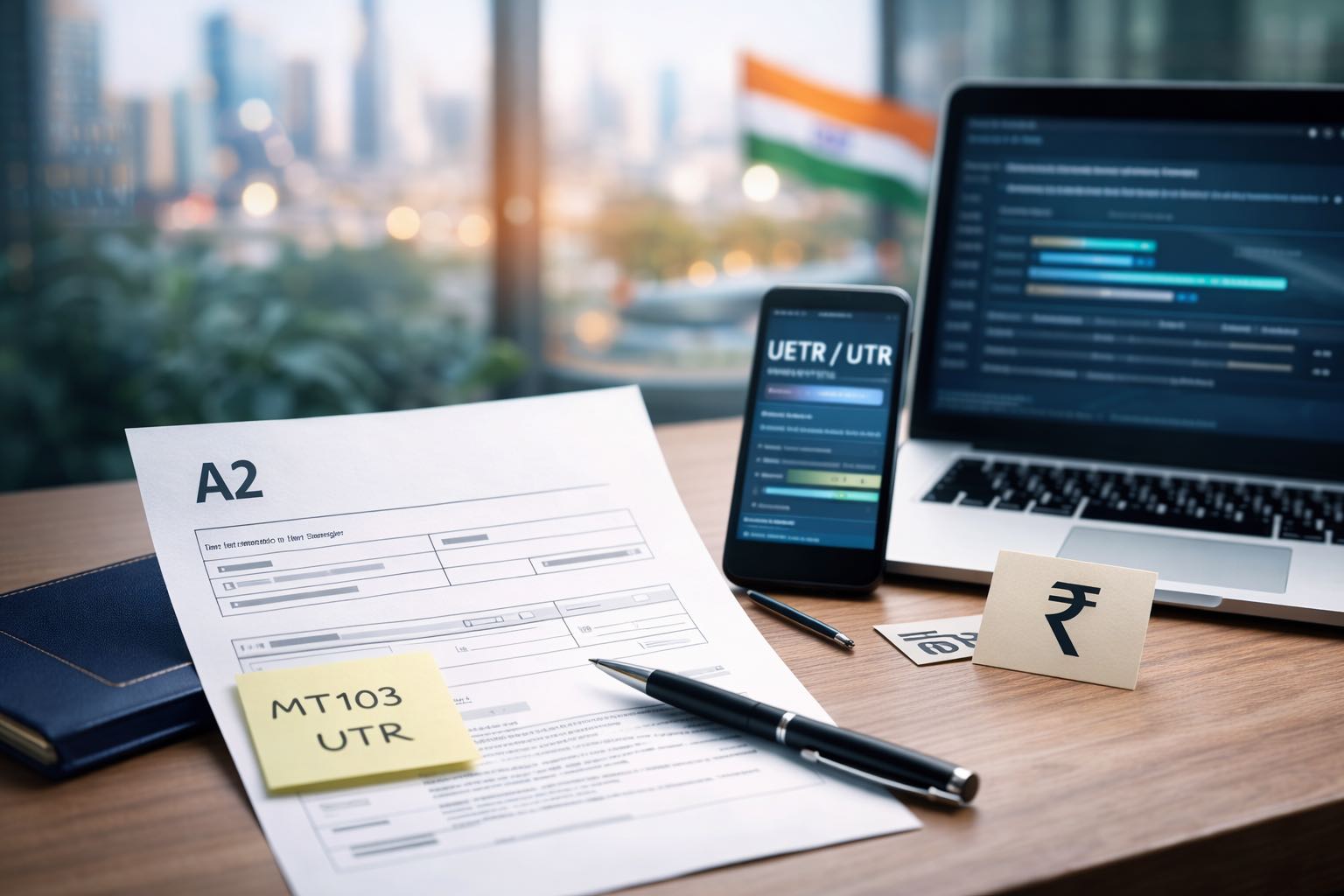
Banks are guided by the nature of transaction declared by the remitter in Form A2 and then certify that the remittance is in line with RBI instructions. RBI also states the ultimate responsibility remains with the remitter to ensure FEMA compliance. [1]
Most resident Indians experience LRS in this sequence:
Choose the permitted purpose (education, medical, travel, investment, gift, maintenance, etc.).
Submit Form A2 and the LRS declaration to the bank.
Provide PAN (mandatory for LRS transactions through authorised persons).
Share supporting documents the bank needs to confirm the purpose and source of funds.
Fund the transfer from INR balances; the bank converts and remits in the chosen freely convertible currency.
RBI’s framework makes the bank responsible for checking genuineness and due diligence, especially for capital account transactions and new customers. Banks may ask for the previous year’s bank statement and, if not available, the latest income tax assessment order or return to satisfy themselves about the source of funds.
In practice, banks commonly request:
PAN
Form A2 + LRS declaration
Passport/visa details (for travel-linked cases)
Fee invoices/admission letters (education)
Hospital estimates/invoices (medical)
Investment agreements or brokerage confirmations (investments)
Proof of relationship (maintenance/gifts, when relevant)
Permitted Uses Explained In Plain English
Education Abroad
LRS is widely used for tuition, accommodation, and related education costs abroad. A key planning point is that the LRS cap is per person, not per family. If multiple family members are paying, each person’s remittances count toward their own LRS limit.
For large fees, people often spread payments across instalments and keep documentation clean, because banks and tax reporting rely heavily on purpose and identity matching.
RBI explicitly allows remittances connected to medical treatment abroad and attendant expenses. [1]
Banks usually ask for an estimate or invoice from the hospital/service provider, and travel details if the remittance is linked to travel.
Private visits are permitted to any country except Nepal and Bhutan within the LRS limit.
RBI also covers business travel and attending conferences or specialised training within the permitted purposes list.
RBI allows gifts/donations and maintenance of close relatives abroad under LRS.
Banks may ask for proof of relationship or a short explanation of the purpose. The remitter should avoid structures that RBI explicitly prohibits, such as gifting foreign currency to another resident for credit to a foreign currency account abroad under LRS.
Residents use LRS to buy overseas financial assets and, where needed, manage the flow through an overseas bank account. RBI states that prior approval is not required to open, maintain, and hold a foreign currency account with a bank outside India for making remittances under LRS.
RBI also notes it does not prescribe ratings or quality restrictions under LRS, but expects investors to exercise due diligence and comply with the Overseas Investment Rules and Regulations, 2022 where applicable. [1]
RBI allows remittances for acquiring immovable property outside India and states such remittances may be consolidated among relatives, as long as each relative is a resident individual complying with LRS terms.
RBI also draws a boundary: family “clubbing” is not permitted for capital account transactions like opening an overseas bank account or making an investment if the family members are not co-owners/co-partners in that overseas account or investment.
RBI prohibits remittances for margins or margin calls to overseas exchanges/counterparties and prohibits remittances for trading in foreign exchange abroad.
If a remittance looks like leveraged trading funding, banks often pause the transaction and ask for deeper clarification.
RBI prohibits capital account remittances (direct or indirect) to jurisdictions identified by FATF as “non-cooperative” and prohibits remittances to individuals/entities identified for terrorism risk as advised to banks. [1]
This is compliance-driven and is one of the most common reasons a bank rejects a payment even if the amount is small.
Schedule I-type items (lotteries, sweepstakes, proscribed magazines, and similar) remain prohibited.
If the declared purpose is vague, banks may treat it as higher risk. Clear purpose description and clean documentation reduce delays.
For many resident Indians, the practical friction point is TCS (Tax Collected at Source) collected at the time of payment/debit.
The threshold for TCS under Section 206C(1G) for remittance under LRS (and for an overseas tour program package) was increased from ₹7 lakh to ₹10 lakh and is effective from April 1, 2025. [2]
Finance Act, 2025 highlights state that the authorised dealer shall not collect TCS under Section 206C(1G) on remittances in foreign currency from an education loan obtained under the specified provision referenced in the highlights.
This matters because it can remove a large upfront cash-flow cost for families funding foreign education through a qualifying education loan route.
CBDT’s Circular No. 10/2023 summarises how TCS rates apply once the threshold is crossed and also clarifies that the threshold is a combined threshold for LRS remittances in a financial year, not a separate threshold for each purpose.
A practical summary many banks implement (based on the CBDT structure, with the updated ₹10 lakh threshold from Finance Act, 2025) is:
| LRS Category | TCS Up To ₹10 Lakh (₹1,000,000) In a FY | TCS On Amount Above ₹10 Lakh |
|---|---|---|
| Education / Medical (non-loan) | Nil | 5% |
| Other LRS Purposes | Nil | 20% |
| Education Loan Remittance (qualifying) | Nil | Nil (as per Finance Act, 2025 highlights) |
TCS is typically visible in tax credit statements and is generally creditable against the final income tax liability, depending on the taxpayer’s total situation.
CBDT clarifies the threshold is applied on the aggregate remitted by a person in a financial year under LRS, irrespective of purpose.
This is why banks often rely on a declaration/undertaking about prior remittances in the same year when you use multiple authorised dealers.
RBI states the LRS limit shall not apply to the use of an International Credit Card for making payment by a person toward meeting expenses while the person is on a visit outside India.
On the tax side, CBDT’s Circular No. 10/2023 (based on the Ministry of Finance press release of June 28, 2023) states that classification of international credit card use while overseas as LRS was postponed and that no TCS is applicable on such expenditure “till further order.”
RBI’s card guidance is stricter on prohibited use cases (such as Schedule I prohibited items) and also notes specific restrictions such as use in Nepal and Bhutan not being permitted for foreign exchange payments through these instruments.
Because card products differ, residents should confirm with the issuing bank how a particular international transaction is reported for LRS/TCS purposes.
Before initiating an outward remittance, most delays can be avoided by doing a quick self-check:
Confirm the remitter is a resident individual and has sufficient unused LRS limit.
Choose a purpose that is clearly permitted and avoid prohibited categories (margin funding, FX trading, prohibited goods/services).
Keep documents ready: invoices, admission letters, medical estimates, agreements, and relationship proof where relevant.
Use the correct currency and understand that any freely convertible currency is allowed.
Plan cash flow for TCS if the year’s remittances may cross ₹10 lakh.
LRS is an RBI scheme that lets a resident Indian individual send money abroad for permitted personal spending and investments, up to US$250,000 per financial year. The transfer is routed through an authorised dealer bank and must be for an allowed purpose under FEMA rules.
Only resident individuals can use LRS, including minors (with a guardian’s countersignature). Entities like companies, partnership firms, HUFs, and trusts cannot use LRS for outward remittances under this scheme.
No. RBI states that remittances under LRS can be made in any freely convertible foreign currency. The US$250,000 figure is the scheme cap reference, not a restriction that forces the remittance currency to be US dollars.
RBI places no limit on the number of remittances. The restriction is on the total amount: all foreign exchange bought or remitted during the financial year must stay within the US$250,000 cumulative limit.
RBI prohibits several categories, including remittances for lottery-type items, margin or margin calls to overseas exchanges/counterparties, purchase of certain FCCBs in overseas secondary markets, and trading in foreign exchange abroad. Certain restricted jurisdictions and flagged parties are also disallowed.
The threshold for TCS under Section 206C(1G) for LRS remittances (and overseas tour program packages) was increased to ₹10 lakh and is effective from April 1, 2025. Above the threshold, rates depend on the purpose category under the law.
LRS is built around one clear rule: a resident Indian individual can remit up to US$250,000 per financial year for permitted purposes, and the bank processes the transfer based on Form A2, declarations, and compliance checks. Most problems come from mismatched purpose descriptions, weak documentation, or attempting prohibited categories.
For many households, the larger planning issue is TCS and cash flow. With the threshold at ₹10 lakh from April 1, 2025 and purpose-based rates beyond that, a clean tracking sheet of all remittances and a disciplined documentation folder often matter as much as the amount being sent.
Disclaimer: This material is for general information purposes only and is not intended as (and should not be considered to be) financial, investment or other advice on which reliance should be placed. No opinion given in the material constitutes a recommendation by EBC or the author that any particular investment, security, transaction or investment strategy is suitable for any specific person.
[1] https://www.rbi.org.in/commonman/english/scripts/FAQs.aspx?Id=1834
[2] https://incometaxindia.gov.in/Lists/Latest%20News/Attachments/708/Highlights-to-Finance-Act-2025.pdf