Published on: 2025-08-01
Updated on: 2026-03-02
The Canadian dollar (CAD), often nicknamed the "loonie", has spent much of 2025 and early 2026 under pressure. Despite being one of the world's most traded currencies, it has struggled against the U.S. dollar, hovering in the weaker half of its 52-week range.
As of early March 2026, USD/CAD trades near 1.365, meaning one U.S. dollar costs about 1.365 Canadian dollars, a sign of sustained weakness in Canada's currency.
Why has the loonie been losing altitude, and what could turn it around? Let's analyze the key factors, including oil prices, interest rates, trade balances, and investor sentiment.
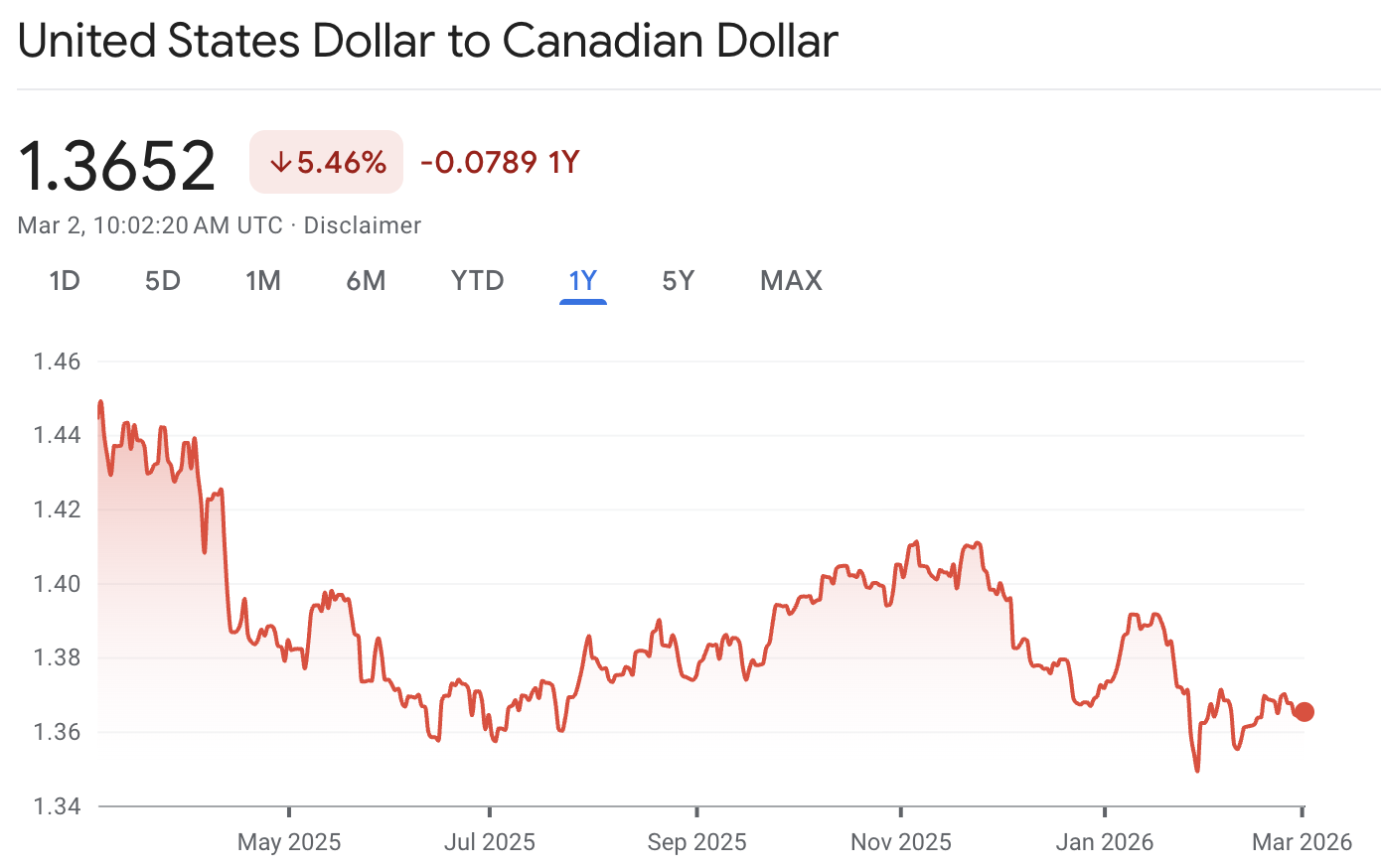
The Canadian dollar slide from 2025 into early 2026 has been steady rather than dramatic. Market data indicates that USD/CAD is around 1.3645, trading within roughly 1.5 cents of its 2026 low.
Historical data shows the pair has traded between 1.349 and 1.393 this year, averaging roughly 1.3719.
This weakness has coincided with a string of soft economic readings and a volatile oil market, two themes that often define the direction of CAD.
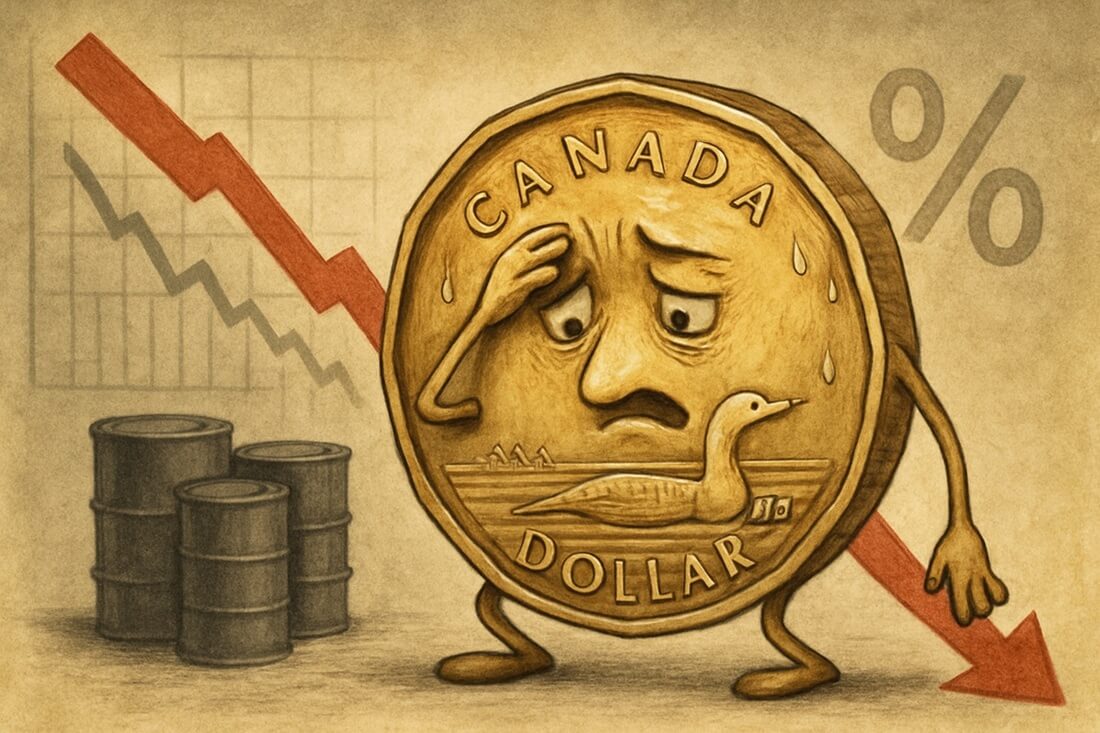
Few currencies are as closely tied to a single commodity as the Canadian dollar is to oil. Canada ranks among the world's top crude exporters, so when oil prices rise, the CAD typically strengthens and vice versa.
In 2026, oil prices have eased from early-year highs. WTI crude currently trades around $66 per barrel (EIA, February 2026), down from nearly $67 earlier in February. This drop weighed heavily on the CAD, pushing USD/CAD toward multi-week highs.
This decline in oil hurts Canada's trade balance, reducing export revenues and weakening foreign demand for CAD.
While the currency occasionally recovers when oil rises, as seen during brief rallies in February, the broader trend remains bearish as long as global growth remains tepid and energy demand surges.
Interest rate differentials, also known as "yield spreads," are a significant factor influencing currency strength. Simply put, investors prefer currencies with higher interest rates because they offer better returns on deposits and bonds.
As of late February 2026, Canada's 2-year government bond yield sits at 2.39%, while the U.S. equivalent stands near 3.42%. This gap discourages capital inflows into Canadian assets, keeping demand for the loonie muted.
The Bank of Canada (BoC) has maintained a cautious stance due to tepid growth, while the U.S. Federal Reserve remains hawkish to ensure inflation is contained. This policy divergence leaves CAD at a disadvantage.
The BoC's January 2026 Monetary Policy Report projected economic growth to average around 1¼% over the projection horizon, giving policymakers little room to raise rates further.
Conversely, the U.S. economy remains resilient, bolstering the strength of the USD.
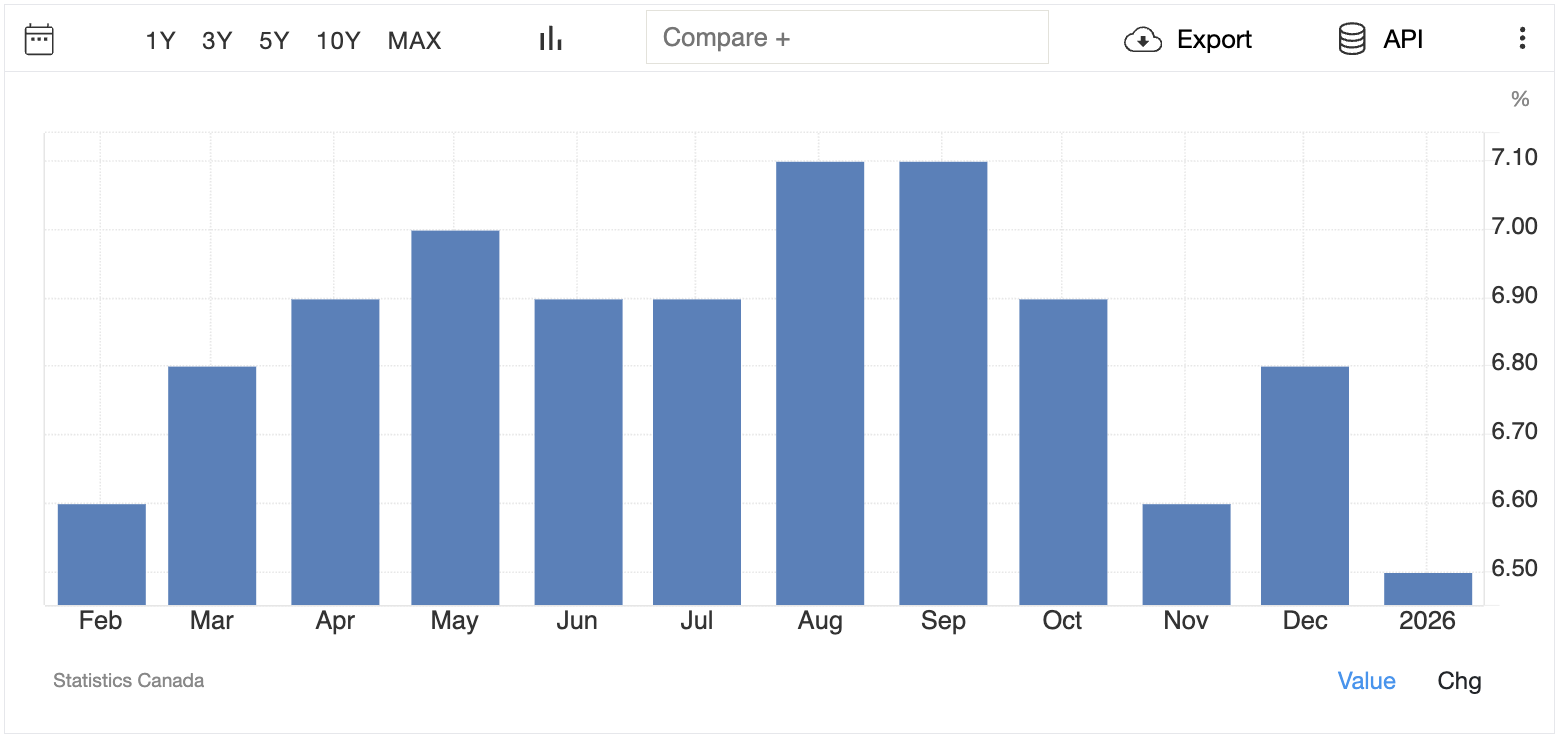
Beyond oil and interest rates, the underlying Canadian economy has lost some momentum in 2026. Recent data shows Canada shed about 25,000 jobs in January, and the unemployment rate fell to 6.5%.
This was the first monthly job drop in five months, indicating weakness in consumer spending, which is essential to Canada's economy.
Manufacturing activity has also cooled. The S&P Global Canada Manufacturing PMI edged up to 50.4 in January, above the 50 threshold that separates expansion from contraction.
Together, these signals suggest that Canada's economy is under strain, reinforcing the market's consensus that the Bank of Canada may need to cut interest rates before its U.S. equivalent, further depreciating the CAD.
Canada's trade deficit has persisted into early 2026, further weighing on the loonie. December data indicate a deficit of roughly $1.3 billion, as shifting export dynamics and higher imports kept trade flows in the red.
When a country imports more than it exports, it effectively sends more of its currency abroad than it receives, creating downward pressure on its exchange rate.
In Canada's case, this imbalance is compounded by the fact that a significant portion of its export income derives from commodities. When oil, gas, and metals prices drop, the export side weakens quickly, leaving the currency vulnerable.
The Canadian dollar is not just a reflection of domestic economics; it's also a "risk-on" currency, meaning it tends to perform well when global investors are optimistic and poorly when markets turn defensive.
In 2026, geopolitical tensions, concerns about slower global growth, and a cautious tone from central banks have kept risk appetite subdued.
As a result, capital has flowed into "safe-haven" currencies like the U.S. dollar, Swiss franc, and Japanese yen, and away from commodity currencies like CAD and AUD.
This dynamic helps explain why even when oil prices briefly stabilise, CAD still struggles to make lasting gains: global money managers are reluctant to add exposure to risk-sensitive assets.
Despite the challenges, it's not all doom and gloom for the Canadian dollar. There are several plausible paths to recovery.
If crude oil prices rally above the $70–$75 range, Canada's export revenues could strengthen quickly. Higher energy prices often attract global capital back into CAD.
If the U.S. Federal Reserve cuts rates before the Bank of Canada, the yield gap might shrink or even reverse in favour of the CAD. According to recent analysis, a Fed-first pivot could be "the spark CAD needs for a sustained rebound."
An improvement in Canada's labour market or exports could shift sentiment. Sectors like technology, green energy, and advanced manufacturing are showing tentative resilience.
In fact, Scotiabank analysts forecast USD/CAD could fall to around 1.33 by late 2026, assuming these tailwinds materialise.
USD/CAD remains range-bound between 1.34 and 1.40 through year-end, as neither oil nor interest rate differentials change dramatically.
If oil rebounds and the Fed cuts before the BoC, CAD could strengthen toward 1.30 or lower.
If Canada's slowdown deepens and global risk sentiment weakens, USD/CAD could rise above 1.40, testing 2026 highs.
While volatility is expected, the loonie's long-term fundamentals remain sound, backed by a strong fiscal base, robust export sectors, and prudent central bank policy.
To anticipate where the loonie heads next, traders and investors should keep an eye on these macro indicators:
| Indicator | Why It Matters | What to Watch For |
|---|---|---|
| Oil prices (WTI/Brent) | Major export driver | Sustained recovery above $70 could lift CAD |
| BoC vs Fed rate moves | Impacts yield spreads | Fed cuts earlier than BoC → CAD rebound |
| Canada trade balance | Reflects export performance | Narrowing deficit signals CAD support |
| Bond yield spreads (2Y, 10Y) | Guides capital flow | Spread compression favors CAD |
| PMI and jobs data | Measures economic health | Upside surprises boost CAD sentiment |
| Global risk appetite | "Risk-on" vs "risk-off" flows | Market optimism supports CAD |
A mix of soft oil prices, mixed domestic data, and higher U.S. yields makes the USD more attractive.
Yes. Especially if the Fed starts cutting rates before the Bank of Canada or oil prices rebound above $70.
No. It's a risk-sensitive commodity currency, meaning it tends to weaken when global investors turn cautious.
Since the U.S. is Canada's top trading partner, U.S. economic growth has a direct impact on Canadian exports and overall sentiment.
In conclusion, the Canadian dollar's weakness in 2025 and early 2026 was due to low oil prices, weaker domestic indicators, and international capital movements seeking better returns elsewhere.
However, currencies move in cycles. As the Fed edges closer to rate cuts and if energy markets stabilise, the loonie could mount a meaningful comeback.
For now, CAD remains under pressure, but it isn't grounded forever. When sentiment turns, the loonie has a history of surprising on the upside.
Disclaimer: This material is for general information purposes only and is not intended as (and should not be considered to be) financial, investment or other advice on which reliance should be placed. No opinion given in the material constitutes a recommendation by EBC or the author that any particular investment, security, transaction or investment strategy is suitable for any specific person.