Published on: 2025-12-29
Updated on: 2025-12-29
Window dressing is one of the few market behaviours that can move prices without any fresh economic news. When a month ends, fund managers may adjust portfolios to look more conservative, more fashionable, or simply more "presentable" in holdings reports.
Those trades can create late-month rallies in recent winners, sudden weakness in laggards, and a brief distortion in market breadth.
In 2025, window dressing also matters more because portfolio transparency rules have been tightening, and the window for "cosmetic" positioning has been shrinking. Funds still have incentives to manage appearances, but the market is becoming better at spotting the footprints.
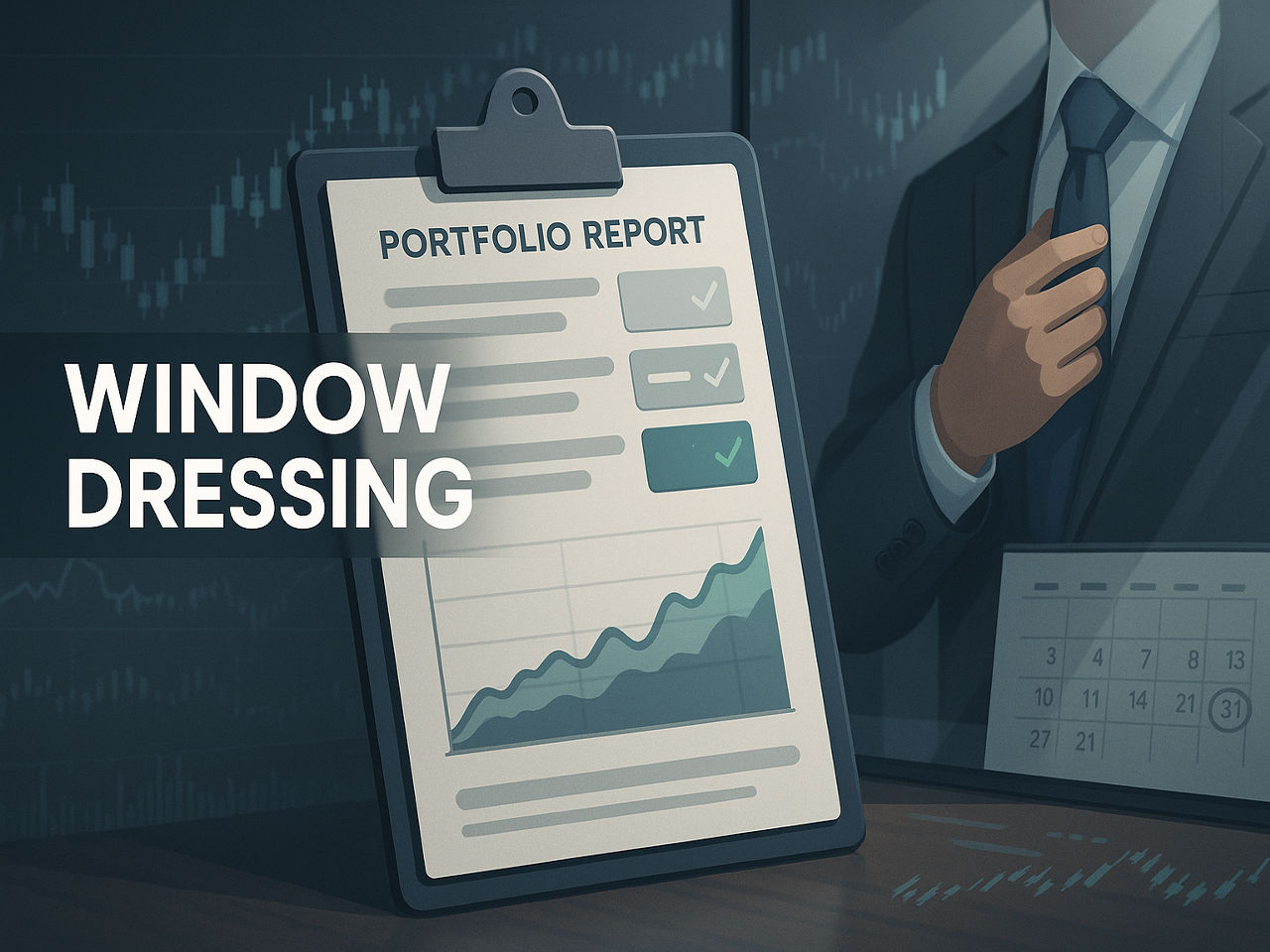
Window dressing is the practice of adjusting a portfolio's holdings or how results are presented right before a reporting date (month-, quarter-, or year-end) to make the portfolio look more attractive to clients or other stakeholders.
In asset management, that often means buying recent winners and selling recent losers shortly before month-end, quarter-end, or year-end disclosures.
Simply put, window dressing is altering a portfolio's holdings or how results are presented near a reporting date to create a misleadingly favourable impression. In mutual funds, it is commonly linked to holdings that look stronger on paper than the manager's true process would suggest.
Much of window dressing resides in a grey area. The trades are real and legal, but the intent is cosmetic.
It can still matter for investors because it may:
distort short-term prices
obscure how a fund truly performed
create "false signals" in momentum and breadth data
Academic work has treated window dressing as an agency problem: managers have incentives to influence how investors judge them based on disclosed holdings and recent performance.
Window dressing does not announce itself. It leaves patterns.
| Common Window Dressing Method | Why It Helps A Report | Typical Market Footprint |
|---|---|---|
| Adding recent outperformers | Makes the portfolio look aligned with what worked | Late buying pressure in strong sectors or "momentum" names |
| Cutting recent underperformers | Removes positions that raise uncomfortable questions | Extra selling into weakness, sometimes followed by a bounce |
| Raising benchmark-like exposure | Reduces the chance of looking "offside" versus peers | Convergence toward index weights near period-end |
| Reducing visibly risky holdings | Improves optics on concentration or volatility | Short-lived de-risking, often reversed after the cutoff |
These behaviours leave a footprint that resembles momentum chasing, tilting reported holdings toward "recent winners" and away from "recent losers", especially when managers know portfolio holdings will be disclosed and scrutinised right after a quarter- or year-end cutoff.
The behaviour is often more visible in less liquid stocks where marginal buying or selling can move prices more easily.
A useful way to think about window dressing is to separate the goal (improving the appearance of holdings) from the method (trading activity that reshapes the list of positions).
Month-end is when three forces collide: reporting optics, benchmark alignment, and flows.
Holdings are disclosed to clients and regulators on a schedule. A portfolio displaying well-known winners may appear more secure, even if those assets were acquired later.
Research on pension funds and mutual funds documents behaviour consistent with window dressing around disclosure dates, including the tendency to tilt towards winners before reporting.
A manager who underweights a market leader can look careless when clients scan the holdings list. Month-end becomes the moment to reduce the career risk of being visibly out of step.
This is adjacent to, but not identical with, window dressing. A separate seasonal pattern known as the turn-of-the-month effect shows that returns are often stronger around the end and beginning of a month.
These ideas are often mixed, but they are not the same thing. Window dressing is a manager incentive tied to disclosure and reputational pressure. The turn-of-the-month effect is a return pattern that can exist even when no one is trying to "pretty up" a portfolio.
Research literature traces this effect back to work such as Ariel (1987) and Lakonishok & Smidt (1988), and newer studies continue to investigate it across markets and investor types.
The short answer is yes, and the better academic work is careful about how it measures it.
Lakonishok, Shleifer, Thaler and Vishny's work on pension fund managers is a foundational reference in this literature.
Agarwal, Gay, and Ling's research on mutual funds provides a rationale for why window dressing can persist and links it to how investors interpret disclosed holdings versus performance.
The practical interpretation is straightforward: you do not need every fund to do it for the market to feel it. You only need enough assets, concentrated into enough similar trades, at the same time.
Yes, window dressing still exists, but it has become more tactical and harder to hide than it was a decade ago.
Why It Still Happens
The incentives have not changed. Professional managers are still judged on:
Quarterly and year-end reports that clients actually read.
Peer comparisons against benchmarks and competitors.
The optics of owning (or not owning) the market's most visible winners.
| Signal | What it looks like | Why it matters |
|---|---|---|
| Breadth divergence | Index up, but fewer stocks up | Suggests buying is concentrated in "showcase" names |
| Late-month momentum extension | Winners push to fresh highs into month-end | Consistent with “buy the winners” optics |
| Laggard capitulation | Losers get sold regardless of news | "Clean up" behaviour ahead of disclosure |
| Closing auction imbalance | Strong net buy/sell pressure at the close | Month-end is a natural time for forced adjustments |
| Early next-month reversal | Winners fade, laggards bounce | Can signal cosmetic demand has passed |
Window dressing does not move every corner of the market equally.
Small caps and thin liquidity stocks: Even modest orders can move the price materially, increasing slippage and short-term volatility.
High-momentum sectors: when "winners" are obvious, flows can crowd.
ETF-heavy themes: end-of-month rebalancing and optics trades can overlap.
Mega-caps with deep liquidity: they can still be bought for optics, but the price impact is often smaller.
Markets with fewer disclosure incentives: where holdings are not scrutinised in the same way.
Be cautious about buying a stock simply because it is strong in the last two sessions of the month.
If you want exposure, consider staging entries into early next month when flows normalise.
Separate "story strength" from "month-end strength."
Reduce leverage and avoid market orders in less liquid names.
Focus on liquid instruments when spreads widen.
Treat month-end as a period where technical levels and auction flows can matter more than headlines.
Window dressing is the practice of adjusting portfolios or presentations near a reporting date to look stronger than reality.
Window dressing is usually legal because it involves real trades. However, it can still mislead investors if it creates a false impression about a manager's typical holdings or process.
It can, but transparency reduces the payoff.
No. Window dressing is a portfolio behaviour that can occur at month-end, quarter-end, or year-end, and it can contribute to seasonal moves without being the same phenomenon.
In conclusion, window dressing represents a real and well-studied behaviour, and it can matter more than a day's worth of macro headlines because incentives drive it.
When managers care about how holdings look at month-end, they tend to concentrate on winners and reduce exposure to losers. That can lift indices, narrow breadth, and distort signals that many investors rely on.
For now, the more important story is not that window dressing will disappear. The story is that greater transparency is steadily narrowing the window.
Disclaimer: This material is for general information purposes only and is not intended as (and should not be considered to be) financial, investment or other advice on which reliance should be placed. No opinion given in the material constitutes a recommendation by EBC or the author that any particular investment, security, transaction or investment strategy is suitable for any specific person.