Published on: 2025-12-02
Updated on: 2025-12-02
Stocks have already done a lot of heavy lifting in 2025. The S&P 500 is up roughly 17% year-to-date, the Nasdaq 100 more than 20%, and both are sitting not far below record territory as December begins.
At the same time, volatility has crept higher, tech leaders are wobbling, and everyone is gaming the odds of another Fed rate cut in mid-December.
Against that backdrop, the usual question appears: Will Santa show up for the market again or has the rally already been spent?

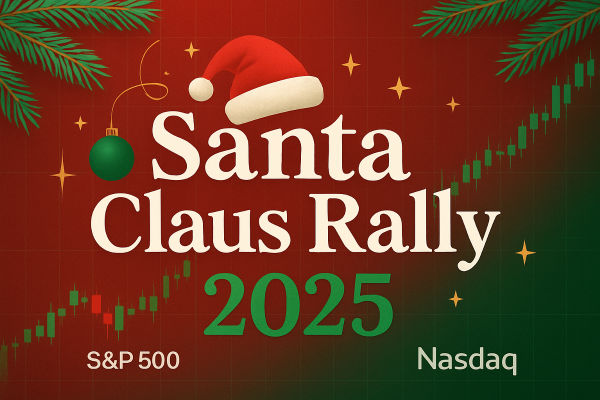
The Santa Claus rally refers specifically to the last five trading days of December and the first two trading days of January, not the whole month.
Since 1950, the S&P 500 has gained about 1.3% on average over this seven-session window and finished higher roughly 76–79% of the time, far better than a random seven-day stretch.
Data suggests that the trend appeared in 58 of the 73 years from 1950 to 2022.
The logic behind the effect is straightforward:
Seasonal flows: Year-end bonuses, tax planning, and fund rebalancing often push fresh money into equities.
Low news flow: Fewer corporate and macro bombs over the holidays can reduce selling pressure.
Positioning clean-up: Funds closing shorts or window-dressing winners can create a mild upward bias.
None of that is mystical. It just says: in a normal year, when the market isn't already stressed, this seven-day stretch has a habit of drifting higher.
Last year, the 2024–25 Santa Claus window delivered a rare negative return for the S&P 500, even as the index still finished 2024 up more than 23%.
Historically, back-to-back negative Santa periods have only happened twice since 1950, which is why this year's pattern is being watched especially closely.
Presently, we see the 2025 setup as a classic tension between a supportive macro shift of easing interest rates, stable but not runaway inflation, and a maturing, concentrated equity rally where expectations are already high.
That combination argues for better-than-even odds of a modest Santa Claus rally, but with significantly more event risk than the long-term averages suggest.
Here's the rough scorecard as of 1–2 December 2025:
| Index | Latest level* | 2025 YTD return | Comment |
|---|---|---|---|
| S&P 500 | ~6,813–6,818 | ≈17% total return | Near all-time highs after a strong AI- and rate-cut-driven run. |
| Nasdaq 100 | ~25,200–25,250 | ≈20.6% | Hit fresh records in Oct–Nov before a mid-month shakeout. |
| Dow Jones Industrial Average | ~47,300 | ≈6–7% (1-yr) | More modest gains as leadership stayed in tech and growth. |
*Levels indicative, based on recent closes.
This is not a market limping into December. It's a market that's already had a good year and is testing upper ranges.
Inflation
US CPI is running at roughly 3.0% year-on-year as of September, with Q4 nowcasts still tracking just under 3%.
That's down from the post-pandemic peaks but still above the Fed's 2% target.
Fed policy
The Fed cut the funds rate in October to a 3.75–4.00% target range.
Futures pricing and bank research now put the odds of another 25 bps cut in December at over 80%, which would lower the target range to 3.50–3.75%.
Volatility and Sentiment
The VIX sits around 17–18, above the sleepy lows near 13 earlier in the year but miles below panic levels.
Analyst notes the S&P 500 just pulled back 0.5% on the first trading day of December after a "post-Thanksgiving hangover," with option protection costs ticking up and "extreme fear" on some sentiment gauges.
In short: growth is okay, inflation is drifting lower, the Fed is tilting toward easing, but investors are jumpy after a big run and a spiky November.
Using available data and figures, the Santa window in the S&P 500 looks roughly like this:
| Metric (since 1950) | Santa period (last 5 Dec + first 2 Jan) | Typical 7-day period |
|---|---|---|
| Average S&P 500 return | ≈+1.3% | ≈+0.3% |
| % of periods positive | ≈76–80% | ≈58% |
| Number of positive Santa periods (1950–2022) | 58 out of 73 | N/A |
Historically, this is one of the most reliable short windows of the year for US stocks.
Analysts and others have pointed out a pattern that traders love to quote:
When Santa shows up (period positive), the S&P 500 has tended to post solid average gains in January and the following year, around +1.4% in January and an average of ~+10% for the full year.
When Santa doesn't show up, subsequent returns and hit rates are weaker, and downside surprises are more common.
It's not a law of nature, but it's a decent sentiment to tell. A weak or negative Santa period usually means something is off: liquidity, policy fears, or hidden stress.
A lot revolves around the S&P's 6,800–6,850 band:
Many analysts flag 6,850 as a key resistance zone on the S&P 500.
Recent analysis points to support around 6,720–6,760, with a deeper floor near 6,500 tied to the 50-day moving average and repeated retests.
S&P 500 Technical Map (Late 2025)
| Zone | Level (approx.) | Role |
|---|---|---|
| 6,850–6,860 | Major resistance | Multiple tests from October onward; widely watched pivot for a fresh leg higher. |
| 6,800 | Near-term resistance | Prior reaction highs; area where intraday rallies are stalling. |
| 6,720–6,760 | First support | Recent pullback lows; “line in the sand” for dip buyers. |
| ≈6,500 | Deeper support | 50-day moving average area and prior consolidation base. |
| ≈6,920–6,950 | Next resistance | Region of late-October record highs; above here, talk shifts to 7,000+. |
The market is effectively coiled between first support and ceiling resistance. A clean break either way into mid-December will heavily colour the Santa odds.
The Nasdaq 100 has been the high-beta engine:
It pushed above 25,000 in October, ran as high as the 25,800 area, then dropped on AI/valuation worries before rebounding.
Several technical notes highlight 25,000 as a key support and 25,500–25,800 as resistance, with some wave-based targets pointing toward 26,000–26,250 if bulls keep control.
Short version: tech is still in an uptrend, but fragile. Anything that shakes the AI story or rate-cut narrative quickly feeds into NDX.
We can't know the outcome in advance, but we can provide scenarios based on where we are now.
| Scenario | Rough probability feel | What it looks like | Key drivers |
|---|---|---|---|
| Base case: Mild Santa | ~50–60% | S&P 500 holds above 6,700, grinds through 6,850, ends the Santa window up ~1–2%. | One December Fed cut, no nasty data surprises, tech wobbly but not breaking. |
| Bull case: Strong year-end squeeze | ~20–25% | Clear break above 6,850, quick run into the 6,950–7,050 zone; NDX pushes back toward or through its highs. | Fed cut plus dovish guidance, calmer AI headlines, sidelined money chases performance. |
| Bear case: Santa no-show | ~20–30% | S&P 500 loses 6,700, trades more toward 6,500 or below; Santa window flat or negative. | Hawkish tone from the Fed, weak data, or a tech/AI scare that spikes VIX back into the 20s. |
(These are not precise probabilities, but a way to frame the setup.)
Given solid YTD gains, a Fed that's more likely to cut than hike next, and history showing a strong seasonal pattern, the balance of probabilities still leans toward a positive Santa period. But the tape is late-cycle and sitting under resistance, so the path is unlikely to be smooth.

Things to focus on:
Levels, not stories: For the S&P 500, the 6,720–6,760 support and 6,850 ceiling are where the real battles are. Let the price tell you which side is winning.
Vol is high enough that chasing breakouts without a stop is asking for trouble. If you're going to trade a Santa thesis, define your risk below the nearest support and stick to it.
Watch the December Fed meeting and jobs/inflation prints: a cut with calm guidance is fuel, a hawkish surprise is water on the fire.
If your horizon is months or years, a Santa rally is more about tactics than strategy:
A positive Santa period, especially after a strong YTD, tends to correlate with decent odds of further gains in the following year, but it doesn't guarantee anything.
If you're underweight equities and the market digests rate cuts without blowing up credit, phased entry on dips toward support (rather than chasing every green candle) usually beats trying to time the exact Santa tick.
If you've had a big year in high-beta names, year-end can be a sensible time to trim concentration risk, not because of Santa, but because your exposure has drifted.
It's the last five trading days of December 2025 and the first two trading days of January 2026.
No, but it can be a warning sign. Historically, when the Santa window is negative, January and full-year average returns have been weaker.
A clean 25bps cut accompanied by balanced guidance would likely support risk assets and increase the chances of a Santa rally.
Conversely, a surprise hold or a hawkish tone that dampens expectations for rate cuts could easily push the S&P 500 back below key support levels and disrupt the seasonal pattern, especially given already rich valuations.
The setup into late December 2025 is nuanced. On one side, the textbook Santa ingredients are there: a market that's already up strongly, a Fed drifting toward another cut, inflation easing toward 3%, and a long history of year-end strength.
On the other hand, the S&P 500 is pinned just under heavy resistance around 6,850, volatility is elevated, and investors remain skittish about AI valuations and policy risk.
This year, the more professional approach is simple: respect the seasonal tendency, anchor on the key levels, and let price action around the Fed meeting and the 6,700/6,850 band tell you whether Santa is really coming to town.
Disclaimer: This material is for general information purposes only and is not intended as (and should not be considered to be) financial, investment or other advice on which reliance should be placed. No opinion given in the material constitutes a recommendation by EBC or the author that any particular investment, security, transaction or investment strategy is suitable for any specific person.