Published on: 2026-03-02
Updated on: 2026-03-02
The MongoDB (MDB) earnings report for the quarter ended January 31, 2026 arrives at a pivotal phase in the database cycle. Investors are rewarding sustained cloud consumption growth while penalizing any signals of demand normalization.
Market attention has shifted from whether MongoDB can grow to whether Atlas-led growth can stay resilient and whether operating leverage can hold through fiscal 2027.
MongoDB is scheduled to report results after the U.S. market closes on Monday, March 2, 2026, followed by a conference call at 5:00 p.m. ET. The setup is unusually binary. MongoDB has already guided to a strong quarter, and options pricing implies a wide post-earnings trading range.
MongoDB entered Q4 with a clear operating message. Atlas reaccelerated, margins surprised to the upside, and customer additions remained firm. In Q3, total revenue was $628.3 million (up 19% year over year), non-GAAP EPS was $1.32, and the company generated $140.1 million of free cash flow.
| Item | Company guidance (Q4 FY2026) | Street consensus estimate | Prior-year actual (Q4 FY2025) | Implied YoY change (consensus vs prior-year) |
|---|---|---|---|---|
| Revenue | $665.0M to $670.0M | $668.19M | $548.4M | +21.8% |
| Non-GAAP EPS | $1.44 to $1.48 | $1.47 | $1.28 | +14.8% |
| Non-GAAP operating income | $139.0M to $143.0M | Not consistently published across free sources | Not shown here | Not shown here |
The company also provided clear fourth-quarter benchmarks. Management projected revenue between $665 million and $670 million and non-GAAP EPS between $1.44 and $1.48, with full-year revenue guidance of $2.434 billion to $2.439 billion. Investors are expected to use these figures as the immediate performance measure before shifting focus to fiscal year 2027.
Leadership and execution cadence: MongoDB appointed Chirantan “CJ” Desai as CEO in Q3, and the market will be watching to se e whether product velocity and go-to-market discipline remain consistent during the transition.
AI workload positioning: MongoDB has emphasized a “unified data platform” approach that blends operational data, search, and vector retrieval. It recently expanded search and vector search availability beyond Atlas into self-managed offerings, which can widen developer adoption and support longer-cycle enterprise conversions.
Capital return as a floor narrative: The company expanded its repurchase authorization by $800 million, taking total authorization to $1.0 billion, which can help stabilize sentiment during drawdowns if cash generation remains strong.
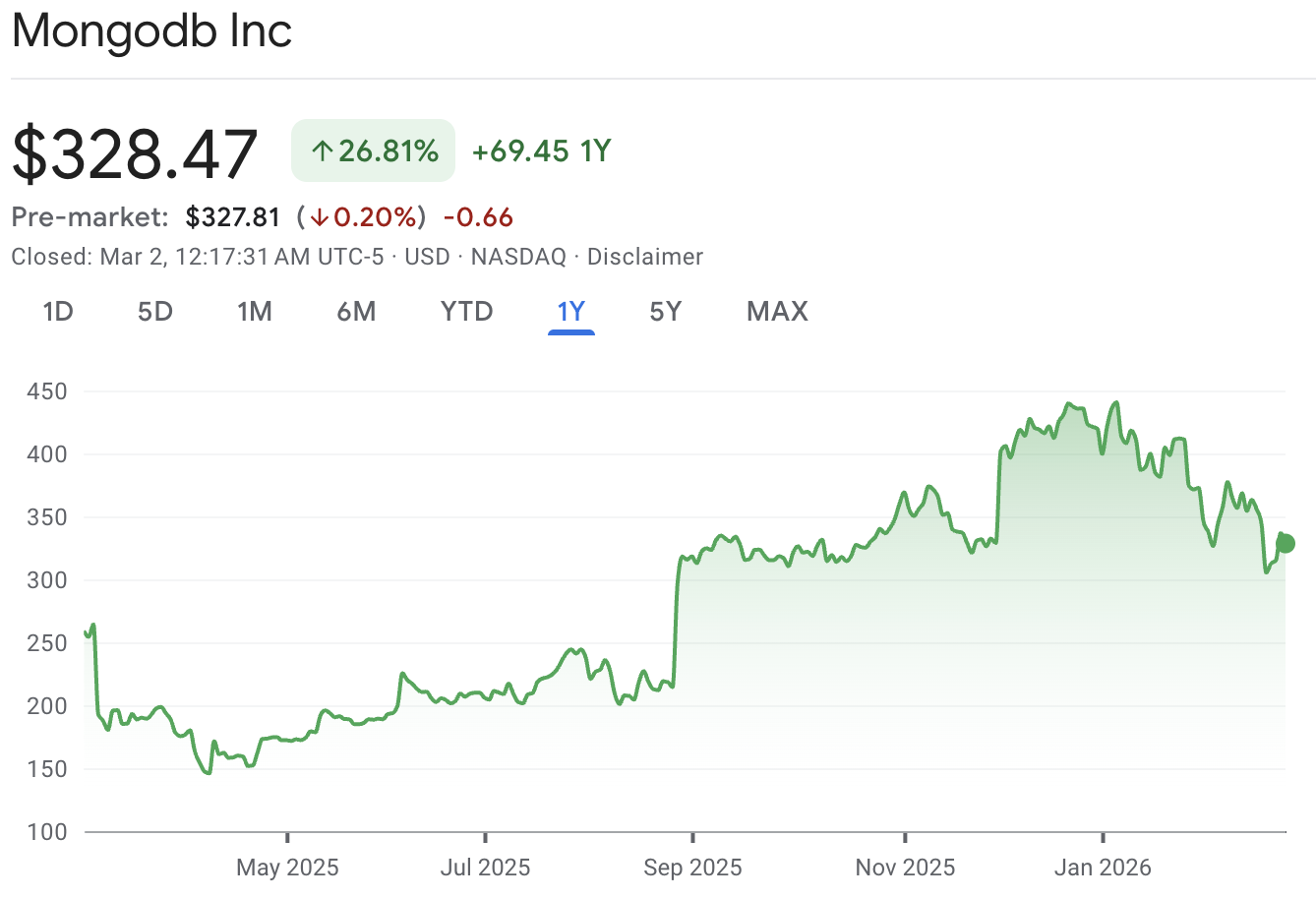
MongoDB’s stock is trading near $328, with a market capitalization of approximately $29.3 billion, following a period of heightened volatility that has increased sensitivity to new information. For high-multiple software companies priced for mid-teen to low-20% growth, stock price reactions are often driven more by forward-looking consumption indicators than by quarterly results.
Options markets are reinforcing that fragility. Current pricing implies a weekly earnings window move of 16.64%toward the March 6 expiry and a monthly move of 19.03% toward the March 20 expiry. Using the latest price near $328.47, that translates into a rough priced range of:
| Window | Implied move | Implied $ move (approx.) | Implied range (approx.) |
|---|---|---|---|
| Weekly | 16.64% | $54.66 | $273.81 to $383.13 |
| Monthly | 19.03% | $62.51 | $265.96 to $390.98 |
The same dataset indicates that the previous earnings event on December 1, 2025, resulted in a next-day opening gap of approximately 23.7%. This historical volatility contributes to the elevated expectations for the upcoming release.
The database layer is being pulled into the AI platform competition. Agentic applications and retrieval-heavy workloads increase the value of tightly integrated operational databases and search capabilities.
Competitors are responding with acquisitions that strengthen PostgreSQL and developer-first database experiences, including Databricks’ planned acquisition of Neon and Snowflake’s move to acquire Crunchy Data.
For MongoDB, the implications are direct. First, it must defend Atlas consumption growth against “good enough” alternatives bundled into broader data platforms. Second, it must keep its developer funnel expanding so that experimentation workloads convert into production spend, especially as vector search and AI retrieval become expected features rather than differentiators.

This is the fastest headline test. A print below the guided range would raise concerns about consumption durability. A beat typically pushes attention toward fiscal 2027 growth assumptions.
Atlas is the growth engine. In Q3, Atlas revenue grew 30% year over year and represented 75% of total revenue. Investors will watch for any deceleration and will scrutinize growth quality, including expansion within larger customers.
MongoDB exited Q3 with 62,500+ customers and 2,694 customers over $100K in ARR or annualized MRR. Growth in large customers often signals future consumption expansion, even when near-term spending is uneven.
Management guided to $139 million to $143 million of non-GAAP income from operations in Q4. The market will assess whether margin strength is structural, particularly if sales efficiency and cloud cost management continue to improve.
The stock is likely to trade primarily on the forward narrative. Investors will look for commentary on Atlas consumption trends, new workload acquisition, and incremental investment tied to AI-related product expansion and go-to-market capacity.
The market’s wide implied move suggests it is preparing for one of these outcomes rather than a muted reaction.
| Scenario | What the print likely looks like | What management likely signals | Typical market interpretation |
|---|---|---|---|
| Upside repricing | Revenue above $670M and strong Atlas indicators | Fiscal 2027 guidance supports durable low-20s growth with stable margins | Multiple expansion becomes plausible if growth and profitability hold together |
| Base case | Results land within guidance with solid, not exceptional Atlas signals | Fiscal 2027 guidance is constructive but cautious on consumption variability | Reaction depends on positioning and whether the call reduces demand uncertainty |
| Downside reset | Miss versus guidance or softer forward commentary | Fiscal 2027 guidance implies slowing Atlas growth or heavier investment drag | Multiple compression risk rises, and options pricing can amplify the move |
Technical indicators are secondary to guidance, but they can influence how far a post-earnings move extends before mean reversion takes hold. As of March 2, 2026, MongoDB’s RSI was 53.734 (neutral), while MACD was -1.74(sell).
The 50-day moving average was near 329.61, while the 200-day moving average was near 361.69. This setup suggests the stock is close to short-term equilibrium but remains below its longer-term trend level.
| Indicator | Latest value | Signal |
|---|---|---|
| RSI (14) | 53.734 | Neutral |
| MACD (12,26) | -1.74 | Sell |
| ATR (14) | 7.1893 | High volatility |
| MA20 (simple) | 323.31 | Buy |
| MA50 (simple) | 329.61 | Sell |
| MA200 (simple) | 361.69 | Sell |
| Level set (pivot framework) | S2 | S1 | Pivot | R1 | R2 |
|---|---|---|---|---|---|
| Classic | 319.43 | 320.52 | 321.57 | 322.66 | 323.71 |
| Fibonacci | 320.25 | 320.75 | 321.57 | 322.39 | 322.89 |
If MDB remains above the pivot zone following the initial market reaction, momentum buyers are likely to sustain upward movement. Conversely, if the stock falls below the pivot, the likelihood of a volatility-driven decline increases.
MongoDB will report its fourth quarter and full fiscal year 2026 results after the U.S. market close on Monday, March 2, 2026, and host its earnings call at 5:00 p.m. ET. In Malaysia, that corresponds to early Tuesday, March 3.
The market typically prioritizes revenue versus guidance, Atlas revenue growth, large customer expansion, and operating leverage. In Q3, Atlas grew 30% and accounted for 75% of revenue, so any change in its momentum can dominate the stock's reaction.
Atlas is MongoDB’s cloud database platform and has become the company’s primary growth engine. It represented 75% of total revenue in Q3, and consumption behavior inside Atlas can shift quickly, which makes guidance and commentary on workload trends unusually price sensitive.
MongoDB has often reported GAAP losses because stock-based compensation and related costs can be large. In Q3, GAAP net loss was $2.0 million while non-GAAP net income was $114.5 million, which is why investors usually focus on non-GAAP EPS and cash flow.
A beat can still be treated as “not enough” if FY2027 guidance implies slowing Atlas consumption, heavier investment pressure, or weaker large-customer expansion. MongoDB has previously seen sharp reactions when forward commentary diverged from expectations, even after a strong print.
MongoDB's earnings event is primarily guidance-driven rather than a retrospective review of the quarter. The company has established fourth-quarter revenue guidance of $665 million to $670 million and non-GAAP EPS guidance of $1.44 to $1.48. Atlas continues to accelerate and now accounts for the majority of revenue.
With options markets implying a double-digit move, investors are seeking a clear indication of whether MongoDB can sustain Atlas-led growth and margin expansion into fiscal 2027.
Disclaimer: This material is for general information purposes only and is not intended as (and should not be considered to be) financial, investment or other advice on which reliance should be placed. No opinion given in the material constitutes a recommendation by EBC or the author that any particular investment, security, transaction or investment strategy is suitable for any specific person.