Published on: 2026-03-03
Updated on: 2026-03-03
CrowdStrike reports earnings today, Tuesday, March 3, 2026, after the U.S. market closes. The company will host its conference call at 5:00 p.m. ET (2:00 p.m. PT).
CRWD stock heads into the release around $384.86 with a market cap of nearly $136 billion, after a strong regular-session move. The stock is still down meaningfully year-to-date, and the market mood around software has been cautious, so tonight's guide matters just as much as the quarter.
What moves CRWD stock tonight will not be the headline EPS by itself. The market will price the quarter through a very specific lens: net new ARR, Falcon Flex expansion, free cash flow durability, and whether management's FY2027 growth framing still holds up after the latest AI-driven sentiment shock.
Revenue: about $1.3 billion
Adjusted EPS: about $1.10
These estimates align closely with CrowdStrike's Q4 guidance, which is why the stock can react strongly to minor variations.
CrowdStrike last guided for:
| Metric | Q4 FY2026 guidance | FY2026 guidance |
|---|---|---|
| Total revenue | $1,290.0M to $1,300.0M | $4,796.6M to $4,806.6M |
| Non-GAAP operating income | $315.4M to $319.4M | $1,036.1M to $1,040.1M |
| Non-GAAP EPS (diluted) | $1.09 to $1.11 | $3.70 to $3.72 |
When consensus is already near the top end of guidance, a report that is merely "in range" can still disappoint if investors were quietly leaning toward an upside surprise.
Claude Code Security by Anthropic scans codebases for vulnerabilities and suggests patches for human review.
Even if it is complementary to enterprise security stacks, markets treated it as a signal that some security workflows could be automated faster than expected, and cybersecurity stocks sold off hard on the headlines.
CrowdStrike presents a straightforward counterargument: AI expands the attack surface and accelerates adversaries, which enhances the importance of detection, identity control, and response.
This perspective is why analysts believe the recent selloff has been exaggerated rather than reflecting fundamental issues.
CrowdStrike's incident on July 19, 2024, was caused by a content configuration update that resulted in Windows system crashes. The company has published post-incident reports and root-cause documentation.
In Q3 FY2026, management still disclosed costs "associated with the July 19 Incident and related matters," which keeps investors focused on trust, retention, and any lingering claims or remediation spend.
CrowdStrike continues to position Falcon as an "operating system" for security consolidation, and it is leaning on Falcon Flex as the commercial engine that turns consolidation intent into contracted ARR.
In Q3, the company reported more than $1.35 billion in ending ARR tied to Falcon Flex accounts, up more than 200% year over year.

CrowdStrike is priced like a compounding subscription business. That means the market usually reacts more to forward indicators than to GAAP earnings noise. These are the pressure points.
In the last reported quarter (fiscal Q3 2026), CrowdStrike reported:
Ending ARR: $4.92 billion, up 23% year over year
Net new ARR: $265.3 million (a record quarter)
The $265M in net new ARR is the benchmark. Investors will assess Q4 net new ARR against this figure, even if management does not label it as "another record."
What would move the stock:
A net new ARR number that stays strong enough to show demand did not cool after Q3's surge.
A weaker net new ARR print paired with cautious commentary on the pipeline, because it would hint that growth is normalizing faster than bulls want.
CrowdStrike disclosed that accounts using the Falcon Flex subscription model exceeded $1.35 billion in ending ARR, growing more than 200% year over year.
The market reads this as a packaging and adoption story. If customers are adopting more modules and committing to bigger platform relationships, revenue tends to be steadier, and renewals tend to be healthier.
What would move the stock:
Continued strong Flex adoption and module expansion commentary.
Any hint that expansion deals are slowing or that customers are "right-sizing" spend.
In Q3, CrowdStrike posted:
Cash from operations: $397.5 million
Free cash flow: $295.9 million
This matters because the market is less patient with growth companies that cannot turn growth into cash, especially in a tighter valuation environment.
What would move the stock:
Strong cash generation and a confident tone on operating discipline.
Cash flow appears lighter than expected, particularly given management's description of it as "investment-heavy" without a clear return schedule.
CrowdStrike's Q3 release included a clear statement that it expects at least 50% year-over-year growth in second-half FY2026 net new ARR, and that it remains confident in delivering 20% net new ARR growth for FY2027 from increased FY2026 expectations.
That statement is important because it reflects management's realistic expectations for the period beyond this quarter. If their confidence diminishes tonight, the stock could experience a rapid re-evaluation.
CrowdStrike's guidance language still references costs associated with the July 19 incident and related matters, as well as legal and strategic plan items. You do not need a large dollar impact for this to matter.
In cybersecurity, investors place a high value on trust and stability. Any renewed discussion that makes customers sound cautious can weigh on the stock.
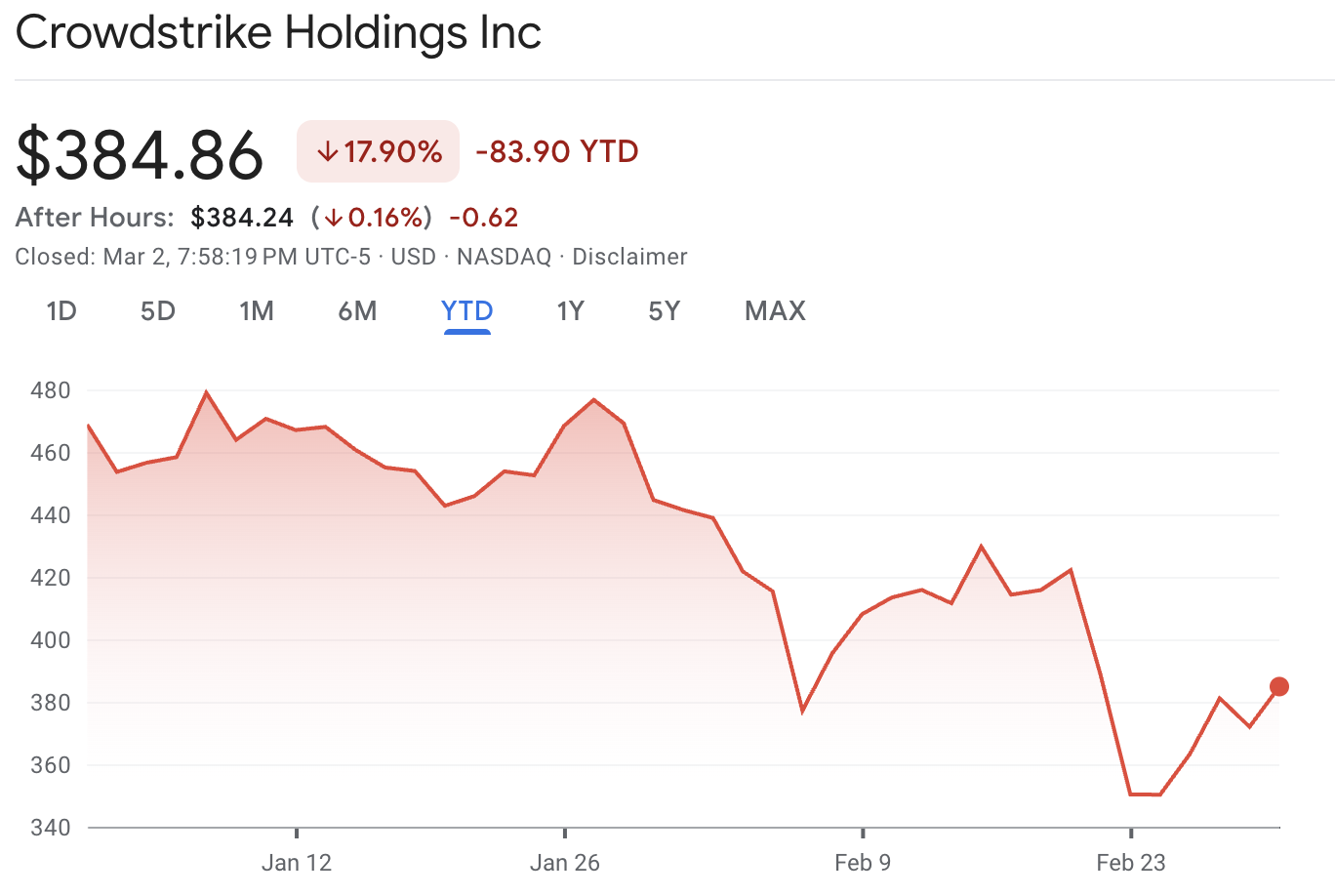
One earnings-volatility tracker indicates an implied weekly move of approximately 8.82% leading to the March 6 expiry, and an implied monthly move of about 11.86% for the March 20 options.
Using the current price near $384.86, that implies:
Weekly implied move: about $34
Implied post-earnings range (rough): about $351 to $419
That range is not a forecast. It is the market's "priced risk," and it explains why CRWD stock often whipsaws even when the results are only slightly off expectations.
The daily technical panel shows a mixed picture: near-term indicators are improving, but longer-term moving averages remain overhead, which keeps rallies sensitive to guidance.
| Indicator | Latest value | What it suggests |
|---|---|---|
| RSI (14) | 61.225 | Bullish momentum, not extreme |
| MACD (12,26) | 3.38 | Trend momentum positive |
| Stochastic (9,6) | 87.243 | Near-term overbought risk |
| ADX (14) | 24.754 | Trend strength is mixed |
| ATR (14) | 5.9035 | Moderate daily range |
| Moving average | Level | Signal |
|---|---|---|
| MA20 | 376.25 | Support zone |
| MA50 | 373.11 | Support zone |
| MA100 | 393.93 | Overhead resistance |
| MA200 | 416.16 | Major resistance |
| Level type | Price |
|---|---|
| Support (S1) | 383.51 |
| Pivot | 385.31 |
| Resistance (R1) | 387.47 |
| Resistance (R2) | 389.27 |
| Support (S2) | 381.35 |
| Support (S3) | 379.55 |
If the report is favorable, the market will monitor whether CRWD can break through the $394 to $416 range, as this is where the longer-term moving averages are located.
If the report disappoints, the $379 to $373 area becomes the first real "must-hold" zone, as it aligns with pivots and the 50-day moving average.
CrowdStrike reports after the U.S. market close on March 3, 2026, and the earnings call starts at 2:00 p.m. PT and 5:00 p.m. ET.
Net new ARR is the key swing metric because it captures demand and expansion in a subscription business.
OptionSlam shows an implied move of about 8.82% for the earnings week. With CRWD near $384.86, that suggests roughly a $350.91 to $418.81 range, although guidance surprises can push beyond it.
In conclusion, CrowdStrike's earnings report today should impact CRWD stock based on whether recurring revenue momentum remains strong and whether management can sustain investor confidence for FY2027, not just for the recently ended quarter.
If the company delivers a clean beat and sounds steady on demand and cash flow, the stock has room to rebuild toward the longer-term resistance levels.
If net-new ARR momentum cools or guidance tone turns cautious, the market will likely punish the stock quickly, as expectations remain high and options are pricing in a big move.
Disclaimer: This material is for general information purposes only and is not intended as (and should not be considered to be) financial, investment or other advice on which reliance should be placed. No opinion given in the material constitutes a recommendation by EBC or the author that any particular investment, security, transaction or investment strategy is suitable for any specific person.