Published on: 2026-04-24
SMCI stock is back in the spotlight after Oracle reportedly canceled a server-rack order worth up to $1.4 billion, turning a high-growth infrastructure story into a fresh test of margins, inventory control, and customer confidence.
The reported order involved 300 to 400 racks and was valued at roughly $1.1 billion to $1.4 billion.
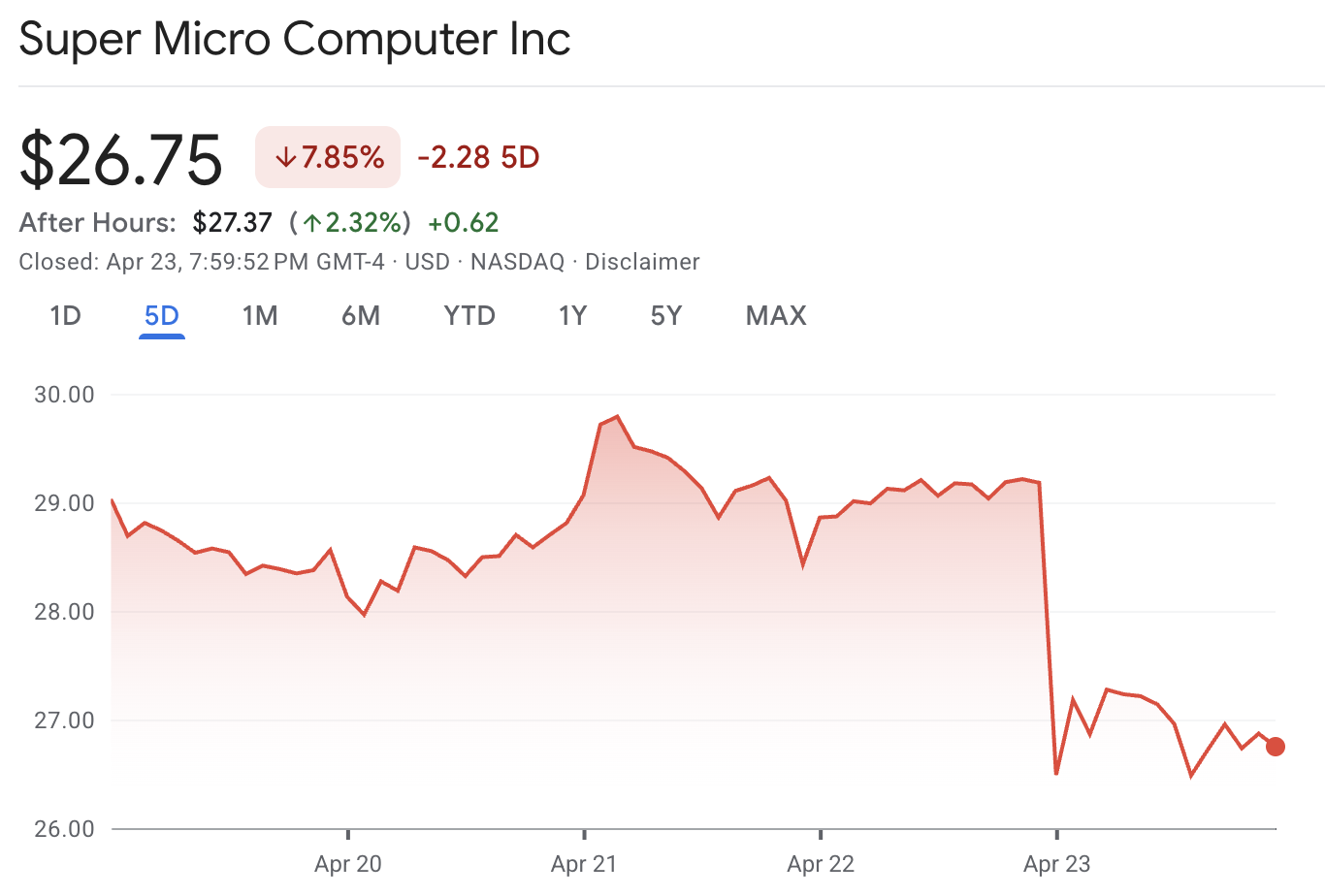
The selloff pushed Super Micro Computer into the mid-$20s range and revived a harder question for 2026: whether rapid revenue growth can offset contract risk, legal scrutiny, inventory pressure, and a sharp deterioration in margins.
Oracle contract risk has become the immediate pressure point.
Revenue growth remains strong, but margin quality is weakening.
Legal scrutiny has raised the stock’s risk premium.
Inventory and customer concentration remain central concerns.
The 2026 outlook now depends on execution, not demand alone.
Oracle reportedly canceled 300 to 400 Nvidia GB300 NVL72 server racks from Super Micro’s order book. With each rack estimated near $3.5 million, the lost business represents more than $1 billion in potential revenue exposure.
Supply-chain reports indicate that Super Micro may already have shipped part of the order before the cancellation. Wiwynn is believed to have absorbed some of the displaced business, turning the issue from a timing setback into a potential share-loss signal.
The reaction reflects the customer profile. Oracle is a major cloud infrastructure buyer, and a contract reversal of this size raises questions about vendor confidence, compliance review, and execution reliability.
The timing also coincided with U.S. prosecutors unsealing charges against Yih-Shyan “Wally” Liaw, a Super Micro co-founder and former board member, and two others over an alleged scheme involving restricted AI technology exports. Super Micro itself was not charged.
The legal backdrop is now more than a courtroom issue. Hyperscale customers operate under strict compliance frameworks, particularly when advanced GPUs and export controls are involved. Any perceived vendor exposure can slow approvals, narrow procurement options, or shift orders to suppliers with cleaner risk profiles.
Prosecutors alleged that the defendants used false documents and shipment structures to conceal the destination of restricted technology. The case has increased scrutiny around Super Micro’s broader governance environment, even though the company has not been charged in the indictment.
Super Micro also faces investor lawsuits tied to disclosure and export-control concerns. These remain allegations, but they add uncertainty around internal controls, reporting quality, and enterprise confidence.
The issue now extends beyond legal process. The market is asking whether major customers will continue treating Super Micro as a low-risk supplier for strategic data-center deployments.
The Oracle report also arrives alongside concerns over reported excess B200 GPU inventory. Supply-chain commentary suggests Super Micro built inventory to support xAI-related HGX server demand before customer preferences shifted toward GB200 NVL72 rack systems.

That shift appears to have benefited competitors including Dell and Hewlett Packard Enterprise. Super Micro may still participate in future rack cycles, but excess inventory could weigh on working capital and margins if it cannot be redeployed efficiently.
Inventory imbalances can turn strong demand into weaker earnings quality. Extended holding periods, discounting, or reconfiguration can pressure gross margin and cash flow.
For Super Micro, the timing is difficult. The company needs to show that order growth is clean, inventory is moving, and customer demand remains broad enough to offset any single contract loss.
Super Micro’s fiscal Q2 2026 results still showed exceptional growth. Net sales reached $12.7 billion, compared with $5.0 billion in fiscal Q1 2026 and $5.7 billion in fiscal Q2 2025. Net income rose to $401 million from $321 million a year earlier.
| Metric | Fiscal Q2 2026 | Fiscal Q2 2025 | Market Signal |
|---|---|---|---|
| Net sales | $12.7 billion | $5.7 billion | Demand remains strong |
| Gross margin | 6.3% | 11.8% | Profit pressure intensified |
| Net income | $401 million | $321 million | Earnings lagged revenue growth |
| Diluted EPS | $0.60 | $0.51 | EPS growth remained positive |
| Non-GAAP EPS | $0.69 | $0.59 | Adjusted profit expanded |
Margins Are the Weak Point
Gross margin fell to 6.3% from 11.8% a year earlier, highlighting pressure from customer mix, pricing, supply-chain costs, and expedited delivery requirements.
That is the central weakness in the SMCI stock story. Revenue more than doubled, but profitability did not scale at the same pace. In a tighter valuation environment, growth without margin improvement gives investors less reason to pay a premium multiple.
The bull case remains tied to sustained infrastructure spending. Hyperscalers, enterprise GPU clusters, and sovereign AI programs still require high-density systems where Super Micro has built technical depth, particularly in liquid-cooled rack design.
The company guided for at least $12.3 billion in fiscal Q3 2026 net sales and at least $40.0 billion for fiscal 2026, indicating that demand has not disappeared.
The bear case is no longer about whether the AI infrastructure market can grow. It is about whether Super Micro can hold share, protect margins, clear inventory, and preserve customer confidence while legal and governance questions remain active.
A co-founder indictment, investor lawsuits, margin compression, Oracle contract risk, and possible inventory overhang create a layered risk profile. Each issue may be manageable alone. Together, they justify a higher risk premium.
Investors assessing SMCI’s recovery potential should monitor:
Whether Oracle-related revenue is replaced by other customers.
Progress in reducing B200 inventory.
Gross margin recovery in upcoming earnings.
Any additional customer cancellations or supplier shifts.
Legal and regulatory updates tied to export-control allegations.
The next earnings update needs to show more than revenue growth. Super Micro must demonstrate cleaner execution, stronger margin control, and stable large-customer relationships.
SMCI stock is falling because the Oracle shock exposed a more fragile execution profile. Super Micro remains tied to one of the largest infrastructure spending cycles in technology, but growth alone is no longer sufficient to support valuation.
The 2026 outlook now depends on proof. If margins stabilize, inventory clears, and customer confidence holds, the selloff may begin to look excessive. If further contract or compliance concerns emerge, the current discount reflects elevated execution and governance risk.