Published on: 2026-04-27
Updated on: 2026-04-27
The best energy ETF to buy during oil price spike conditions is rarely the fund with the highest short-term crude correlation. Oil rallies reward different parts of the energy chain at different speeds, and the gap between a producer ETF, a pipeline fund, and a crude futures vehicle can widen quickly when volatility rises.
For 2026 investors, the decision is not simply whether oil prices rise. Which exposure fits the shock: large-cap energy equities, high-beta oil producers, oilfield services, midstream income, global energy stocks, or tactical crude futures?
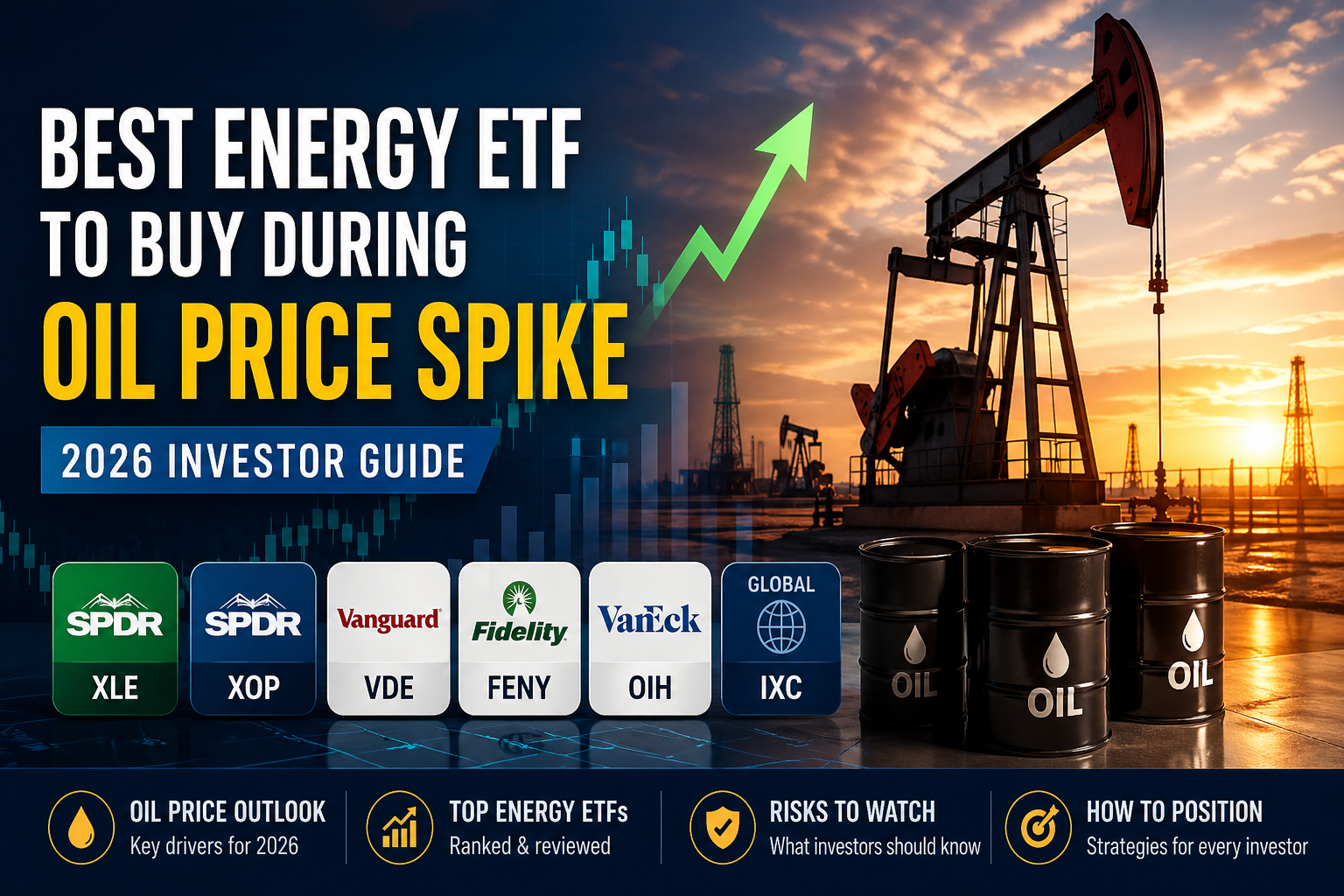
The ranking weighs liquidity, cost, oil-price sensitivity, fund structure, and investor use case. Broad equity ETFs rank higher with general investors because they are easier to understand and withstand volatility. Producer, services, and futures-based funds carry stronger tactical upside, but also higher timing and drawdown risk.
XLE is the benchmark choice for broad U.S. energy exposure. The fund tracks the Energy Select Sector Index, charges 0.08%, and holds 22 stocks as of 31 March 2026. Exxon Mobil and Chevron were the two largest holdings at 23.77% and 17.32%, giving the fund strong liquidity but clear mega-cap concentration.
That concentration is the reason XLE ranks first. It is not the most aggressive oil-price trade, but it is the cleanest default energy stock ETF for investors who want exposure to large balance sheets, dividends, and institutional trading depth.
XOP is the stronger choice when the goal is oil-producer beta. The fund tracks a modified equal-weighted index, charges 0.35%, and holds 50 stocks as of 31 March 2026. Its largest subindustry exposure was oil and gas exploration and production at 70.25%.
That structure gives XOP a cleaner link to producer cash flows than XLE. When crude rises, upstream margins can reprice quickly. When oil reverses, the same beta works against the fund. XOP is best for investors who understand that higher upside comes with sharper drawdown risk.
VDE is a low-cost diversified energy allocation rather than a pure oil-spike trade. Vanguard’s energy fund covers integrated oil and gas, exploration and production, storage and transportation, equipment and services, refining and marketing, drilling, and consumable fuels. Its subindustry mix gives broader sector coverage than a narrow producer fund.
The appeal is simplicity and diversification. The limitation is overlap. VDE still has heavy exposure to large U.S. energy companies, so investors should not expect it to behave like a small-cap or exploration-focused oil ETF.
FENY is the fee-sensitive alternative in the broad U.S. energy category. Fidelity lists the fund as passively managed, with 100 holdings, $2.0376 billion in portfolio assets, and gross and net expense ratios of 0.084% as of 31 March 2026. The fund seeks returns that correspond to the MSCI USA IMI Energy Index.
FENY is not designed to be dramatically different from VDE. Its value is cost-efficient exposure to the same broad energy opportunity set. It is better suited to long-term sector allocation than short-term speculation.
OIH is a second-wave oil-spike ETF. It does not simply track crude oil. It tracks companies involved in oil equipment, oil services, and oil drilling, meaning the fund depends on whether higher oil prices translate into stronger producer spending. VanEck lists OIH with $2.10 billion in total net assets, a 0.35% expense ratio, and 26 holdings as of 15 April 2026.
OIH works best when the oil rally looks durable. A brief geopolitical spike may not change drilling budgets. A sustained price move can lift service pricing, offshore work, and equipment demand.
AMLP is the income-focused choice, not the best crude-price ETF. The fund tracks the Alerian MLP Infrastructure Index and provides exposure to energy infrastructure MLPs. As of 31 March 2026, AMLP had $12.13 billion in net assets, paid quarterly distributions, and had total operating expenses of 1.01%.
AMLP fits investors who want energy exposure through pipelines, storage, processing, and transportation. These assets depend more on volumes, contracts, regulation, and distributions than on daily crude prices. That can make AMLP steadier, but less explosive than producer-heavy ETFs.
IXC adds global energy exposure. The iShares Global Energy ETF tracks global energy equities and gives access to companies that produce and distribute oil and gas worldwide. As of 31 March 2026, the fund had 51 holdings, $2.851 billion in net assets, and a 0.40% expense ratio.
IXC matters when oil shocks are global rather than purely U.S.-driven. OPEC policy, shipping disruption, Middle East risk, and Brent crude stress can make international exposure more relevant. The trade-off is additional currency risk, tax risk, and geopolitical risk.
USO and BNO belong in a separate category. USO is designed to track daily movements in WTI crude prices through benchmark oil futures. BNO is designed to track daily Brent crude movements through near-month Brent futures.
These are tactical crude-oil vehicles, not diversified energy stock ETFs. Futures roll, contango, backwardation, collateral returns, and expenses can cause spot oil results to diverge from futures over longer periods. They are useful for short-term crude exposure, but poor substitutes for a traditional energy equity allocation.
Producer risk: XOP can move sharply if crude prices reverse or investors question producer margins.
Concentration risk: XLE, VDE, FENY, and IXC all rely heavily on large energy companies, even when they appear diversified.
Capex risk: OIH needs a sustained drilling and development cycle, not just one headline-driven oil spike.
Income risk: AMLP distributions depend on midstream cash flows, leverage, regulation, and MLP structure.
Futures risk: USO and BNO are designed for tactical daily crude exposure. They do not represent ownership of physical oil.
XLE is the best default choice for broad, liquid U.S. energy exposure. XOP is better for higher producer sensitivity. The right ETF depends on whether the investor wants stability, upside beta, income, global exposure, or direct crude-price exposure.
XOP can outperform during sharp crude rallies because it has broader producer exposure and less mega-cap concentration. XLE is usually steadier because it is dominated by large integrated energy companies.
USO and BNO are better viewed as tactical crude vehicles. They use futures exposure, so returns can diverge from spot oil returns over time due to futures roll, collateral income, contango, and backwardation.
AMLP is the clearest income-focused ETF on this list because it focuses on energy infrastructure MLPs and pays quarterly distributions. It is less sensitive to daily crude-price moves than producer-heavy funds.
The strongest answer is not one ticker. It is a framework. XLE is the best core U.S. energy ETF; XOP is the best high-beta producer ETF; OIH captures the oilfield-services cycle; AMLP is the income choice; IXC adds global energy exposure; and USO or BNO are tactical crude tools.
During an oil price spike, ETF structure matters as much as oil direction. Investors should match the fund to the exposure they actually want: energy equities, oil producers, oil services, infrastructure income, global energy, or direct crude-price exposure.