Published on: 2026-04-27
The buyback blackout period matters because it can remove one of the market’s most reliable sources of equity demand during earnings season. When companies step away from repurchasing their own shares, investors lose a quiet but powerful buyer just as earnings, margins, guidance, and valuation assumptions are being reset.
As of 27 April 2026, that timing is highly relevant. Q1 earnings season is moving into one of its busiest phases, with 180 S&P 500 companies scheduled to report during the week following 24 April. At the same time, S&P 500 blended earnings growth stands at 15.1%, while the forward 12-month P/E ratio sits at 20.9, above both its 5-year and 10-year averages. That combination makes the buyback blackout period more than a compliance detail. It becomes a liquidity signal.
A buyback blackout period usually restricts share repurchases around earnings, reducing corporate demand during a sensitive reporting window.
S&P 500 companies spent $249.0 billion on buybacks in Q3 2025, showing how large repurchases have become as an equity-market force.
Late April 2026 is important because earnings reports are concentrated, with 180 S&P 500 companies due to release Q1 results in one week.
Blackouts do not automatically pressure stocks, but they can expose weak guidance, crowded positioning, and stretched valuations.
Rule 10b-18 provides a voluntary safe harbor for issuer repurchases that meet conditions on manner, timing, price, and volume.
A buyback blackout period is a window when a company usually pauses repurchases of its own stock. These periods often occur before quarterly earnings and may continue until results are released and the market has absorbed the new information.
The logic is simple. A company may possess material non-public information before earnings. That information can include revenue trends, margin pressure, cash-flow changes, guidance revisions, restructuring plans, or capital allocation decisions. Repurchasing shares during that period could create legal, governance, or reputational risk.
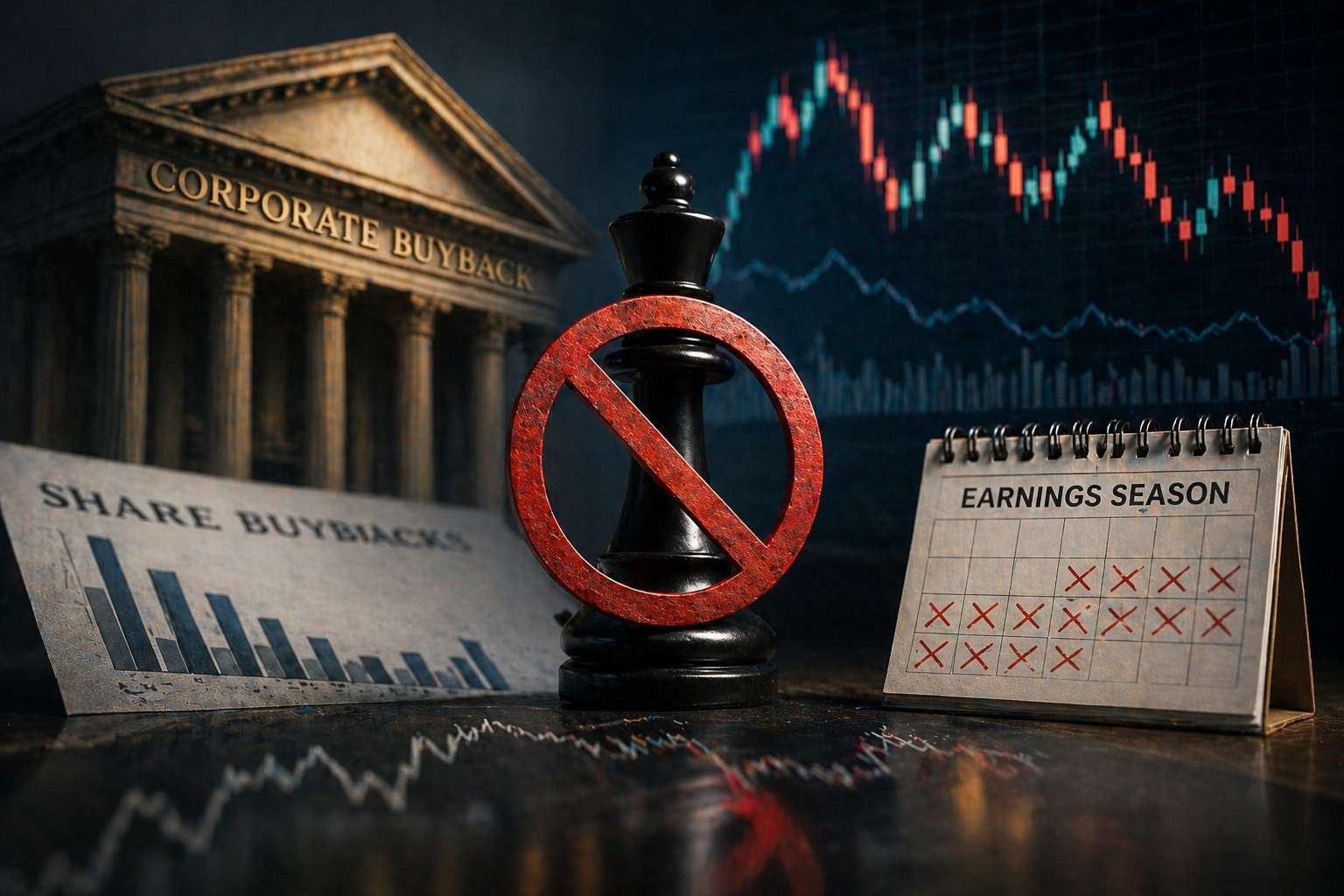
There is no single universal blackout calendar. Policies vary by company, exchange, jurisdiction, and legal advice. Some companies rely on structured trading plans. Others pause discretionary repurchases around earnings and restart once the trading window reopens.
For investors, the central issue is not the exact number of days. It is the temporary disappearance of the corporate bid.
Buybacks are often treated as background noise. That is a mistake. Corporate repurchases can be one of the largest recurring sources of demand in the U.S. equity market.
S&P 500 buybacks reached $249.0 billion in Q3 2025, up 6.2% from Q2 and 9.9% from Q3 2024. The 12-month total through September 2025 reached a record $1.020 trillion. That scale means the timing of buyback activity can influence liquidity, especially around earnings.
When a company enters a blackout, the stock must rely more heavily on institutional flows, ETF demand, hedge-fund positioning, and retail sentiment. If results are strong, that may not matter. If guidance disappoints or valuation is already stretched, the absence of buyback support can make the reaction sharper.
This is why blackouts are not inherently bearish. They are liquidity-sensitive. They can amplify existing pressure, but they rarely create the fundamental problem by themselves.
The late-April 2026 earnings window gives investors a clear example of why buyback timing matters.
| Market Factor | Latest Reading | Why It Matters |
|---|---|---|
| S&P 500 companies reported for Q1 2026 | 28% | Earnings season still carries major information risk |
| Positive EPS surprise rate | 84% | Results are stronger than recent averages |
| Q1 blended earnings growth | 15.1% | Supports corporate capital return capacity |
| Q1 blended revenue growth | 10.3% | Strongest potential revenue growth since Q3 2022 |
| Companies reporting in coming week | 180 | Buyback windows may reopen in clustered waves |
| Forward 12-month P/E | 20.9 | Elevated valuation increases sensitivity to liquidity gaps |
The table shows why the buyback blackout period is relevant now. Earnings growth remains healthy, but valuations leave less room for disappointment. When the market trades above its long-term average multiple, the temporary loss of buyback demand can carry more weight.
Investors should watch not only which companies beat earnings, but also which companies resume repurchases after reporting. A stock that stabilizes after earnings and then attracts renewed volume may be benefiting from reopened corporate demand. A stock that fails to recover after its window reopens may be signaling deeper concerns.
The buyback blackout period is often discussed as if it were a single formal rule. In practice, it is usually a company policy shaped by securities law, insider trading controls, disclosure obligations, and governance standards.
Rule 10b-18 is central to U.S. issuer repurchases. It provides a voluntary safe harbor from manipulation liability when repurchases meet conditions related to manner, timing, price, and volume. If a company fails to meet one of those conditions on a given day, the safe harbor is unavailable for that day’s transactions.
Disclosure rules have also shifted. The SEC’s Share Repurchase Disclosure Modernization rule was vacated by the U.S. Court of Appeals for the Fifth Circuit on 19 December 2023, which returned disclosure requirements to the prior framework.
The investor takeaway is straightforward. Buyback capacity depends on when a company is legally and internally permitted to act, whether it has authorization, and whether management believes repurchases are the best use of capital.
A buyback blackout period should be treated as a liquidity filter, not a trading signal by itself.
First, assess the size of the repurchase program relative to market capitalization. A $5 billion authorization is meaningful for a $40 billion company but less material for a mega-cap with a trillion-dollar valuation.
Second, examine free cash flow. Durable buybacks come from recurring cash generation. Repurchases funded by excess cash are different from repurchases funded through rising leverage.
Third, watch share count. A company can spend heavily on buybacks while barely reducing outstanding shares if stock-based compensation offsets the repurchase effect. Net share reduction matters more than headline authorization size.
Fourth, compare buybacks with valuation. Repurchases create the most value when companies retire shares below intrinsic value. Buybacks made at stretched multiples can support earnings per share in the short term while reducing long-term capital efficiency.
Finally, observe post-earnings behavior. If a company reports solid results, confirms guidance, and resumes buybacks near a key support zone, the stock may regain a liquidity cushion. If it misses earnings and uses cash defensively, the reopened window may offer little support.
Buybacks are not a substitute for growth. They can improve earnings per share, return excess cash, and signal confidence, but they cannot fix weak revenue, poor margins, or declining competitive position.
They also carry opportunity cost. Capital used for repurchases cannot be used for acquisitions, research, capacity expansion, debt reduction, or dividends. In sectors facing disruption, aggressive buybacks may look less attractive than reinvestment.
Tax effects also matter. The U.S. 1% excise tax on net buybacks reduced Q3 2025 S&P 500 operating earnings by 0.36% and GAAP earnings by 0.41%. The impact is modest, but it reinforces that repurchases are no longer costless from a reporting perspective.
The strongest buyback stories are not always the largest. They are the most disciplined, supported by recurring free cash flow, reasonable valuation, and clear capital allocation priorities.
A buyback blackout period is a window when a company usually pauses share repurchases, often around earnings. The purpose is to reduce insider trading risk and avoid trading while material non-public information may exist.
Not necessarily. It can reduce liquidity support, but the stock reaction depends on earnings quality, valuation, guidance, positioning, and broader market conditions.
Buyback windows often reopen after earnings are released and the market has absorbed the information. The exact timing depends on company policy, legal controls, and trading-plan structure.
Investors monitor them because buybacks can be a major source of demand. When repurchases pause, stocks may become more sensitive to earnings surprises and valuation pressure.
No. An authorization gives management permission to repurchase shares, but actual execution depends on cash flow, valuation, leverage, market conditions, and board priorities.
The buyback blackout period is not just a legal footnote. It is a recurring liquidity event that can influence earnings-season volatility, market breadth, and post-results price action.
As of 27 April 2026, the topic is especially relevant. A heavy earnings calendar, strong profit growth, elevated valuation, and historically large buyback activity all point to the same lesson. Corporate repurchases matter, but they are not constant.
Investors should focus on three questions: when companies can buy, whether they should buy, and whether the market has already priced in their return.