Published on: 2026-04-28
Joby stock jumped after Joby Aviation completed electric air taxi demonstration flights in New York City, giving investors a fresh reason to reprice one of the market’s most closely watched eVTOL stocks. The rally reflected more than enthusiasm for a futuristic aircraft. It showed that traders are increasingly focused on whether Joby can turn test flights, airport routes and regulatory coordination into an early commercial air mobility business.
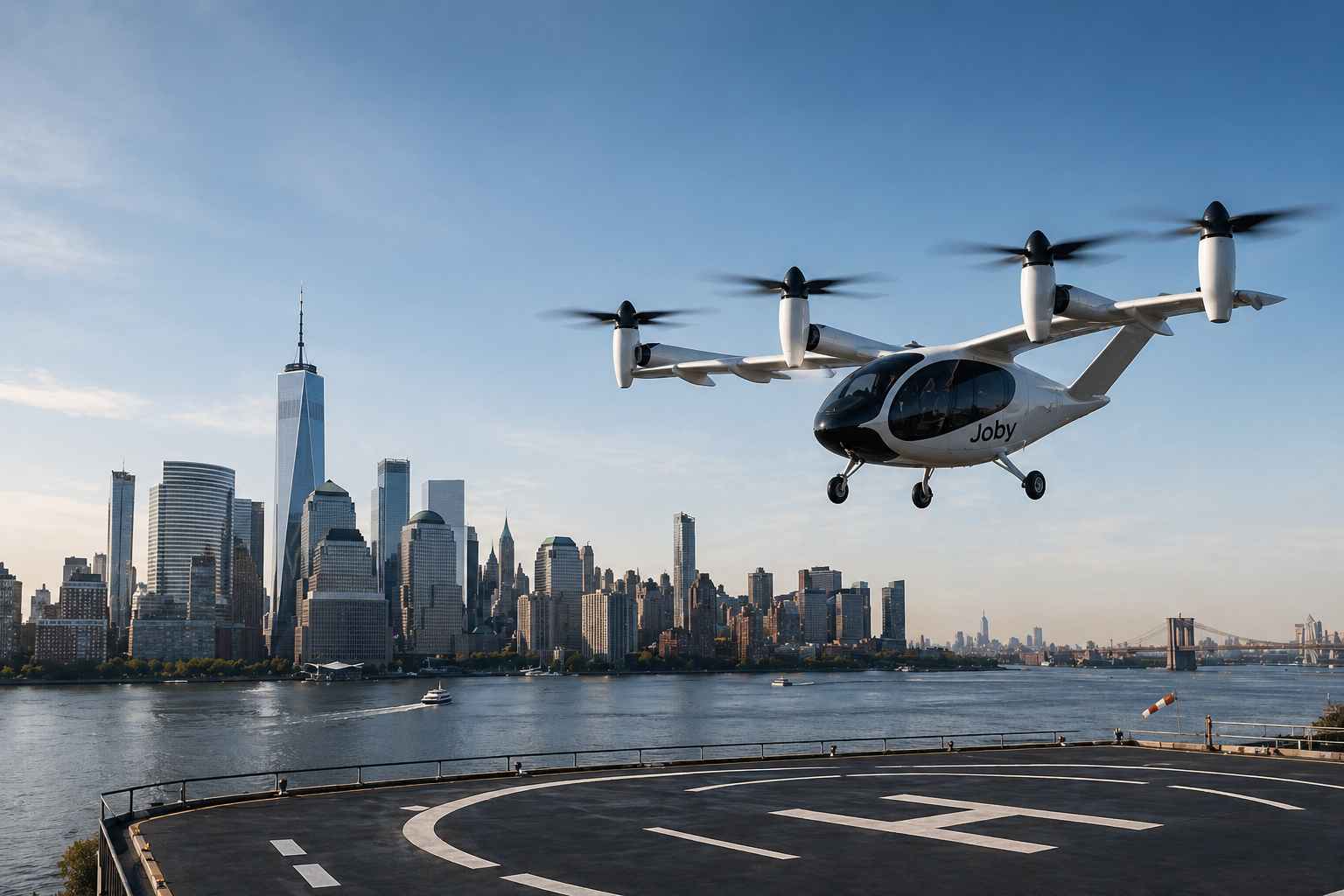
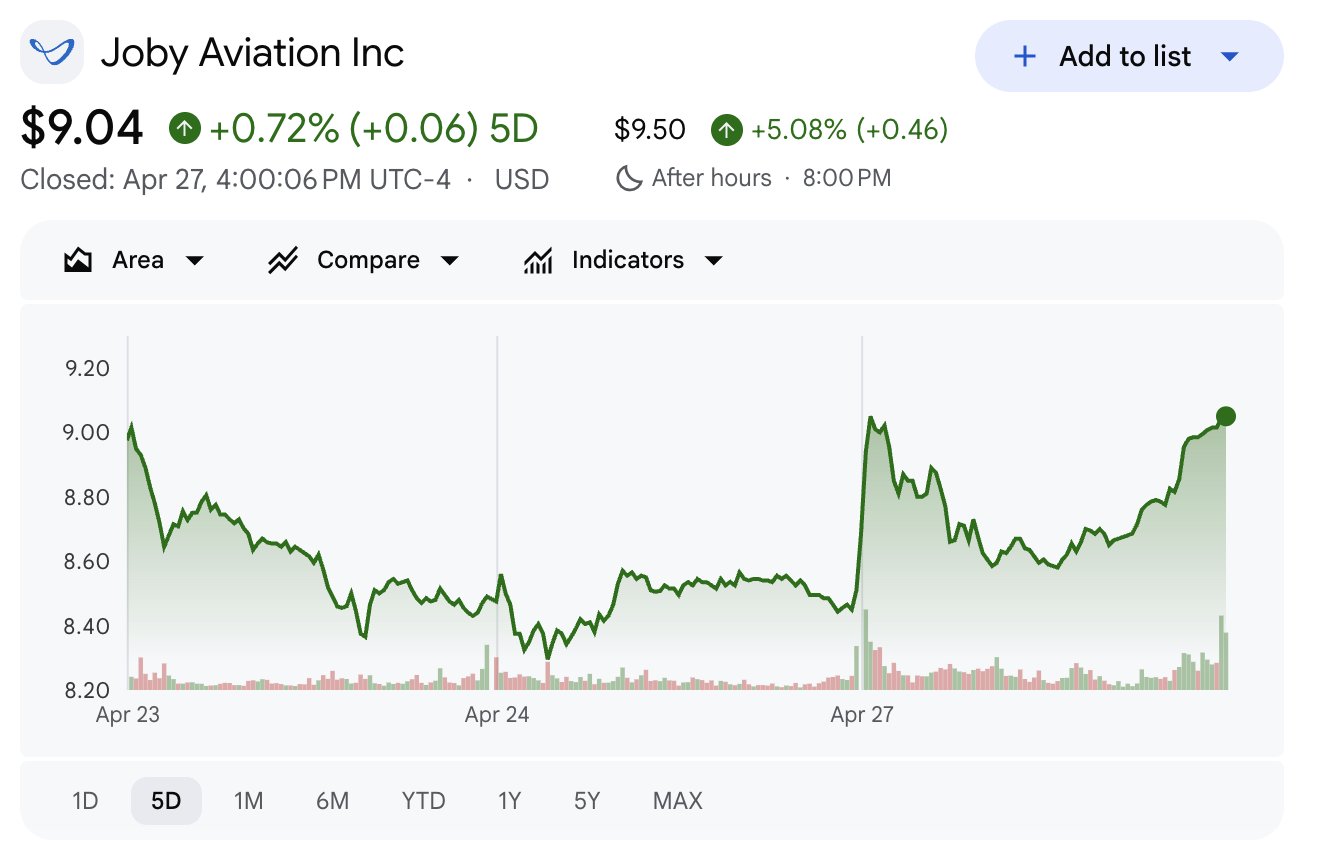
JOBY closed Monday at $9.04, up 6.47%, after reaching an intraday high of $9.50 on volume of about 45.65 million shares. The move came after Joby completed point-to-point electric vertical takeoff and landing demonstration flights in New York City, including routes tied to JFK and Manhattan heliport infrastructure.
Joby stock rose 6.47% to $9.04, with heavy volume suggesting the air taxi news triggered a broad repricing across eVTOL stocks.
New York demo flights strengthened the airport-transfer thesis, with Joby targeting routes that could reduce JFK-to-Manhattan travel times from more than an hour by road to under 10 minutes by air.
Regulatory momentum is improving, with Joby selected as a partner in applications covering potential early operations across 10 U.S. states under the White House-backed eVTOL Integration Pilot Program.
Dubai remains the clearest global launch marker, after its first commercial vertiport near Dubai International Airport reached technical completion ahead of targeted operations before the end of 2026.
The chart has improved, but not fully reversed, with JOBY testing near-term resistance around $9.40 to $9.50 while longer-term trend pressure remains unresolved.
The immediate catalyst was Joby Aviation’s New York air taxi demonstration campaign. The company completed the first point-to-point eVTOL demonstration flights in New York City history, a milestone that moved the story beyond factory testing and into one of the world’s most visible urban transport markets.
For investors, the key issue is route economics. Airport transfers are one of the most credible early use cases for electric air taxis because the time saving is clear. In heavy traffic, a trip between JFK and Manhattan can take more than an hour. Joby’s air taxi concept aims to cut that journey to under 10 minutes, creating a premium mobility use case that is easier to monetize than mass-market urban commuting.
That is why the rally matters. The stock did not rise simply because an aircraft flew. It rose because the flight campaign gave investors a clearer commercial framework: airports, heliports, high-income travelers, route density and a visible path toward early service.
Joby’s New York flights connect three parts of the eVTOL investment case: aircraft readiness, infrastructure access and urban demand. The company is trying to prove that electric air taxis can fit into existing airport and heliport networks, although certified passenger service still depends on FAA approval and local operating readiness.
The challenge is that demonstration flights are not the same as commercial service. Joby still needs certification progress, aircraft production scale, reliable charging infrastructure and local operating approvals. The company also has to prove that passengers will pay enough to support attractive unit economics once the novelty fades.
| Metric | JOBY |
|---|---|
| Last price | $9.04 |
| Daily move | +6.47% |
| Intraday high | $9.50 |
| Intraday low | $8.45 |
| Volume | 45.65 million |
| Market capitalization | $7.63 billion |
| EPS | -$1.34 |
| P/E ratio | Not meaningful |
The valuation remains the central debate. A market capitalization above $7.6 billion gives Joby meaningful credit for future air taxi adoption, even though the company is still loss-making. That makes each certification, production and launch milestone important because the stock is priced on execution rather than current earnings.
Policy support has become a larger part of the Joby Aviation stock story. In March, Joby said it had been selected as a partner in multiple winning applications under the White House-backed eVTOL Integration Pilot Program, giving it a pathway to begin early operations in several U.S. states.
This does not eliminate FAA type certification risk. It does, however, improve coordination among federal, state and local authorities. For a new aviation category, that matters. Airspace rules, infrastructure standards, public acceptance and safety oversight all need to develop alongside the aircraft.
Dubai adds a second catalyst. The first commercial vertiport near Dubai International Airport reached technical completion in April, with initial operations targeted before the end of 2026. The site is designed to support electric vertical takeoff and landing aircraft and forms part of Dubai’s planned air taxi network.
| Indicator | Reading | Signal |
|---|---|---|
| RSI 14 | 53.00 | Neutral, improving momentum |
| MACD 12,26 | -0.19 | Bearish but stabilizing |
| EMA 20 | $8.89 | Price above short-term trend |
| EMA 50 | $9.77 | Medium-term resistance remains |
| EMA 200 | $11.70 | Long-term trend still pressured |
| Support | $8.97, then $8.81 | Near-term demand zone |
| Resistance | $9.40, then $9.50 | Breakout confirmation area |
| Trend | Mixed | Short-term recovery, longer-term caution |
| Momentum | Improving | Needs follow-through volume |
The technical setup has improved, but it is not yet a clean bullish reversal. JOBY trading above its 20-day EMA shows that buyers have regained short-term control after the New York catalyst. However, the stock remains below its 50-day and 200-day EMAs, which means longer-term supply has not been fully absorbed.
A sustained close above $9.50 would strengthen the breakout case and suggest the rally is moving beyond headline-driven buying. Failure to hold the $8.80 to $9.00 support area would weaken the recovery and signal that traders are fading the air taxi catalyst rather than accumulating the stock.
Technical indicators are based on the latest available delayed market data and may shift with intraday price action.
The next major event is Joby’s first-quarter 2026 earnings release, scheduled for after the market close on 5 May 2026. Investors will look for updates on cash burn, aircraft production, FAA certification progress, Dubai readiness and management’s commercial launch timeline.
The stock’s next move will likely depend on whether management can convert strong headlines into measurable execution. For now, the market is rewarding visible progress. The risk is that enthusiasm can reverse quickly if certification timelines slip or spending rises faster than investors expect.
Joby stock rose after the company completed electric air taxi demonstration flights in New York City. Investors treated the flights as a visible step toward commercialization milestone because they linked the eVTOL aircraft to real airport-transfer routes.
Yes. Joby Aviation is one of the leading publicly traded eVTOL stocks. The company is developing electric vertical takeoff and landing aircraft for passenger air taxi service in U.S. and international markets.
Joby’s commercial timeline depends on FAA certification, local approvals and infrastructure readiness. Dubai is targeting initial air taxi operations before the end of 2026, while U.S. activity is being supported by the eVTOL Integration Pilot Program.
Joby stock’s 6% gain reflects a stronger phase in the air taxi narrative. New York demonstration flights gave investors a visible route-based catalyst, while U.S. regulatory support and Dubai infrastructure progress reinforced the broader commercialization case.
The rally is meaningful, but not risk-free. Joby still trades on future execution rather than current profitability, and the technical picture remains mixed below longer-term moving averages. For the stock to sustain momentum, the next phase must show certification progress, launch discipline and clearer evidence that electric air taxis can become a scalable aviation business.