Published on: 2026-04-22
Updated on: 2026-04-22
A headline that says “GDP is rising” can sound bullish at first glance. But for traders, the more useful question is what is driving that rise. Is the economy producing more goods and services, or are prices simply higher?
Markets care about that distinction because it shapes how investors read demand, inflation pressure, interest rates, and future earnings.
As of April 2026, the distinction is especially relevant. The U.S. Bureau of Economic Analysis (BEA) said real gross domestic product (GDP) grew at a 0.5% annualised rate in Q4 2025, while the GDP deflator rose 3.7%. The March 2026 Consumer Price Index (CPI) rose 3.3% year over year, and the Federal Reserve's March 18, 2026, median projections still showed 2.7% Personal Consumption Expenditures (PCE) inflation for 2026.
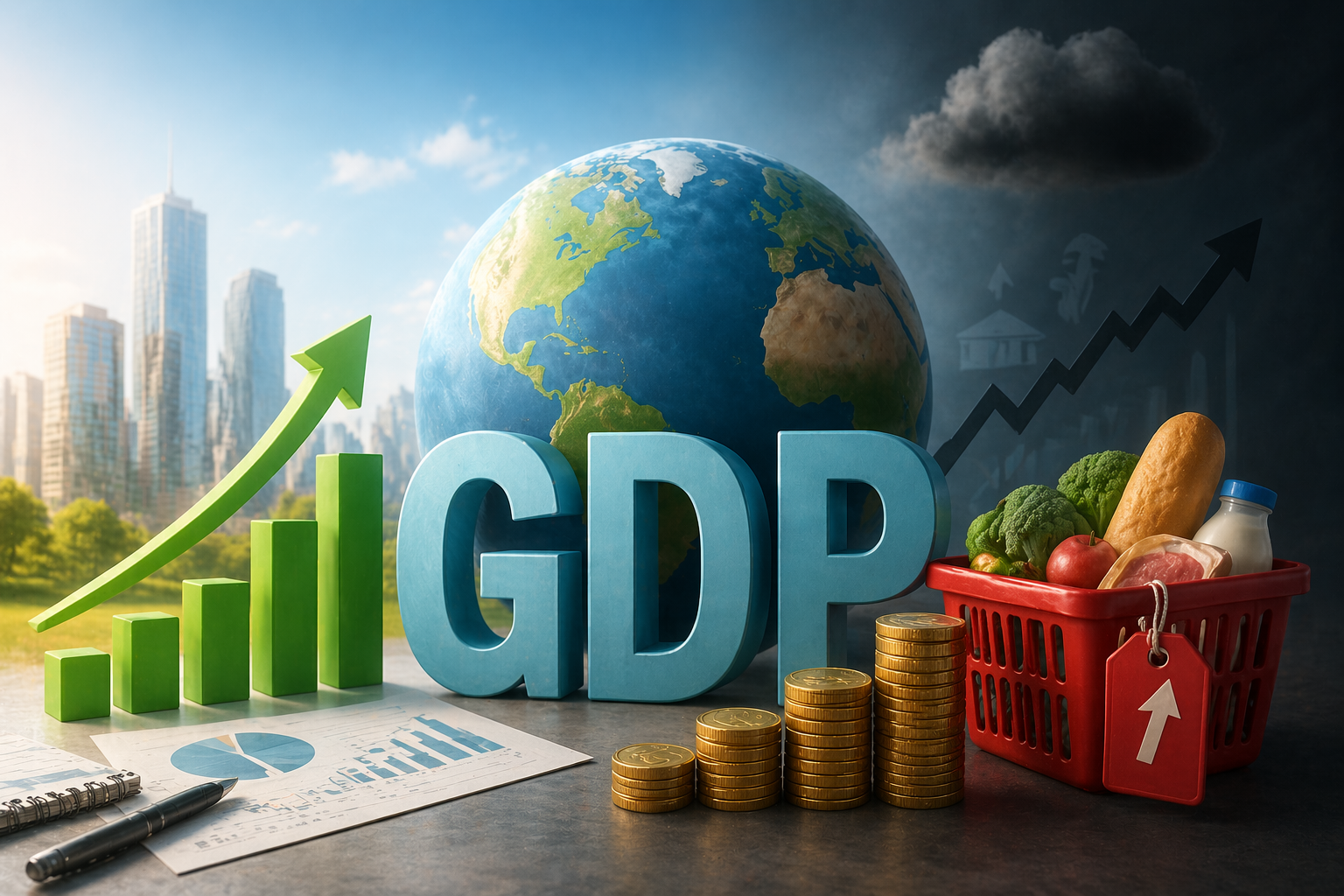
GDP is adjusted for inflation so economists can measure real growth, not just higher prices.
A rise in nominal GDP does not always mean the economy is meaningfully stronger.
For traders, real GDP matters because it helps explain how central banks, bonds, currencies, and equities may respond to the growth outlook.
Gross domestic product measures the value of final goods and services produced within an economy. In U.S. reporting, the figure people usually hear quoted is often the percentage change in real GDP, because BEA adjusts it for inflation so different periods can be compared more meaningfully.
For traders, that matters because GDP is not just a textbook term. It is a broad macro signal of whether demand is expanding, stalling, or weakening. Markets usually treat real GDP as a cleaner signal of momentum than headline dollar growth.
Inflation changes the price of what an economy produces, but it does not automatically mean the economy produces more. If a country sells the same quantity of goods and services at higher prices, nominal GDP rises even if real activity is flat. Real GDP is designed to remove that distortion. BEA defines real GDP as output adjusted for inflation relative to a reference year.
This is easiest to see with a simple example. Suppose a factory produces exactly 100 machines in both years. In year one, each machine sells for $10,000. In year two, the factory still produces 100 machines, but the price rises to $11,000. Nominal GDP goes up, yet real output has not changed. Without inflation adjustment, that would look like growth when it is really just repricing.
The table below shows why nominal growth alone is not enough.
Output rose as well as prices
For market participants, that distinction is crucial. If GDP rises mainly because prices are higher, the signal may be more inflationary than growth-positive.
Nominal GDP measures output at current prices. Real GDP adjusts that number for inflation. The GDP deflator, formally the gross domestic product implicit price deflator, tracks price changes for goods and services produced in the United States, including exports and excluding imports. That makes it broader than CPI, which tracks the prices paid by urban consumers for a market basket of goods and services.
This difference matters in live markets. A firm GDP headline can still disappoint if the price component is doing most of the work. Equities may not celebrate a stronger headline if traders think the growth came from inflation rather than stronger real activity. The same logic applies in rate markets, where a sticky deflator can support higher yields even if headline growth looks respectable.
The latest U.S. data offer a clear example. BEA's third estimate showed Q4 2025 real GDP growth slowing to 0.5% annualised, down from 4.4% in Q3 2025, while the GDP deflator rose 3.7%. That is a very different message from simply saying “GDP increased.” It points to slower real momentum alongside persistent price pressure.
For traders, this kind of mix can create tension across markets. Slower real growth can weigh on cyclical assets, but persistent inflation can also reduce the odds of quick rate cuts.
Real GDP matters because central banks care about the balance between growth and inflation, not just headline spending in dollar terms. In its March 2026 projections, the Fed's median view was 2.4% real GDP growth and 2.7% PCE inflation for 2026, which still implies an economy that is growing while inflation remains above target.
That matters across asset classes. In forex, a stronger real GDP can support a currency if it implies relatively tighter policy or stronger capital inflows. In bonds, weaker real growth can push yields lower, but only if inflation is also easing. In equities, markets generally prefer growth driven by real demand rather than by higher prices that keep policy restrictive.
This is why experienced traders rarely read GDP in isolation. They compare real GDP with inflation data, labour market trends, and central bank guidance. March 2026 CPI is a good reminder: the all-items index rose 3.3% year over year, and the BLS said energy accounted for nearly three-quarters of the monthly increase.
A common beginner mistake is to focus only on whether GDP beat or missed expectations. A better approach is to ask three questions. First, how strong was real GDP? Second, what did the price measures say? Third, which components drove the move: consumer spending, investment, inventories, government spending, or trade?
It also helps to remember that BEA publishes advance, second, and third GDP estimates as more complete data arrive. That means the story can change meaningfully over time. In Q4 2025, for example, the growth estimate was revised down from 1.4% in the advance estimate to 0.5% in the third estimate.
For traders, the practical takeaway is simple. A softer real GDP print is not always bearish if inflation also cools, because that can support easier policy later. On the other hand, a respectable headline number paired with a hot deflator can be less market-friendly than it first appears.
It means economists remove the impact of changing price levels to measure true economic growth. This inflation-adjusted figure, known as real GDP, reflects whether actual output increased rather than simply rising due to higher prices.
Nominal GDP measures total economic output using current market prices, without adjusting for inflation. Real GDP, in contrast, removes the effects of price changes, allowing for a more accurate comparison of economic growth and production levels over time.
In most cases, yes. Real GDP provides a clearer view of underlying economic momentum, which helps traders assess central bank policy expectations, market sentiment, and potential movements across asset classes such as equities, bonds, and currencies.
No, not directly. GDP is adjusted using its own price index, primarily the GDP deflator, which reflects prices across the entire economy. The Consumer Price Index (CPI), by contrast, measures price changes for a specific basket of consumer goods and services.
GDP is adjusted for inflation because higher prices can make an economy look stronger than it really is. Real GDP strips out that distortion and gives traders a better view of whether demand and output are genuinely expanding. In markets, that distinction matters because the reaction to growth depends on whether growth is real, inflation-driven, or a mix of both.