Published on: 2026-04-21
Updated on: 2026-04-21
CAR stock is surging because Avis Budget Group has become a rare market-structure event, where a tightly held share base, heavy short positioning, and momentum buying are feeding on one another much faster than the company’s fundamentals can explain.
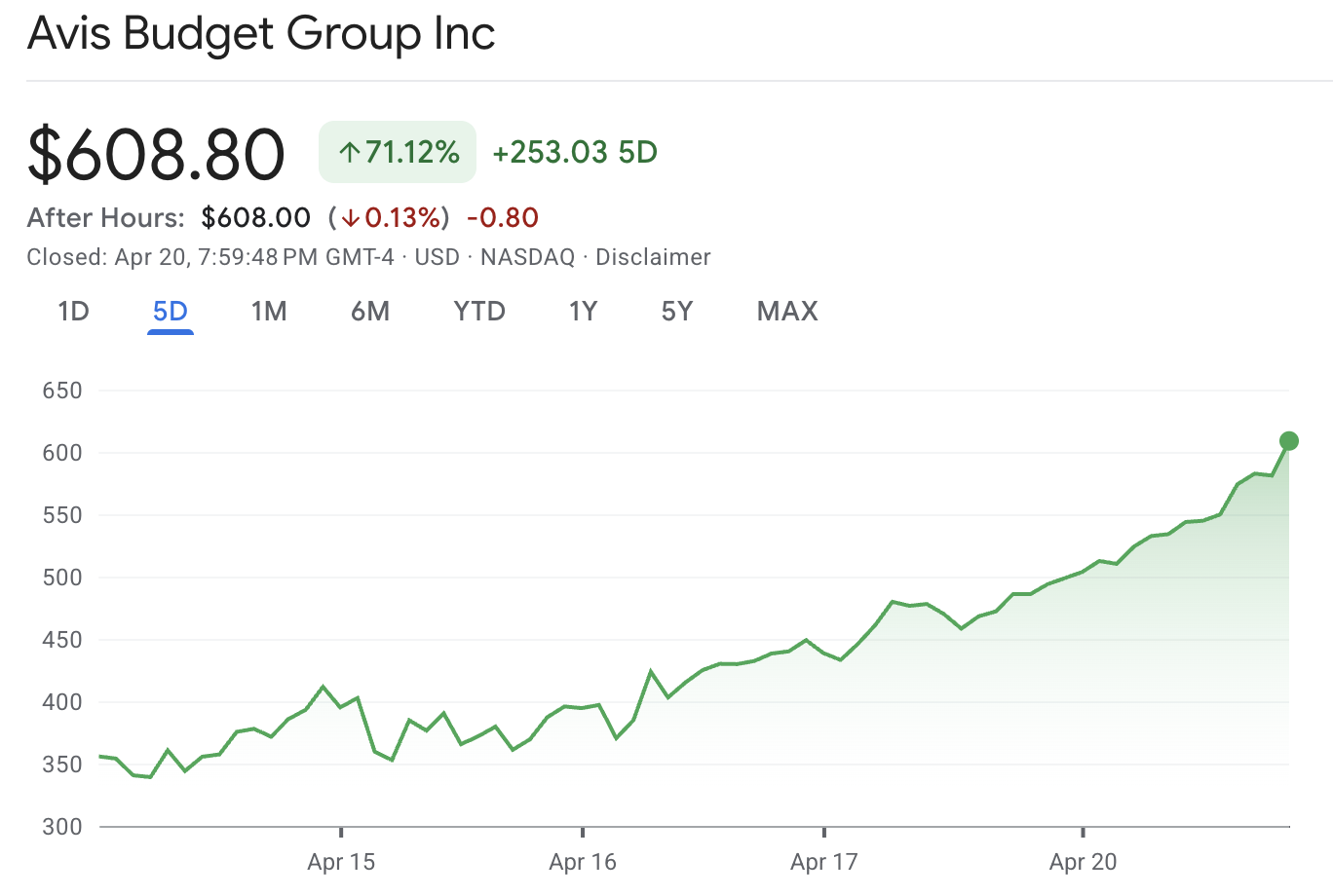
On April 21, Avis shares traded at $608.80 after hitting an intraday high of $618, leaving the stock up more than fivefold from levels near $100 a month earlier. Recent coverage has framed the move as one of the sharpest short squeezes in the market, while Barclays has described it as “all technical” after the stock ran to record levels.
That contrast is what makes the story worth writing now. Avis reported $11.7 billion in full-year 2025 revenue, yet it also posted a $995 million net loss, including a $856 million fourth-quarter loss. The same results showed $6.073 billion of corporate debt, $19.188 billion of vehicle-program debt, and negative equity of $3.129 billion, which leaves the operating picture far weaker than the stock chart suggests.
The rally is primarily technical, not earnings-led. The stock has risen more than fivefold in about a month and ties the move to a major short squeeze rather than a sudden rerating of the business.
The float is unusually tight. Avis had roughly 35.32 million shares outstanding, while SRS Investment Management and Pentwater Capital together held about 71% of the stock, with added swap exposure lifting their combined economic interest even higher.
Short sellers remain central to the story. Barron’s reported roughly 9 million shares sold short as of March 31, which helps explain why forced covering has become such a powerful driver of price action.
Fundamentals still look strained. Avis remains highly leveraged and deeply loss-making on the latest annual numbers, even after maintaining sizable revenue scale.
The clearest explanation starts with ownership concentration. Avis’s April 2 proxy shows 35.32 million shares outstanding, with SRS owning about 17.43 million shares and Pentwater owning about 7.82 million. Barron’s then added a crucial layer, reporting that the two investors also held enough cash-settled swap exposure to push their combined economic interest to roughly 107% of the company.
This is an extraordinary setup for any stock, and especially for one that already had about 9 million shares sold short by the end of March.
Once a stock with that profile starts to rise quickly, the mechanics can become self-reinforcing. Short sellers who need to close positions must buy shares back into a shrinking pool of available stock, while momentum traders often add fresh demand as the move accelerates.
The result is a rally that can outrun valuation, at least for a while, because the marginal buyer is not evaluating normalized earnings power but reacting to scarcity and positioning stress.
Barron’s noted that long airport security lines and broader travel disruption may have helped rental-car names at the margin, and that narrative fits the idea that near-term demand for rentals could improve when travelers look for alternatives. Even so, the scale and speed of CAR’s move look far too extreme to be explained by a modest operating tailwind alone.
A company does not usually rise several hundred percent in a month on incremental travel demand when its latest reported results still show deep losses, negative equity, and heavy leverage. The stronger evidence still points to a squeeze first, with any demand narrative acting as a supplementary tailwind rather than the core engine.
The latest earnings release gives little support to the idea that Avis has already completed a durable turnaround. Fourth-quarter 2025 revenue came in at about $2.7 billion, but the company still reported a $856 million net loss, while full-year net loss reached $995 million.
Part of that damage came from a $518 million impairment tied to certain U.S. EV rental vehicles and related charges, underscoring how quickly fleet strategy can pressure earnings when residual values and utilization assumptions move the wrong way.
The balance sheet remains another clear pressure point. Avis ended 2025 with around $818 million of liquidity, which gives it operating room, but the company also carried $6.073 billion of corporate debt and $19.188 billion of vehicle-program debt.
Those obligations do not prevent a squeeze-driven rally, yet they do make it harder to argue that the stock’s current price reflects a settled improvement in business quality.
There is also a second force running underneath the rally: management now has a clear option to sell stock into it. Avis filed a 424B5 prospectus supplement on March 27, 2026, allowing the company to issue up to 5,000,000 common shares through an at-the-market offering.
Against roughly 35.32 million shares outstanding, that is large enough to matter if the company uses the program aggressively.
Barron’s reported that none had been sold as of its April 20 coverage, but the authorization alone creates a real overhang because a move built on scarcity becomes less explosive once fresh supply enters the market.
If upcoming short-interest data show that bearish positions have already been reduced sharply, some of the fuel behind the move may have been consumed. If short positioning remains elevated while the float stays tightly held, the stock could remain volatile and vulnerable to further upside bursts that look disconnected from valuation.
The company’s filing gives it flexibility, but the market will care about execution rather than authorization alone. If Avis sells shares into strength, the balance sheet could improve, yet the same move would also weaken the scarcity that has amplified the rally so dramatically.
For CAR stock to hold these levels over a longer horizon, investors would need to see cleaner earnings, lower leverage, and firmer evidence that the company can generate durable returns without relying on a market dislocation. Until those markers improve, the stock still looks more like an expression of positioning stress than a conventional rerating of intrinsic value.
CAR stock is up because the market is dealing with a severe squeeze setup. Ownership is concentrated, roughly 9 million shares were sold short at the end of March, and momentum buying has intensified the pressure on bearish traders who need to cover.
Not primarily. The latest annual results still show a $995 million net loss, heavy debt, and negative equity, which leaves the operating story much weaker than the recent share-price move implies.
Yes. Avis has already filed an at-the-market program for up to 5 million shares, so management has a mechanism to raise equity capital if it chooses to take advantage of the rally.
It can, as long as short positioning remains high and the float stays constrained, but the same setup also makes the stock vulnerable to abrupt reversals once covering pressure eases or new supply appears.
CAR stock is surging for reasons that are real, but they are mostly technical rather than fundamental. The strongest explanation is a severe short squeeze built on concentrated ownership, limited effective float, and heavy short positioning, while the company underneath the rally still shows large recent losses, heavy leverage, and a live dilution option through its 5 million-share ATM program.
The CAR stock rally is genuine, but the underlying business still looks fragile.