Published on: 2026-02-23
Richard Dennis and the Turtle Trading Strategy remain relevant in 2026 because they address a longstanding question in financial markets: whether a rule-based approach can reduce the emotional biases that often undermine trading decisions.
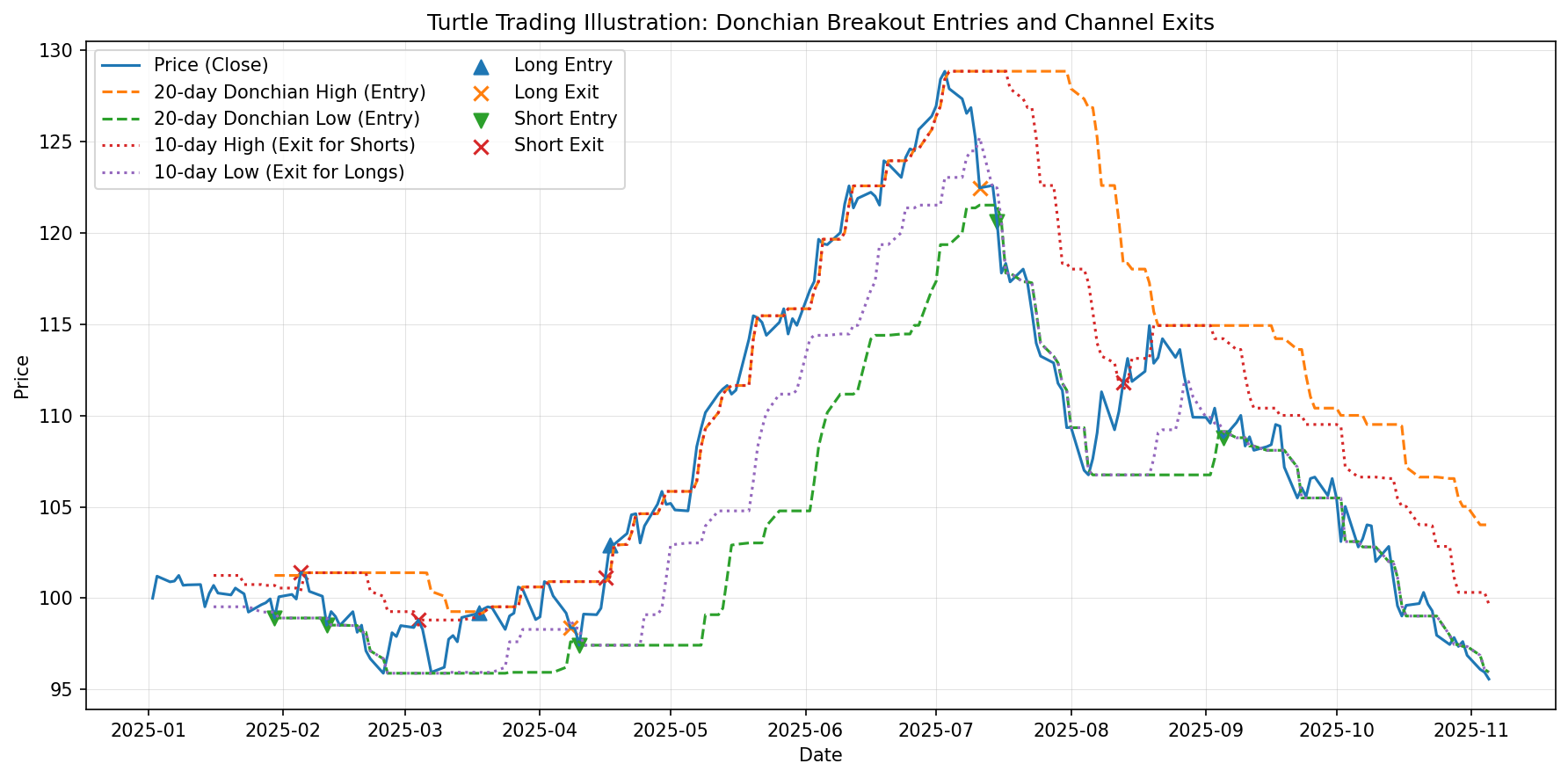
In an environment where news cycles outpace fundamental analysis, the Turtle approach avoids prediction. Instead, it offers a structured way to capture major trends as they develop, while using disciplined risk controls during less favourable periods.
The importance of timing is practical, not theoretical. Trend-following funds have shown that annual performance can swing sharply even when the underlying approach stays broadly consistent. For example, the Barclay CTA Index (CTA stands for commodity trading advisor) returned 7.13% in 2022, declined to -0.39% in 2023, rose to 3.45% in 2024, delivered 3.16% in 2025, and was up 2.64% year to date (YTD) as of February 23, 2026.
In 2026, Turtle trading can still be viable, provided that performance is evaluated according to the strategy’s intended design. The approach is not structured to generate consistent monthly gains, but rather to avoid catastrophic losses and participate in the few significant trends that often define annual performance.
Broad CTA benchmarks have remained positive, though not spectacular, in recent years. The Barclay CTA Index posted mid-single-digit returns in 2024 and 2025 and was positive again early in 2026. Trend-following subsets have been more volatile, including the early-2025 drawdown noted above, followed by a stronger start to 2026 in some trend measures.
| Benchmark | 2022 | 2023 | 2024 | 2025 | 2026 YTD* |
|---|---|---|---|---|---|
| Barclay CTA Index | 7.13% | -0.39% | 3.45% | 3.16% | 2.64% |
*2026 year-to-date performance estimated with reported data as of February, 2026.
The strategy's advantage persists, but returns are uneven. Evaluating success on a monthly basis may lead to abandoning the approach prematurely, just as it begins to demonstrate effectiveness.
Contemporary implementations of the strategy have evolved. Trend managers have modified time horizons, diversified market exposure, and adopted new analytical tools. Even within a framework that values simplicity, professional practitioners have advanced beyond a static set of rules.
Turtle trading can remain profitable in 2026 when markets exhibit sustained trends across rates, currencies, commodities, and equity indexes. However, it remains vulnerable to policy-driven reversals and range-bound conditions. Profitability is attainable, but it is contingent on prevailing market dynamics.
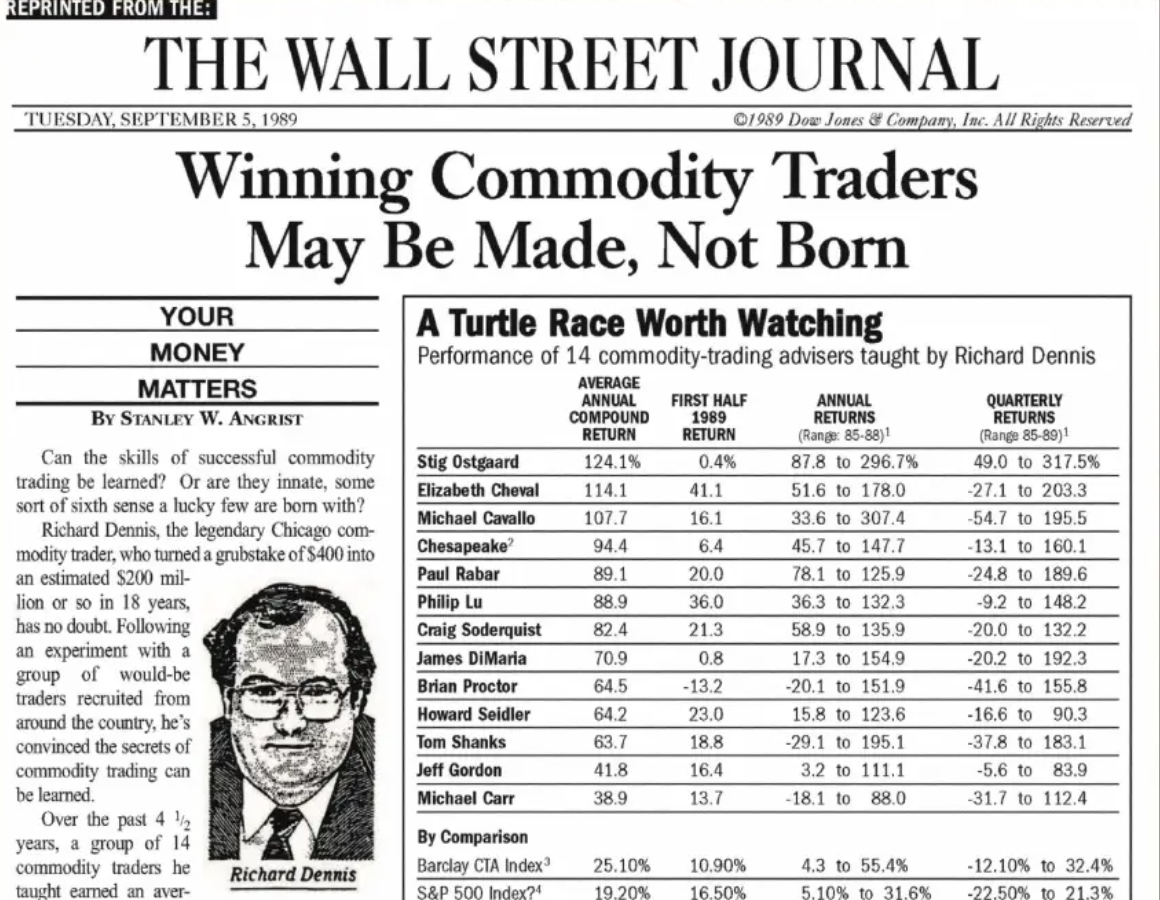
The Turtle Trading Strategy originated from a broader debate regarding whether successful traders are inherently skilled or can be systematically trained. Dennis contended that rules and discipline were more important than instinct. To demonstrate this, he recruited trainees through advertisements in late 1983 and 1984, provided intensive training, and allocated real capital for them to trade.
A Wall Street Journal profile published in September 1989 described the Turtle trainees’ results as extraordinary, reporting an average annual compound return of about 80% for the group over several years. The same article also cautioned that early returns reflected unusually low or no commissions and no management fees for part of the period, alongside other reporting assumptions. The article also explains the nickname: Dennis compared the process to “growing” traders like turtles raised in Singapore.
An often-overlooked aspect is that Turtle trading was never intended as a forecasting tool. Rather, it serves as a behavioral framework designed to enforce discipline, including actions that may appear counterintuitive, such as buying after prices have already risen and selling after they have already declined.
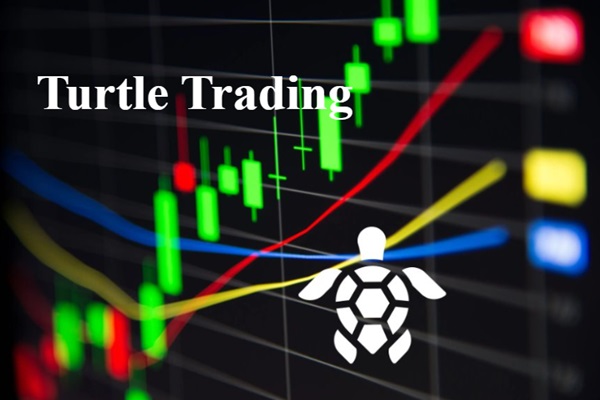
At its core, Turtle trading is a trend-following strategy governed by clearly defined rules. Positions are entered only when the market breaks out of a range and are held as long as the trend remains favorable.
The classic Turtle approach used breakouts from a recent price range, often described through Donchian channels, which mark the highest and lowest prices over a chosen window. A break above the upper band is treated as a buy signal; a break below the lower band is treated as a sell signal.
Many summaries of the Turtle rules highlight two common windows: a faster system that looks at roughly 20 trading days and a slower system that looks at roughly 55 trading days, with exits based on shorter pullbacks from those ranges.
The strategy is built to enter trends that are already underway, not to guess where they will begin.
The strength of the Turtle rulebook lies more in risk control than in entry timing. The Turtles sized positions based on market volatility, so that one adverse day in a volatile market did not do the same damage as one adverse day in a calmer market. They also used strict exit rules to cap losses if price moved against them.
While simple in theory, this approach addresses a common retail trading error: applying uniform position sizes across all trades and subsequently discovering that a single routine market movement can result in disproportionate losses.
The Turtles also increased exposure as a trend moved in their favor. Although this approach may seem counterintuitive, it is practical: when markets exhibit strong momentum, capitalizing on a measured advantage can be more effective than taking early profits out of caution.
Consequently, the strategy may appear unremarkable for extended periods, only to demonstrate effectiveness when sustained trends emerge. It is specifically designed to benefit during periods when markets deviate from mean-reverting behavior.
Trend strategies feed on a basic market habit: big moves often last longer than most people expect. Central bank cycles, inflation shocks, commodity squeezes, and slow-moving shifts in growth expectations can all produce periods in which the prevailing direction persists.
The Turtle method enforces three behaviours that clash with most instincts:
It does not average down. Losses are cut, not explained away.
It does not try to call tops or bottoms. It follows price, even if that feels late.
It does not focus on a single story. In its original spirit, it spread risk across many liquid futures markets so that no single theme could dominate results.
This design explains why trend-following strategies may appear irrelevant during stable, rising equity markets but become valuable when traditional portfolios encounter difficulties. The strategy can take both long and short positions, depending on market direction.
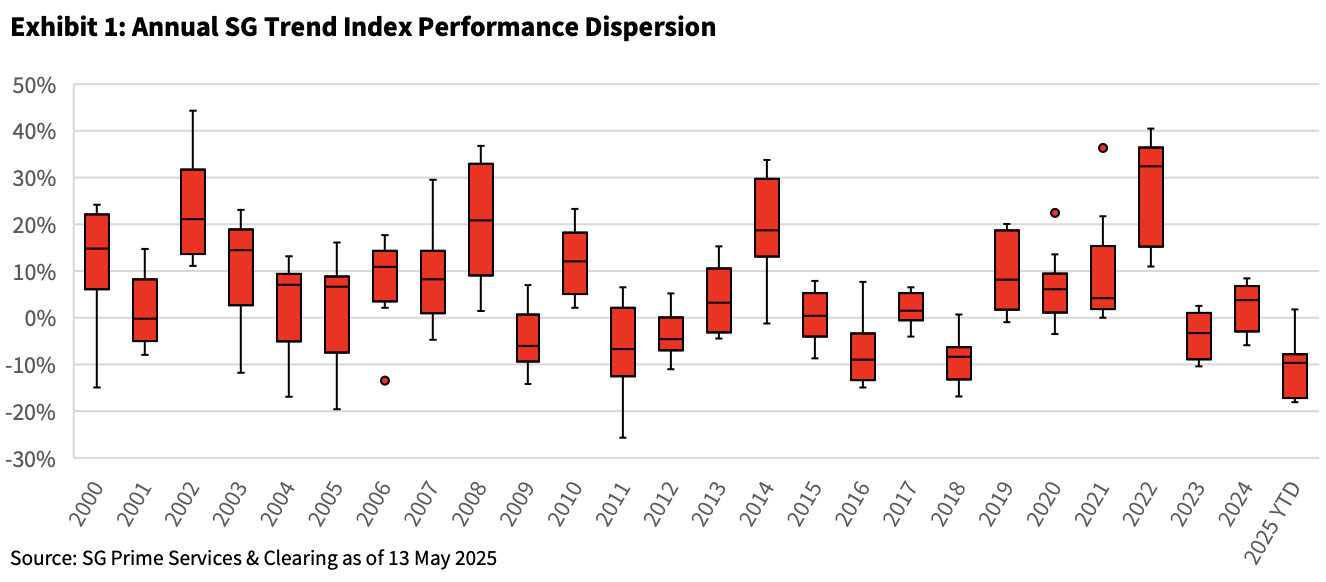
All trend-following strategies incur recurring costs due to false signals or unsuccessful entries.
Sideways markets frequently produce breakouts that quickly fail. A strategy that buys new highs and sells new lows may incur repeated losses when prices fluctuate unpredictably. During these periods, the system can accumulate frequent small losses that, while individually minor, may collectively impact overall performance.
A Société Générale Prime Services note highlighted early 2025 as a clear example of how timing matters: the SG Trend Index fell -4.9% in April and was down -9.3% year to date by the end of April, after trends reversed suddenly and volatility rose.
This is also why new traders often misunderstand the approach. They copy the breakout entry and assume that it is the “strategy.” The real strategy is accepting that many signals will be wrong while keeping each loss small enough to stay in the game until market conditions improve.
The Turtle strategy is frequently described as a breakout system, but its primary advantage lies in risk control. While entry signals attract attention, risk management is essential for enduring long enough to capture the few significant trends that define annual performance. In practice, Turtle trading is based on the principle that small, repeatable losses are acceptable, whereas large losses must be avoided.

Turtle-style position sizing begins by determining the maximum acceptable loss per trade, then calculating the appropriate position size accordingly. Rather than selecting arbitrary amounts, position size is based on typical market volatility and the predetermined exit point if the trade moves unfavorably.
A clean way to express it in plain terms:
Pick a fixed loss limit per trade (a small, predefined slice of your account).
Set the stop loss distance based on the instrument’s normal daily movement, or the most logical technical exit (for example, below a recent support area or below the last few weeks’ low for a long).
Size the position so that if the stop is hit, the loss stays within your limit.
| Step | What you set | Example |
|---|---|---|
| 1) | Risk per trade | Fixed loss limit: $1,000 |
| 2) | Stop loss distance | How far your stop is from entry: $2.00 |
| 3) | Position size | Risk ÷ stop distance: 500 shares |
This approach operationalizes the 'keep losses boring' principle through quantitative risk limits.
The Turtle approach uses rule-based stops, not emotional ones. In classic versions, exits often sit around recent lows for long trades and recent highs for short trades, so the trade stays open while the trend holds, then closes when the trend clearly weakens.
Two practical principles matter more than the exact formula:
Stops must be placed before the trade is entered.
Stops should tighten only when the trade moves in your favour, not when you feel nervous.
When managing multiple trades, the primary risk is not a single stop loss but the possibility of several trades moving adversely simultaneously. Turtle-style risk management mitigates this by diversifying exposure, avoiding oversized positions in highly volatile markets, and maintaining consistent overall risk even as positions are increased in winning trades.
This is why the Turtle system is less about being right and more about staying consistent when markets are not.
Turtle Trading Strategy is a rule-based trend strategy that buys when price breaks above recent highs, sells when price breaks below recent lows, cuts losses quickly, and holds winners until the trend fades.
A contemporaneous Wall Street Journal report states Dennis compared training traders to growing turtles in Singapore, framing the program as a process that could produce skilled traders through rules and repetition.
The logic can be applied to stocks, but the original design benefited from diversification across many liquid markets, including commodities, rates, and currencies. A single-stock version usually carries more company-specific risk than the classic approach.
They often lose small amounts during sideways markets because breakouts fail and reverse. Those repeated, controlled losses are the “cost” of being positioned for the rare periods when markets run strongly in one direction.
They copy the entry rule and ignore the risk rules. The original framework treated position sizing and loss limits as non-negotiable, because the strategy expects many small losing trades before a few large winners appear.
Richard Dennis and the Turtle Trading Strategy persist because they embody a disciplined philosophy of execution rather than a rigid predictive tool. The framework anticipates frequent errors and is structured to limit the impact of individual mistakes.
The Richard Dennis trading strategy remains relevant in 2026 because market trends continue to emerge and behavioral biases persist in influencing decision-making. The primary challenge lies not in understanding the rules, but in adhering to them consistently during extended periods of limited activity to be positioned for decisive market movements.
Disclaimer: This material is for general information purposes only and is not intended as (and should not be considered to be) financial, investment or other advice on which reliance should be placed. No opinion given in the material constitutes a recommendation by EBC or the author that any particular investment, security, transaction or investment strategy is suitable for any specific person.
2) BarclayHedge Indices, “Barclay CTA Index” (annual returns and 2026 estimated YTD timestamp)