Published on: 2025-12-09
Updated on: 2025-12-09
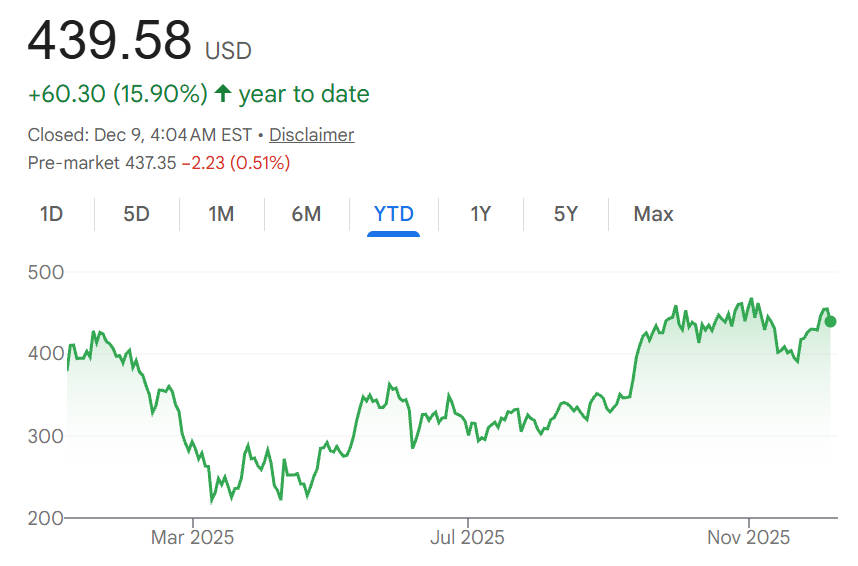
Tesla, Inc. (TSLA) ends 2025 at around US $439–$440 per share. Recent earnings and market dynamics show a company at a crossroads: its core electric‑vehicle (EV) business remains substantial but under increasing margin and demand pressure, while its forays into autonomous driving, energy storage, and robotics are positioned as the main engines for long‑term growth.

In Q3 2025, Tesla's total vehicle production and delivery numbers remained robust (production 447,450, deliveries 497,099), yet gross margins in automotive fell to around 16%, down from a higher threshold a few years ago, signifying cost pressures and margin compression.
On the flip side, Tesla's energy generation and storage business is growing quickly. As of 2025, that segment accounts for over 12 per cent of total revenue, with shipments of battery/storage units up ~59 per cent year‑over‑year.
Several recent analyst reports reflect diverging investor sentiment: one firm lowered its price target to US $475, citing near‑term subsidy cuts in key markets like China and the U.S., but still sees long‑term upside through autonomous driving and robotics.
Another raised a price target to US $508, attributing value to progress on robotaxi deployment and upgrades to the autonomous driving programme.
Thus, as of late 2025, Tesla seems to be evolving: from a high‑profile EV manufacturer to a diversified, tech‑centric firm mixing energy storage, autonomous mobility, and robotics, with the latter segments increasingly vital for its 2030 valuation.
Rather than a single point estimate, Tesla's trajectory to 2030 can be framed through three plausible scenarios, each shaped by different combinations of growth drivers, risks, and macro conditions.
| Scenario | Price Range / Share (2030) | Key Assumptions | Estimated Share of Total Value from Non‑Auto Business |
|---|---|---|---|
| Conservative | ~US $200 – $300 | EV market growth slows; global EV subsidies shrink; competition intensifies; automaker margins remain weak; slow adoption of FSD/robotics | Low (Automotive dominates) |
| Base Case | ~US $300 – $520 | Steady EV growth; gradual uptake of energy storage business; modest introduction of autonomous/robotics revenue; stable margins | Medium (Auto + Energy + some Robotics/AI) |
| Bullish | ~US $520 – $650+ (or higher in a breakthrough year) | Widespread EV adoption globally; strong growth in energy‑storage business; successful launch and scaling of robotaxi/autonomous mobility and robotics; improved margins through scale and vertical integration | High (Large portion from Robotics/AI & Energy) |
Why such wide ranges? Tesla today carries a "technology premium", much of the current share price already reflects investor optimism about its AI, energy, and robotics ambitions. If those ambitions materialise, upside is substantial; if not, downside becomes non-trivial.

Global EV adoption remains on a long‑term growth trajectory. Some market forecasts suggest total global EV sales could nearly double in the coming years, presenting an expanding addressable market for Tesla.
If Tesla succeeds in delivering a competitively priced, mass‑market EV model (for example, a sub‑US$25,000 car by mid‑decade), it could substantially expand sales volume, especially in emerging markets.
Tesla's energy storage and generation segment is scaling fast. With shipments up nearly 60 per cent YoY in 2025, the company appears to be transitioning, at least in part, from carmaker to integrated energy‑tech provider.
Given increasing global demand for grid storage, renewable energy integration, and data‑centre power supplies, this segment could become a stable source of revenue and margin, cushioning Tesla against volatility in auto sales.
Tesla is pushing aggressively into autonomous driving, with its Full Self-Driving (FSD) software continuously evolving. Some analysts anticipate rollouts of robotaxi services and deployment of autonomous features in metropolitan areas before 2030.
If Tesla succeeds in commercialising robotaxis at scale, or even offering subscription-based autonomous mobility services, this could considerably boost recurring revenue, raise margins, and fundamentally transform its business model.
Beyond cars and energy, Tesla's ambitions reportedly include robotics (e.g., humanoid robots) and perhaps other AI‑driven applications. Some bullish forecasts attribute a significant portion of Tesla's long‑term value to these ventures.
If Tesla becomes a leader in robotics/AI, its valuation could increasingly decouple from automotive risk cycles and align more with high‑growth tech firms.

In the near term, Tesla is facing pressure from fading EV subsidies, especially in markets like China and the United States. That could weaken demand, especially for higher‑priced EVs, and compress margins further.
Rising competition from legacy automakers and new entrants, particularly in lower/mid-price EV segments, could erode Tesla's market share, especially if Tesla fails to release affordable models at scale.
As seen in recent quarters, gross margin on automotive sales has fallen. Unless Tesla finds cost efficiencies or shifts revenue mix toward higher-margin segments (energy, services, software), profitability may remain under pressure.
Manufacturing capacity expansion is capital‑intensive. Delays, supply‑chain issues, or cost inflation could hamper Tesla's ability to deliver on volume growth forecasts.
Autonomous driving (FSD, robotaxi) and robotics are high‑reward but also high‑risk ventures. Regulatory hurdles, safety concerns, and technological challenges remain material. If these efforts fail or are delayed, a large portion of the current valuation premia may unravel.
Likewise, scaling a robotics business (e.g., humanoid robots) is extremely challenging, with uncertain demand and high capital requirements. Success is far from guaranteed.
Some analysts argue that current price already embeds "perfect case" assumptions about EV growth, energy scale‑up, autonomous mobility, and robotics. That leaves little room for disappointment.
If macroeconomic headwinds, competition, or execution missteps materialise, downside could be sharp.

Several milestones will help indicate whether Tesla is heading toward a conservative, base, or bullish outcome for the Tesla Stock Price.
Rising EV adoption and stable market share in the United States, Europe, China, and emerging markets will support stronger long term growth. Weak demand or shrinking share would signal a slower trajectory.
Investors should watch delivery growth, factory expansion, and any confirmation of a truly affordable model. Scalable manufacturing remains central to the long term strength of the Tesla Stock Price.
Increasing Megapack deployments, new storage contracts, and steady margins in the energy segment could provide a more stable revenue base and reinforce valuation.
Key indicators include improved reliability, wider city street capability, and early regulatory acceptance. Any pilot robotaxi service would significantly increase future revenue expectations.
Early commercial use cases for Tesla's robotics projects or notable AI improvements would strengthen confidence in Tesla's long term diversification.
Healthy cash flow and balanced capital spending will remain essential. Strong finances allow Tesla to scale without taking on unnecessary risk, which supports a stable long term Tesla Stock Price outlook.
Tesla remains best suited for investors with a long‑term horizon and a higher risk tolerance.
If you believe in a future where EVs, clean‑energy storage, autonomous mobility, and robotics converge, and you accept that success is not guaranteed, then Tesla offers a high‑upside opportunity.
For investors focused on stable returns and lower risk, Tesla may be too volatile and speculative, especially given the number of “if‑then” assumptions baked into the bullish narrative.
As of December 2025, Tesla shares trade around US $440. Prices fluctuate daily based on market sentiment, EV demand, and company performance. Investors should track quarterly reports and global EV trends for up-to-date insights.
Tesla's stock is affected by EV sales growth, energy storage performance, autonomous driving progress, robotics initiatives, regulatory changes, and macroeconomic conditions such as interest rates, inflation, and global consumer demand.
Analysts project a wide range: roughly US $200 to US $650, depending on EV adoption, energy business growth, autonomous mobility success, robotics expansion, and operational efficiency. Bullish scenarios assume successful technology and market scaling.
Tesla may suit long-term growth-focused investors comfortable with volatility and speculative risks. Its exposure to EV, energy, and AI sectors offers upside, but investors should be aware of competition, regulatory hurdles, and execution uncertainties.
Strong EV adoption, successful Full Self-Driving deployment, mass-market robotics, and scaling energy solutions could push Tesla shares higher. Innovation, operational efficiency, and positive market sentiment are also crucial factors influencing potential growth.
Slower EV demand, rising competition, margin pressures, regulatory delays for FSD and robotics, or macroeconomic challenges could limit growth. Overvaluation may amplify declines if investor expectations are not met.
As of late 2025, Tesla straddles two identities: a legacy EV manufacturer with declining margins and an ambitious technology company aiming to reinvent mobility, energy, and even robotics. Its 2030 valuation could go several directions, from modest growth to spectacular upside, depending on which identity defines Tesla going forward.
The next few years will be pivotal. If Tesla can successfully scale energy storage, bring affordable EVs to mass markets, and deploy autonomous mobility or robotics at scale, shareholders could see returns well beyond today's valuations. But if execution stumbles or macroeconomics turns sour, even the conservative scenario carries risk.
Disclaimer: This material is for general information purposes only and is not intended as (and should not be considered to be) financial, investment or other advice on which reliance should be placed. No opinion given in the material constitutes a recommendation by EBC or the author that any particular investment, security, transaction or investment strategy is suitable for any specific person.