Published on: 2026-07-21
The baht is weakening because the US holds a 250 to 275 basis point policy rate advantage over Thailand, while higher oil costs and a weaker trade position are adding to dollar demand.
Together, those pressures are overwhelming the support that elevated gold prices and softer US inflation would normally provide. USD/THB reached 33.640 on 20 July, its highest level of 2026, up 6.95% since the start of the year.
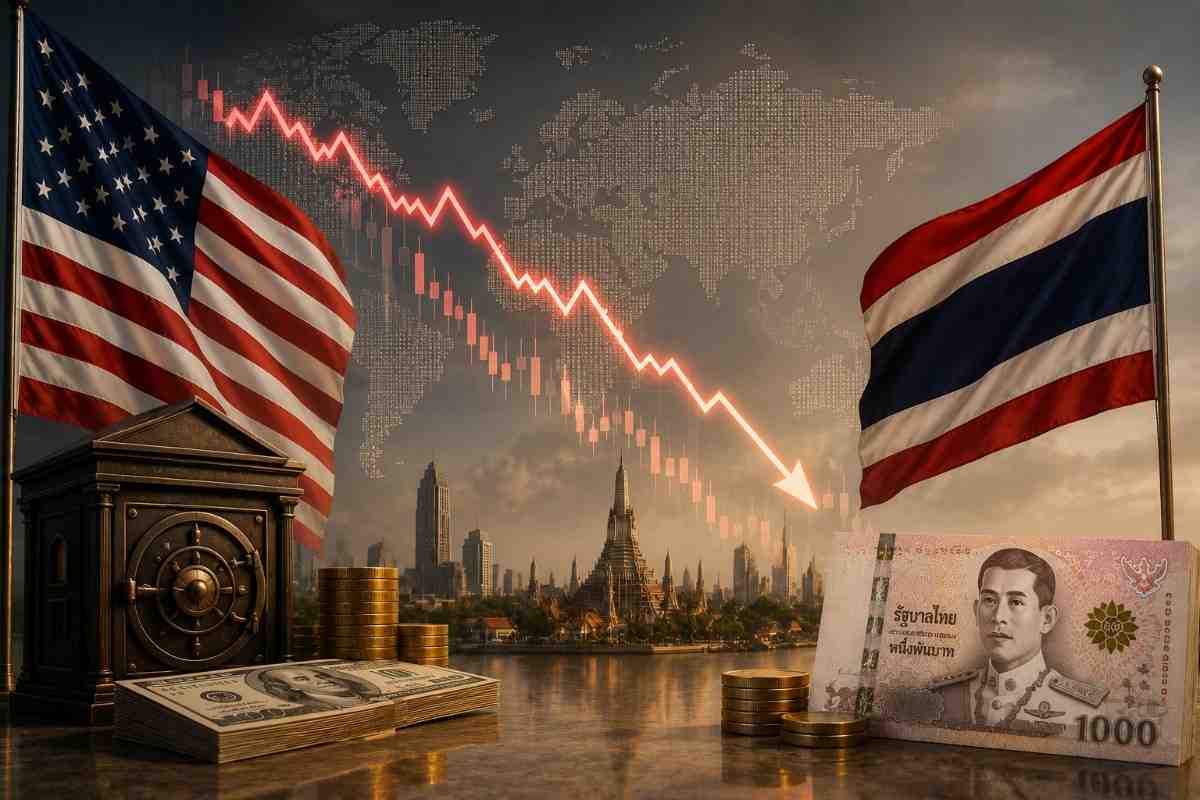
That weakness is already raising the local cost of fuel, imported materials, overseas travel, and anything owed in dollars. It isn't a repeat of a classic external funding crisis. Thailand's reserve position is why, and that's worth its own section below.
USD/THB’s 2026 high of 33.640 sits about 1.1% below 34.00, up 8.78% from the 13 February low, putting the psychological 34 level within reach for the first time this year.
The Fed’s 3.50%–3.75% target range stands 250–275 basis points above the Bank of Thailand’s 1.00% policy rate, preserving a structural carry advantage for dollar assets even after the softer June US inflation print.
Brent crude near $88.50 is raising Thailand's import bill and dollar demand, adding pressure on top of the rate gap.
Thailand posted a THB875.3 billion trade deficit from January through May, with a 19% US tariff still in place.
Reserves of $279.2 billion and 2.8% first-quarter GDP growth are why this looks like a repricing, not a crisis.
June US consumer prices fell 0.4% from May, while annual inflation held at 3.5% and core CPI rose 2.6% year on year. That combination would normally ease pressure on emerging market currencies, including the baht.
Instead, USD/THB rose from 33.445 on 14 July, the day the report came out, to 33.640 on 20 July over the following four trading sessions. US inflation hasn't stopped mattering. The existing rate gap and Thailand-specific pressures were simply strong enough to outweigh the initial benefit of a softer print.
That rate gap has a structural cause. The Bank of Thailand held its policy rate at 1.00% on 24 June, weighing currency pressure against weak credit conditions and a recovery it calls low and uneven. The Fed held its target range at 3.50% to 3.75% on 17 June, leaving short-term baht assets with materially less carry than dollar assets. Higher oil prices reinforce the upward pressure on USD/THB rather than replacing the rate differential as a driver.
Brent crude traded near $88.50 a barrel on 21 July, up roughly 13.5% over the past month and 29% year on year. Higher oil prices raise the foreign currency Thailand needs to settle energy imports and add pressure to transport, production, and household costs. The Bank of Thailand confirmed this channel from the other direction in May, when falling energy imports helped narrow the current account deficit.
Gold complicates the picture instead of resolving it. Thai gold dealers convert bullion sale proceeds into baht, so a higher gold price has historically supported the currency, and the Bank of Thailand has previously linked rising gold prices to upward pressure on the baht.
Gold was trading near $4,050 an ounce on 21 July, still historically elevated but well below its late-January record. USD/THB is still sitting at its 2026 high anyway. The gold channel hasn't disappeared. It's being overwhelmed by low carry, oil-import demand, and external uncertainty.
Thailand exported THB5.10 trillion of goods and imported THB5.97 trillion between January and May, a merchandise deficit of THB875.3 billion. In May specifically, exports excluding gold declined from the previous month, led by weaker electronics and jewelry shipments.
Tourism receipts increased in May, but Thailand’s broader current account remained in deficit. That improvement sits in the services balance, a separate account from the merchandise figure above, and it wasn't enough on its own to close the gap.
A 19% US tariff still applies to Thai exports, with some products qualifying for exemptions. Separate Section 301 duties tied to forced labor concerns were officially proposed in June but haven't been enacted. The existing tariff is already shaping current trade conditions. The proposed measure remains a forward risk, not part of the present burden.
Not every signal that normally moves the baht is pointing the same way right now.
| Driver | Normal Effect | Current Signal |
|---|---|---|
| Gold | Can support the baht | Support is being overwhelmed |
| Oil | Weakens the baht | Negative |
| Fed-BOT rate gap | Favors the dollar | Negative |
| US inflation | Softer data can support the baht | Insufficient to reverse USD/THB |
| Trade balance | Deficits reduce currency support | Negative |
Gold and US inflation are the two rows that should be helping the baht right now. Neither is.
Thailand's gross reserves stood at $279.2 billion in June, with net reserves including forward positions at $302.2 billion, both down from May but still a large buffer against volatility. First-quarter GDP grew 2.8% year on year, with private investment up 10.1%, and the Bank of Thailand forecasts 2.3% growth for the full year, calling the recovery low and uneven rather than absent.
None of that erases what Thai households and importers are paying for dollars every day. What the data show is that current conditions do not resemble the external-funding seizure associated with a classic currency crisis. That's a repricing. It isn't the same thing as Thailand running out of foreign currency to meet its obligations.
USD/THB is holding above its major moving averages, and its 14-day RSI near 65.7 shows strong momentum without reaching the conventionally overbought reading above 70.
| Level or Indicator | Reading | Signal |
|---|---|---|
| 2026 high | 33.640 | Immediate resistance |
| Breakout confirmation | 33.70 | Clears the 2026 high with a margin |
| Psychological level | 34.00 | Next major upside threshold |
| 50-day moving average | ~32.98 | Medium-term support |
| RSI, 14-day | ~65.7 | Strong momentum, not yet overbought |
A daily close above 33.70 strengthens the case for a test of 34.00. A break below the 50-day average would suggest the July risk premium is fading, though the level itself can't isolate which specific driver is unwinding.
USD/THB traded near 33.63, a day after the Bank of Thailand's official reference rate hit 33.638 on 20 July, up from 33.376 a week earlier.
Yes. USD/THB's 33.640 high on 20 July is the baht's weakest point of the year, up 8.78% from its 13 February low.
Momentum alone isn't enough. A test of 34 is plausible if current pressures persist. A sustained break above it would become more likely if oil climbs further, the Fed remains hawkish or tariff risks intensify.
A real currency crisis looks different from this. It shows up as reserves falling fast against short-term foreign obligations, or a central bank burning through reserves to defend the currency. Neither is happening here. Thailand's reserves remain large in absolute terms, and this looks like a slower repricing of risk, not a scramble for dollars.
Lower oil prices would ease import costs and current account pressure. A narrower Fed-BOT rate gap, through Fed cuts or a BOT hike, would reduce the dollar's carry advantage. A resolution of US tariff uncertainty could improve confidence in future Thai export receipts and strengthen forward demand for the baht.
The Fed's next rate decision lands on 29 July. The next scheduled BOT decision does not arrive until 26 August, leaving several weeks for USD/THB to react to changes in the US policy outlook before Thailand’s next regular meeting.
A hawkish Fed message, persistently high oil, or an enacted trade measure would raise the odds of a test above 34. Softer Fed guidance, falling oil, or an improving trade position would make a pullback toward support more likely instead.