Published on: 2026-03-02
The Middle East escalation has added a significant war-risk premium to crude oil. Asia’s oil-importing currencies are the primary channel for this shock, as the region imports oil priced in US dollars.
The trade is less about predicting the exact oil price and more about identifying which FX regimes break first: high-import, high-pass-through, and intervention-constrained currencies tend to reprice faster than “safe haven” narratives suggest.
Central banks in Asia are now on divergent policy paths. As a result, the most compelling opportunities are often in Asia crosses, where oil-related stress intersects with local interest rate trends and external funding requirements.
The current market structure is critical. If shipping risks increase, physical supply may be constrained, causing balances to shift rapidly even if baseline forecasts still indicate inventory builds for 2026.
| Metric | Latest Read | Date | Why FX Traders Care |
|---|---|---|---|
| Brent Crude | ~$76 to $79 per bbl | Mar 2, 2026 | Oil upshifts Asia’s USD import bill and worsens terms-of-trade for net importers. |
| Strait Of Hormuz Oil Flow | ~15M bbl/day (about 20% of global supply) | Mar 2, 2026 | Chokepoint risk creates abrupt price gaps and freight/insurance shocks. |
| OPEC+ Announced Supply Increase | +206,000 bpd (April) | Apr 2026 start | A marginal offset if shipping constraints, not upstream output, are the binding constraint. |
| Japan Crude Imports From Middle East | 95.1% share | Jan 2026 | Japan is structurally exposed to Gulf disruption, even before second-round inflation. |
| Japan Trade Balance | -¥1.164T | Jan 2026 | A live reminder that energy prices still steer Japan’s external math. |
| India Policy Repo Rate | 5.25% (held) | Feb 6, 2026 | Oil-driven inflation risk can limit easing and keep USD/INR bid in stress. |
| Indonesia BI-Rate | 4.75% (held) | Feb 19, 2026 | BI explicitly prioritizes rupiah stabilization in volatile global conditions. |
| Thailand Policy Rate | 1.00% (cut) | Feb 25, 2026 | Easier policy can widen vulnerability when oil spikes and tourism cash flows slow. |
| South Korea Base Rate | 2.50% (held) | Feb 26, 2026 | KRW sensitivity depends on oil vs. exports and global risk appetite. |
| Philippines RRP Rate | 4.25% (cut) | Feb 19, 2026 | Lower rates can amplify oil-to-inflation-to-FX feedback loops. |
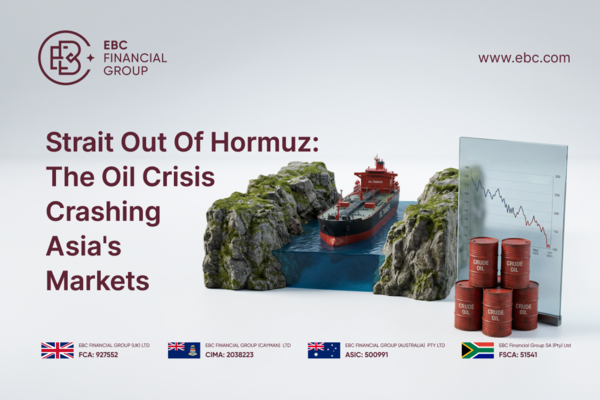
The market now views oil as a logistics and security issue rather than a straightforward supply forecast. After U.S.-Israeli strikes on Iran and increased maritime risk, the Strait of Hormuz has become a key factor in price discovery, as it handles about one-fifth of global oil flows.
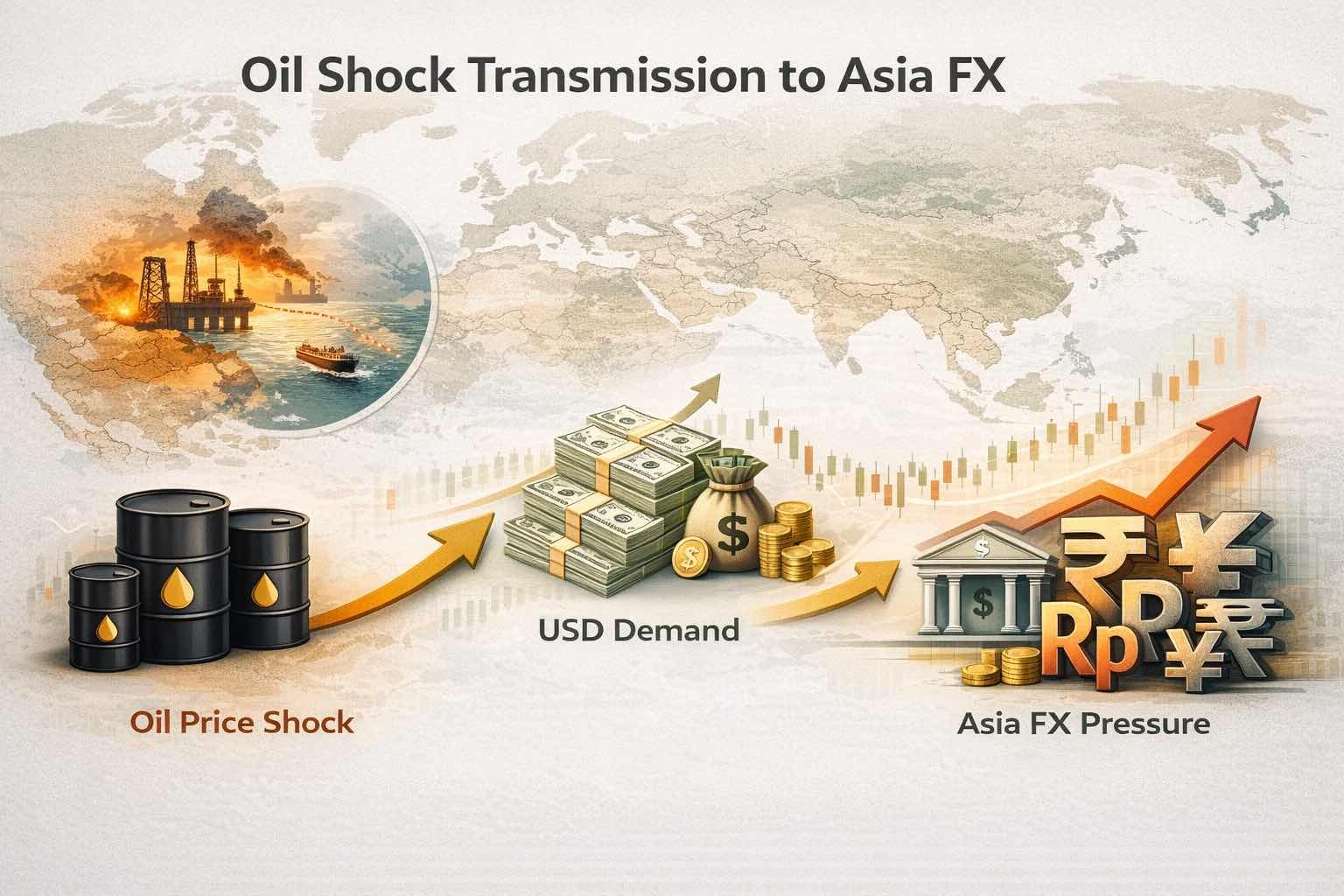
This impacts FX because the initial macro variable to move is not CPI, but the implied USD demand from refiners, utilities, and importers. When crude prices rise and shipping insurance tightens, Asian importers must quickly secure more dollars, often as local risk assets decline.
While baseline forecasts may still project 2026 inventory builds and lower prices, a chokepoint event can temporarily create a market deficit by delaying cargoes, rerouting, and increasing transport costs. Such shocks typically impact FX markets before appearing in official data.
Channel 1: Current Account and Terms-of-Trade Impact. Oil is primarily invoiced in dollars. For net importers, higher crude prices widen the trade deficit unless import volumes decline rapidly, which is uncommon early in a shock. Japan’s reliance is notable: METI data shows 95.1% of crude imports came from the Middle East in January 2026, and the trade balance remained in deficit.
Channel 2: Monetary Policy Constraints. Oil price spikes raise the inflation baseline and complicate monetary easing. Central banks must balance supporting growth with defending their currencies. Bank Indonesia’s February decision highlighted rupiah stabilization amid a persistently uncertain environment, signaling limited tolerance for disorderly depreciation as global funding conditions tighten.
The most challenging scenario occurs when both channels align: a widening external deficit and limited capacity to cut rates. This is why oil-driven FX stress often concentrates in high-beta Asian currencies, even if the global narrative frames it as a temporary war premium.
Indian Rupee (INR): India’s sensitivity to oil is heightened by its large import needs and the rapid market adjustment in hedging demand when crude prices rise. RBI policy remains on hold at 5.25%, but the MPC highlights geopolitical uncertainty and energy price volatility as inflation risks, which can support USD/INR during oil spikes.
Indonesian Rupiah (IDR) and Philippine Peso (PHP): These currencies are influenced by oil as both an inflation driver and a balance-of-payments risk. Bank Indonesia is prioritizing stability, while the BSP has cut rates to 4.25%, reducing policy support if imported inflation rises again.
Thai Baht (THB): Thailand’s policy rate was reduced to 1.00% in late February, increasing THB’s sensitivity if oil spikes coincide with weaker tourism or broader risk aversion. Easing cycles reduce the currency’s carry buffer just as oil costs rise.
Korean Won (KRW) and Japanese Yen (JPY): KRW is a mixed case. Korea imports energy, but its export cycle can offset some oil-related pressures in stable risk environments. The yen is often seen as a haven, but recent events show the dollar can still strengthen against JPY when U.S. yields and Japan’s energy import vulnerability are significant.
The preferred approach is a conditional position that adds risk only when Brent remains above a breakout level (such as sustained in the high $70s to $80) and shipping risk indicators deteriorate. This helps avoid unnecessary exposure when crude prices retreat.
Crosses may outperform USD pairs when the dollar is influenced by Fed expectations or broad risk sentiment. In an oil shock, focus on which country imports more oil and has less policy flexibility. Crosses also help prevent a general dollar selloff from obscuring Asia-specific terms-of-trade effects.
Oil shocks often prompt policy responses such as verbal guidance, liquidity measures, or direct FX intervention. Options help manage risk in currencies where authorities resist rapid depreciation. The objective is to maintain exposure to potential tail risks if chokepoint threats escalate.
Monitor whether the oil move is both physical and sustained. A lasting FX trend typically requires at least two of the following: ongoing shipping disruptions or war-risk advisories (MARAD’s Strait of Hormuz warning signals elevated risk), a tighter prompt crude structure indicating near-term scarcity, and Asian central-bank statements shifting toward FX defense.
Track high-frequency external indicators in Asia. Japan’s trade data is a key barometer, but the same principle applies region-wide: if energy import values increase faster than exports, FX pressure becomes structural rather than sentiment-driven.
Consider de-escalation a tradable event. If diplomatic developments lower the likelihood of prolonged Hormuz disruption, the risk premium can decline rapidly, shifting the best trades from shorting Asia importers to mean reversion and carry strategies.
The bearish Asia-FX, bullish-USD oil-shock thesis weakens if any of the following occur: credible de-escalation restoring shipping confidence, coordinated supply responses stabilizing prompt prices, or a rapid decline in U.S. yields reducing dollar support. The goal is not to predict political developments, but to define invalidation based on variables that FX markets actually price.
It also matters whether the shock is “price only” or “volume plus price.” If cargoes keep moving and only the futures curve reprices modestly, Asia FX often stabilizes after an initial gap. If volumes are delayed, insurers pull cover, or rerouting becomes widespread, the currency impact usually lasts longer than the oil headline cycle.
Net importers with great, price-inelastic demand and limited policy flexibility, such as INR, IDR, PHP, and THB, tend to reprice first. KRW and JPY are mixed cases, as exports, rate differentials, and risk sentiment can partially offset energy vulnerability in the short term.
FX reflects the immediate need for dollars to pay for higher-priced imports and hedges, while CPI data lags. When chokepoint risks increase, crude and insurance costs rise, prompting the market to anticipate a near-term current account impact and to reprice currencies before official inflation data is released.
Not always. The USD often benefits from risk aversion and dollar invoicing, but Asia crosses may be more effective when the USD is influenced by factors such as Fed repricing. In practice, traders often combine a USD leg with crosses to isolate oil sensitivity from global rate shocks.
Central banks prioritize smoothing disorderly moves through communication, liquidity measures, and at times intervention, especially when imported inflation threatens credibility. Recent statements reflect this approach: BI emphasizes rupiah stabilization, while BSP’s easing requires balancing growth support with inflation risks if oil prices rise further.
Define the regime. If shipping risk and prompt tightness fade while oil retraces, reduce exposure quickly because the FX impact often mean-reverts. If disruptions persist and central banks signal currency defense, keep size smaller but stay with the trend, ideally using options to cap downside in intervention-sensitive pairs.
Trading the oil deficit in 2026 centers on Asia importing a Middle East risk premium via the dollar. With Brent in the high-$70s amid Hormuz security concerns and clear maritime risk signals, the strongest FX opportunities lie in vulnerable oil importers and policy-constrained high-beta currencies, while crosses often offer clearer isolation than USD pairs.
Disclaimer: This material is for general information purposes only and is not intended as (and should not be considered to be) financial, investment or other advice on which reliance should be placed. No opinion given in the material constitutes a recommendation by EBC or the author that any particular investment, security, transaction or investment strategy is suitable for any specific person.