Published on: 2026-04-03
Updated on: 2026-04-03
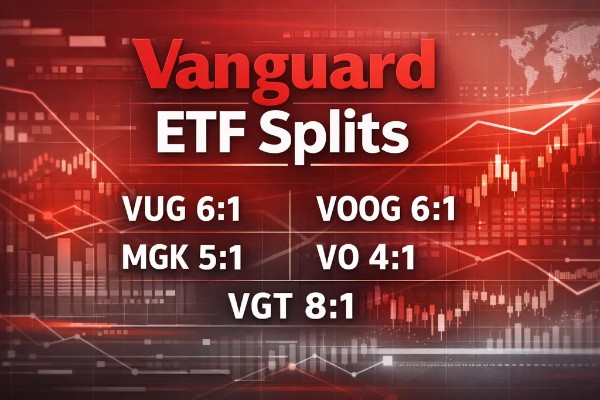
Vanguard has announced upcoming share splits for five equity ETFs, effective April 21, 2026: VUG at 6:1, MGK at 5:1, VOOG at 6:1, VO at 4:1, and VGT at 8:1. These splits will reduce per-share prices but will not affect the total portfolio value.
A forward ETF split generally does not create a taxable event under U.S. federal tax rules. No gain or loss is recognised at the time of the split. Your total cost basis stays the same; only the per-share basis changes.
For covered shares, brokers generally adjust cost basis records automatically. For non-covered shares, investors should verify their records and keep their own documentation.
Vanguard will suspend mutual fund-to-ETF share conversions on April 20 and 21. If you are planning to convert to any of the five affected funds, complete the conversion before April 20 or wait until April 22.
Vanguard announced on March 24, 2026, that it will split shares of five of its largest equity index ETFs. The effective date is April 21, 2026. The record date is April 17, and the payable date is after market close on April 20. Investors who hold shares as of the close of trading on April 20 will receive the additional shares automatically.
On March 24, 2026, Vanguard stated it reviews ETF market price, bid-ask spread, and trading volume when deciding whether a fund is a candidate for a split. The stated goal is to keep share prices within accessible trading ranges.
The rest of this article covers what most investors actually need to know: how the split changes your cost basis, whether it creates a tax bill, and what steps (if any) you should take before April 21.
Five ETFs are included in this round of splits. Each has a different ratio, calibrated to bring per-share prices into a roughly similar range. Here is the full breakdown:
| ETF | Split ratio | Approx. market price on Apr. 3, 2026 | Implied split-adjusted price |
|---|---|---|---|
| VUG | 6:1 | $442.03 | $73.67 |
| MGK | 5:1 | $371.84 | $74.37 |
| VOOG | 6:1 | $413.49 | $68.92 |
| VO | 4:1 | $289.96 | $72.49 |
| VGT | 8:1 | $712.65 | $89.08 |
*Approximate market prices above are from Apr. 3, 2026. The implied split-adjusted prices are simple ratio-based estimates, not forecasts. Actual post-split trading prices on Apr. 21, 2026 will depend on market conditions.
The pattern is clear. Vanguard is targeting funds whose share prices had climbed high enough to create unnecessary denomination friction.
That does not affect intrinsic value, but it can matter at the margin for investors making fixed-dollar contributions, handling smaller tactical trades, or managing options and stop orders around round-number price levels.
According to IRS guidance, a stock split does not create a taxable event. Your total cost basis remains unchanged. Instead, you reallocate the same total basis across a larger number of shares, which lowers the per-share basis.
The math works like this: divide your original cost basis per share by the split ratio.
Example: You bought 10 shares of VGT at $500 per share. Your total cost basis is $5,000. After the 8-for-1 split, you hold 80 shares. Your total cost basis remains $5,000. But your per-share cost basis drops from $500 to $62.50 ($5,000 divided by 80 shares).
If you purchased shares in multiple lots at different prices, the same rule applies to each lot individually. Every lot's cost basis is divided by the split ratio, and every lot's share count is multiplied by the split ratio.
If you have been reinvesting dividends, each reinvestment created a separate tax lot with its own purchase date and cost basis. The split applies uniformly to every lot. Each lot's share count increases, and each lot's per-share cost basis decreases in proportion to the split ratio.
Your holding period for each lot remains unchanged. Shares you acquired more than one year ago remain long-term positions after the split.

A forward ETF split does not, by itself, trigger a taxable event. Vanguard stated that stock splits do not trigger tax consequences, and IRS guidance indicates that these splits do not create taxable income at the time they occur.
You generally report gain or loss only when you later sell shares.
For covered shares, brokers generally report adjusted cost basis information on Form 1099-B. If the split is processed correctly, the total basis for the holding should stay the same while the per-share basis is adjusted to reflect the new share count.
For non-covered shares, basis information may still be visible on account records for reference; however, the investor is ultimately responsible for maintaining accurate records and reporting the correct adjusted basis.
If you hold older lots or reinvested shares, review your records now so you can substantiate your basis when you eventually sell and calculate any capital gains correctly.
For most investors holding these ETFs in a brokerage account, the answer is: nothing. The split is automatic. Your account will reflect the updated share count and adjusted per-share price when markets open on April 21.
However, there are specific situations where action may be needed:
At Vanguard, the average cost is typically used by default for Vanguard mutual funds. In contrast, FIFO is typically used for investments other than Vanguard mutual funds unless you choose a different method.
If you are using specific identification, HIFO, or MinTax with your broker, ensure each lot accurately reflects the split as of the effective date.
After the split posts, review your lot-level records and confirm that the total basis for the holding remains unchanged, and that the split ratio has reduced the per-share basis for each affected lot.
Vanguard said investors will not be able to convert mutual fund shares to ETF shares on April 20 and 21. This matters for investors who use Vanguard's share-class conversion feature to move from the mutual fund share class to the ETF share class without a sale.
If you are planning a conversion into VUG, MGK, VOOG, VO, or VGT, complete it before April 20 or wait until April 22
For investors holding options on any of the five affected ETFs, contract terms are typically adjusted after a standard forward split so the overall contract economics remain aligned with the pre-split position.
OCC adjustment memos for stock splits show the standard mechanics: strike prices are reduced by the split ratio, and deliverables are adjusted accordingly.
Check the OCC memo and your broker's contract specifications after the effective date to confirm the final adjustment terms for each series.
If you have recurring automatic purchases set up for any of these ETFs, no changes are needed.
Your dollar amount stays the same; you will only receive more shares at the lower post-split price per purchase.
No. Under IRS guidance, a stock split does not create taxable income at the time of the split. Your total basis remains unchanged, and only the per-share basis is adjusted.
The total dollar basis of each lot stays unchanged, but the share count rises by the split ratio, and the per-share basis falls by the same ratio. Each lot keeps its original acquisition date for holding-period purposes.
For covered shares, brokers generally track basis and show split-adjusted lots on Form 1099-B. For non-covered shares, the investor remains responsible for accurate records even if the broker displays basis information for reference.
Disclaimer: This material is for general information purposes only and is not intended as (and should not be considered to be) financial, investment or other advice on which reliance should be placed. No opinion given in the material constitutes a recommendation by EBC or the author that any particular investment, security, transaction or investment strategy is suitable for any specific person.