Published on: 2025-12-30
Updated on: 2025-12-30
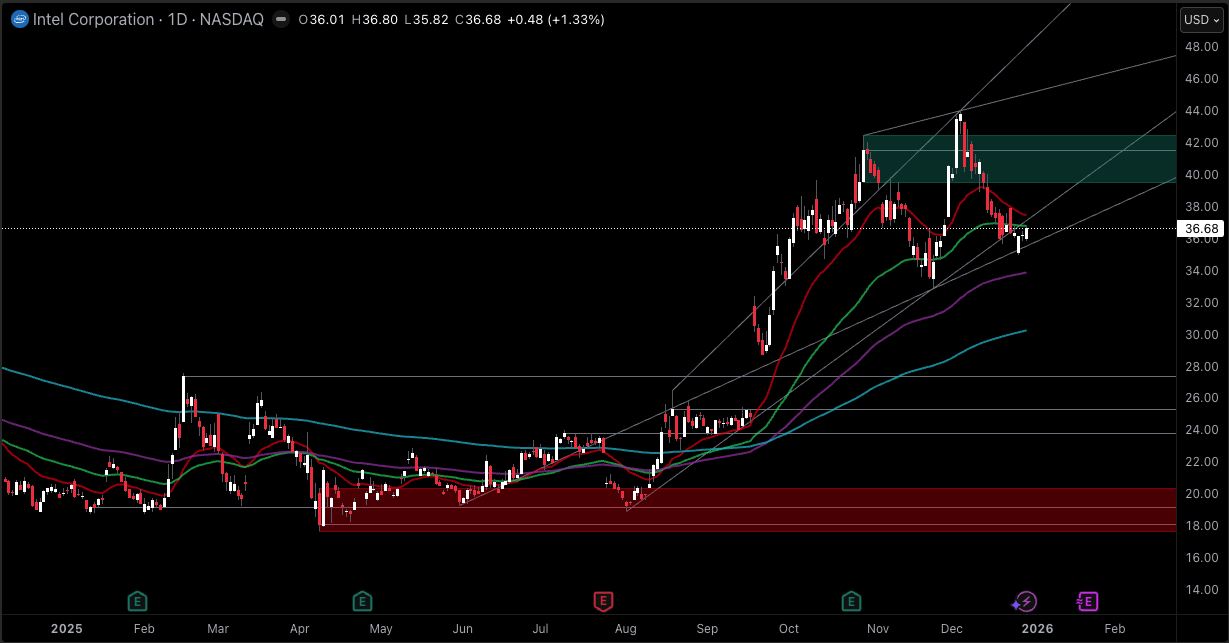
Intel has had a wild 12 months. INTC stock has risen significantly this year, yet they remain below its recent peaks. As of the December 29 close, Intel stock finished at $36.68, with a 52-week range of $17.67 to $44.02.
At present, the major news is Nvidia's $5 billlion investment in Intel, which officially concluded on December 26, 2025. That matters because it ties Intel's future to a real product partnership, not only a hopeful roadmap.
Thus, our 2026 price targets (ranges, not single numbers) start like this:
Bear case (2026): $23 to $30, if execution slips and the market stops paying up for the turnaround.
Base case (2026): $35 to $48, if Intel keeps improving margins and ships on schedule.
Bull case (2026): $50 to $60, if sentiment flips back to "growth" and Intel breaks above the key highs with follow-through.
Those are wide ranges on purpose, because Intel in 2026 is likely to trade like a stock with two clocks running: the product cycle and the manufacturing cycle. The Nvidia deal can speed up the first clock, but it does not automatically fix the second.
Firstly, this was not a vague "partnership talk." It was a real cash investment and a specific product plan.
For context, Intel disclosed it completed the issuance and sale of 214,776,632 shares to Nvidia for $5.0 billion, at $23.28 per share, through a private placement.
Two simple market takeaways come from that pricing:
$23.28 becomes a psychological reference level for 2026. It is not a guaranteed floor, but traders will treat it as a "line in the sand" during panic.
Currently, Intel stock is trading far above the deal price. At about $36.68, the stock is roughly 58% above that $23.28 level. That spread tells you the market is already pricing in a meaningful improvement story.
A quick "market math" note: $5B at $27.50 implies about 181.8 million shares. At $36.68, that stake is worth roughly $6.67 billion, a paper gain of about $1.67 billion so far (based on the December 29 close).
The collaboration is centred on connecting Intel CPUs with Nvidia's interconnect technology and combining CPU and GPU designs more tightly:
For data centres, Intel will build Nvidia-custom x86 CPUs that Nvidia will integrate into its AI infrastructure platforms.
For personal computing, Intel will build an x86 system-on-chip (SoC) that integrates Nvidia RTX GPU chiplets for future PCs.
This is why the deal matters for an Intel stock forecast for 2026. It creates a path for Intel to show measurable progress in areas that investors care about most: platform relevance, performance, and demand pull-through.
Intel's latest quarterly release (Q3 2025) shows a business that is stabilising, but still not "easy money."
Revenue (Q3 2025): $13.7 billion, up 3% year over year.
Gross margin (Q3 2025): 38.2% GAAP, 40.0% non-GAAP.
Cash from operations (Q3 2025): $2.5 billion.
Q4 2025 guidance: revenue of $12.8 to $13.8 billion, with non-GAAP EPS of $0.08.
Additionally, Intel's price action confirms the market has been pricing in better days. Intel is up about +82.94% year-to-date as of the December 29 close.
Intel also set a clear cost target earlier in 2025: it aimed for $16 billion of non-GAAP operating expenses in 2026 (and $17 billion in 2025), alongside a plan for $18 billion in gross capital expenditures for 2025.
That expense target is one of the most important "quiet" numbers for 2026. If expenses rise while income remains unchanged, Intel shares can rapidly lose support.

For INTC stock prediction 2026, the most effective method is to monitor three checklists.
Intel is tied to big, cyclical end markets. When demand is choppy, Intel experiences a decline quickly.
If 2026 brings a more normal replacement cycle and steadier enterprise spending, Intel doesn't need "perfect" conditions to improve. It just needs conditions that are not getting worse.
Even small margin gains matter because of Intel's scale. Traders should watch for:
better gross margin trend
tighter operating expense control
fewer "one-off" items that blur the picture.
If Intel can string together a few quarters where guidance beats fear, the stock can rerate quickly.
The market is not waiting until 2027 for proof. In 2026, investors will likely look for:
Clear product timelines and early customer signals for the joint data centre CPU effort.
Concrete details on the future PC chips that integrate Nvidia GPU chiplets.
| Metric | Value | What it suggests |
|---|---|---|
| Last close | $36.68 | Current reference price |
| 1-day change | +1.33% | Short-term bounce |
| 52-week high | $44.02 | Major resistance |
| 52-week low | $17.67 | Long-term base reference |
| RSI (14-day) | 57.77 | Mildly bullish momentum |
| MACD | 0.010 | Momentum slightly positive |
| 5-day moving average | $36.45 | Very near price, trend stabilising |
| 50-day moving average | $36.47 | Price barely above, pivot zone |
| 200-day moving average | $37.83 | Overhead pressure until reclaimed |
Intel peaked at $44.02 in early December, then pulled back into the mid-$30s.
That pullback is not automatically bearish. Strong stocks often retest after a sharp run. The key is whether buyers defend the right zones.
Right now, Intel is sitting in a tight spot:
It is above the 50-day moving average (supportive for swing trades)
It is below the 200-day moving average (longer-term trend still needs evidence)
| Zone | Level | Why it matters |
|---|---|---|
| Resistance | $37.80 to $38.00 | Near the 200-day MA and a key retracement area |
| Resistance | $40.00 to $41.00 | Prior breakdown area from mid-December |
| Major resistance | $44.02 | 52-week high |
| Support | $35.80 to $36.10 | Recent lows and close-range base |
| Support | $34.00 to $34.70 | Prior swing lows and decision zone |
| Support | $33.95 | Fibonacci retracement (52-week swing) |
| Bigger support | $30.84 | Fibonacci retracement (52-week swing) |
| Deal anchor zone | ~$27.50 | Nvidia’s entry price, big sentiment level |
In short, Intel is not in "free fall: mode. It is in a pullback after a strong run. Bulls want to see $37.80 to $38.00 reclaimed and held. Bears want a clean break under the mid-$30s and a failed bounce.
| Scenario (2026) | What has to happen | What usually shows on the chart | 2026 target range |
|---|---|---|---|
| Bear case | Margins stall, costs creep up, and the market treats the story as "not fixed." | The stock fails rallies and revisits deep support zones. | $23 to $30 |
| Base case | Execution stays steady, costs stay controlled, and guidance stays believable. | The stock holds higher lows and grinds. | $35 to $48 |
| Bull case | The partnership narrative turns into shipped products and stronger demand, and risk appetite stays healthy. | A clean breakout above the big highs with volume. | $50 to $60 |
Above is a trader-style scenario map that ties price ranges to clear conditions.
Why $23 matters in the bear case: It is the deal price for Nvidia's investment, and it also aligns closely with a deep retracement level traders often respect during major pullbacks.
Why $44 to $60 matters in the bull case: Intel's 52-week high is about $44.02. If price breaks and holds above that area, the next "round-number" zones typically come into play, especially when sentiment is strong.

Buy only on strength: A daily close above $38 followed by a pullback that holds above $37 is the cleaner setup.
Why: It tells you the market has accepted a price above the long-term trend line area.
Two common setups:
Pullback buy: Watch $35.80 to $36.10. If buyers defend it and RSI holds near the mid-50s, you can trade the bounce back toward $38 to $40.
Breakout buy: A clean push above $40 with follow-through puts $44.02 back on the map.
Avoid (or tighten risk hard) if Intel loses $34 and can't reclaim it quickly.
That's where pullbacks often turn into trend breaks, and where sellers can press toward the low-$30s
NVIDIA agreed to buy $5 billion of Intel shares at $27.50, resulting in approximately 4.4% ownership for NVIDIA.
Momentum is slightly positive, with RSI (14) at around 57.77 and MACD positive. However, Intel is still below the 200-day moving average.
Key upside levels are $38 and $40, then $44.02. Key downside levels are $36, then $34 and the $33.95 zone.
In conclusion, Intel's 2026 story is not just "good quarter, bad quarter." It is a tug-of-war between real operational progress and the market's patience.
The $5B Nvidia deal adds credibility and a clearer product direction, but it also raises the bar because investors will want evidence, not promises.
Therefore, treat Intel like a levels-driven stock: respect the support zones, do not chase breakouts that fail, and look for confirmation above the major highs before paying for the full bull case.
Disclaimer: This material is for general information purposes only and is not intended as (and should not be considered to be) financial, investment or other advice on which reliance should be placed. No opinion given in the material constitutes a recommendation by EBC or the author that any particular investment, security, transaction or investment strategy is suitable for any specific person.