Published on: 2026-02-26
Updated on: 2026-02-26
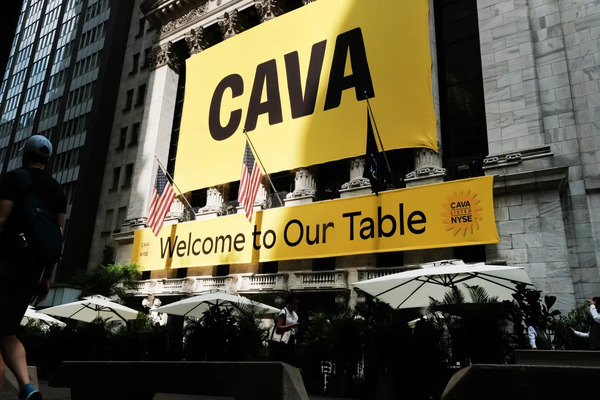
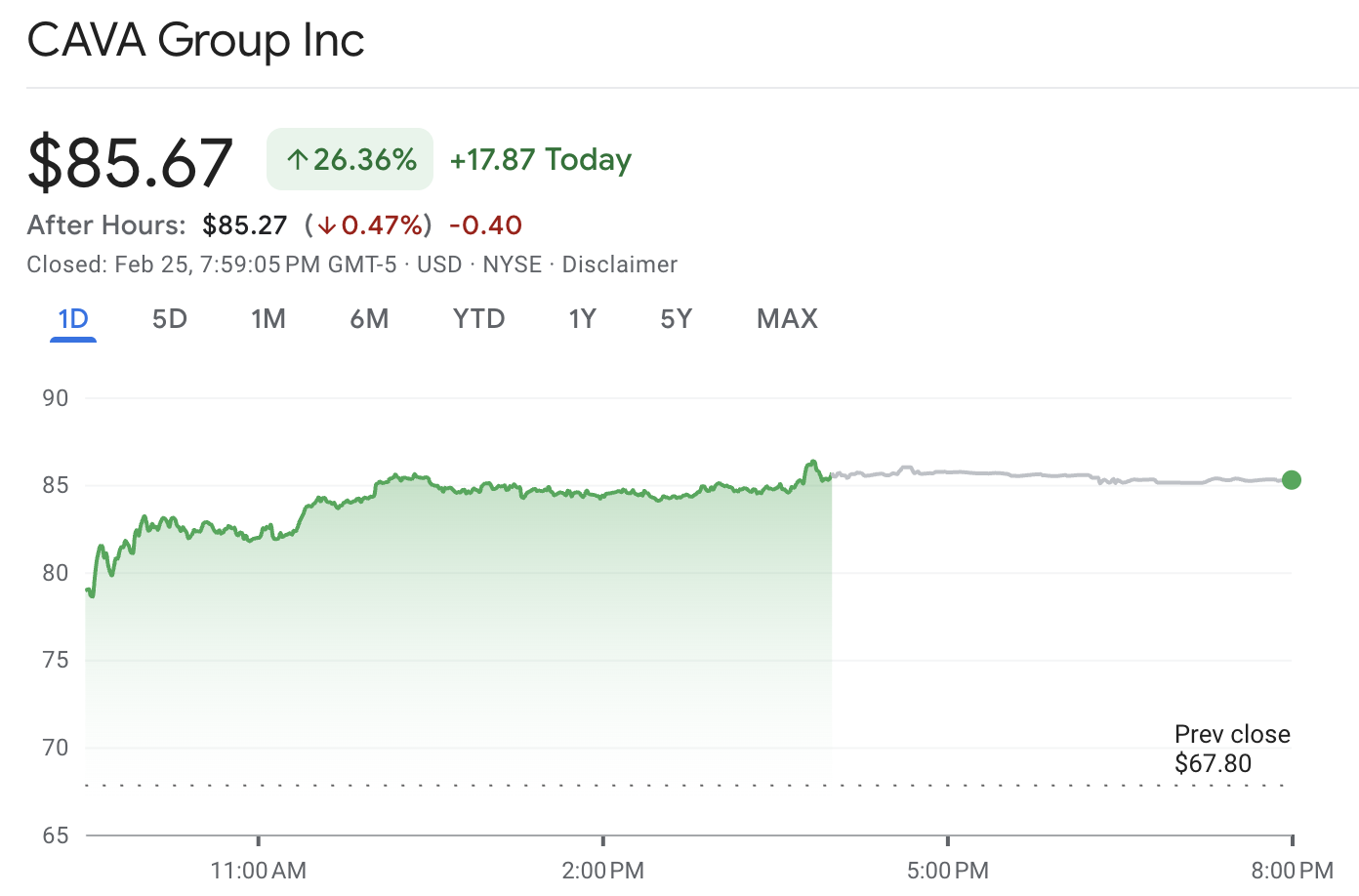
CAVA stock just delivered the kind of post-earnings move that forces a decision. Shares closed at $85.67, up 26.36% on the session, after trading between $77.22 and $86.48.
A simple mix drove the rally: CAVA beat on growth, maintained profitability, and provided investors with a clearer view into 2026. So, is this a "take the money and run" moment, or the start of a new leg higher?
The answer depends on your timeframe, as the chart is now overbought, and the business is still in the middle of a transition from price-led growth back to traffic-led growth.
CAVA's fiscal fourth-quarter and full-year 2025 results demonstrate that the brand can continue to grow rapidly, even when consumers are selective.
| Metric | Q4 FY2025 | FY2025 |
|---|---|---|
| Revenue | $272.8 million | $1,169.3 million |
| Same-restaurant sales | +0.5% | +4.0% |
| Net new restaurants | 24 | 72 (total 439) |
| Restaurant-level profit margin | 21.4% | 24.4% |
| Adjusted EBITDA | $25.8 million | — |
| Net income | $4.9 million | — |
| Digital revenue mix | 38.9% | 37.9% |
The headline that matters most is not the $1 billion milestone, even though it is important. Profitability remained strong while the company opened restaurants quickly.
CAVA implemented a 1.4% menu price increase in January, and management indicated it does not expect additional price increases this year.
That matters because it changes what the market expects from the next twelve months. If there is limited assistance with pricing, then the guidance for comparable sales in 2026 must be achieved through traffic, product mix, and operational efficiency.
It also clarifies why investors were ready to pay more after the earnings report. In a restaurant industry heavily reliant on discounts, a company that can maintain positive comparable sales while implementing modest price increases demonstrates pricing discipline and earns customer trust.
This rally concentrated on CAVA's 2026 projections, suggesting an improved growth mix.
In 2025, a significant portion of the growth was attributed to new restaurant openings. That is great, but markets usually pay a higher multiple when same-restaurant sales are also healthy, because it suggests the concept is pulling demand, not just adding locations.
Net new restaurant openings: 74 to 76
Same-restaurant sales growth: 3.0% to 5.0%
Restaurant-level profit margin: 23.7% to 24.2%
Pre-opening costs: $19.5 to $20.0 million
Adjusted EBITDA: $176.0 to $184.0 million
At the midpoint, Adjusted EBITDA implies roughly high-teens growth versus 2025. Even using the low end of the range, it is still solid growth off an already larger base.
Management also discussed expanding into new Midwest markets and reiterated the "at least 1,000 restaurants by 2032" target, which matters because the long runway remains the core of the bull case.
The market is rewarding a potential shift from price-led growth to demand-led growth.
In Q4, same-restaurant sales were positive, mainly driven by price/mix, while traffic dipped.
For 2026, management is guiding to meaningfully higher same-restaurant sales (3% to 5%).
If traffic stabilizes, that guidance becomes much easier to trust, and the stock can hold a higher valuation.
If traffic continues to decline, the market may consider this rise too swift and excessive.
CAVA also gave the reasons margins dipped in Q4. It is important because after a significant rally, the market will react negatively to any indication that profits are being squeezed.
The company said restaurant-level profit margin fell year over year in Q4 due to:
Higher delivery mix
Technology costs tied to kitchen system investments
Higher food, beverage, and packaging costs, including the impact of tariffs
Wage investments
None of these is fatal on its own. But if you combine "overbought chart" + "margin pressure" + "traffic still negative," that is how sharp pullbacks happen.
After a 26% gap up, the technical picture is strong, but it is also stretched. Right after a gap-and-run move like this, the most common outcome is not "straight up forever." It is usually one of these:
Consolidation (sideways chop)
Partial gap fill (pullback into support)
A second push higher, then a deeper pullback
| Indicator | Value | Read |
|---|---|---|
| RSI (14) | 79.911 | Overbought |
| MACD (12,26) | 4.8 | Buy |
| ATR (14) | 2.4159 | High volatility |
| Stoch (9,6) | 89.419 | Overbought |
| Williams %R | -3.984 | Overbought |
| ADX (14) | 26.421 | Trend strength improving |
Key Takeaway
Momentum is strong, but an RSI near 80 is not a "fresh entry" condition for most swing traders. It is usually a "manage risk" condition.
| Moving average | Level |
|---|---|
| 5-day | 72.07 |
| 20-day | 66.70 |
| 50-day | 64.42 |
| 100-day | 59.88 |
| 200-day | 68.97 |
Key Takeaway
Price is far above the short-term averages, which is exactly what you expect after a one-day surge. It also means support levels below can feel "magnetic" if the market mood turns.
These are short-term reference levels often used for planning entries, exits, and stops:
| Pivot set | S1 | Pivot | R1 | R2 | R3 |
|---|---|---|---|---|---|
| Classic | 84.39 | 84.74 | 85.40 | 85.75 | 86.41 |
| Fibonacci | 84.35 | 84.74 | 85.13 | 85.36 | 85.75 |
This is not a question with one correct answer, because "correct" depends on why you bought the stock.
If you bought before earnings (or early in the move), you are holding a position after a 26% day with RSI in overbought territory. That is not the time to get casual.
What to do:
Trim some size into strength (lock a win while the market is excited).
Trail a stop under a level that matters, not under your feelings.
A practical area is below the $84 to $83 region (pivot cluster), or wider below $78 to $77 if you want to give it room.
Why:
Big gap moves often retrace part of the jump, even in healthy trends.
You are not trying to sell a perfect top. You are trying to hold the stock as long as the unit economics and the expansion engine look intact.
The bull case for holding:
The 2026 guidance suggests rapid, ongoing growth in unit numbers, along with improved same-restaurant sales.
The digital mix continues to be significant, and the average unit volume (AUV) remains strong.
The bear case you must respect:
Traffic was negative in Q4, and margins faced real headwinds (delivery mix, tariffs, wage increases, and tech investments).
After a surge, even good companies can see sharp pullbacks if the next update is merely "fine."
If you are unsure, the "middle road" is often the cleanest: you can take some profit to reduce emotion, and you can hold the rest as long as the stock stays above key support zones such as the MA10 and MA20.
Chasing strength after a day like this is usually a poor trade.
What to wait for:
A pullback that respects support (ideally $78 to $84, depending on how aggressive you are).
RSI is cooling off from extreme levels.
The best swing entries often appear when the story is still good, but the chart is no longer crowded.
CAVA surged because it delivered strong revenue growth, opened 24 net new restaurants in the quarter, maintained profitability, and guided to 3% to 5% same-restaurant sales growth for 2026.
The daily RSI is about 79.9, which is considered overbought. Overbought does not mean the stock must fall, but it does mean the odds of short-term pullbacks rise, especially after a one-day move of over 20%.
Investors should watch traffic trends, restaurant-level margins, and execution on 74 to 76 net new openings.
In conclusion, CAVA stock surged because the quarter delivered what investors wanted most: strong revenue growth, steady profitability, and a more constructive 2026 outlook.
But after a 26% day, the chart is stretched, and momentum indicators are flashing "overbought." If you are sitting on profits, trimming and using a trailing stop is a professional way to stay in the game without giving back a great win.
If you missed the move, patience is the edge. Let price come back toward support and prove it can hold.
Disclaimer: This material is for general information purposes only and is not intended as (and should not be considered to be) financial, investment or other advice on which reliance should be placed. No opinion given in the material constitutes a recommendation by EBC or the author that any particular investment, security, transaction or investment strategy is suitable for any specific person.