Published on: 2026-02-25
Updated on: 2026-02-26
The 'USD weaken' narrative sounds straightforward, USD/JPY rarely rewards straight-line thinking. In 2026, the yen’s performance is not mechanically linked to broad US dollar weakness. USD/JPY reflects relative pricing based on interest-rate differentials, hedging economics, and the prevailing global volatility regime. When these factors diverge, the dollar may weaken against a basket of currencies while the yen continues to underperform.

Recent data illustrate this divergence. Between February 20, 2025, and February 20, 2026, the Federal Reserve’s Nominal Broad U.S. Dollar Index declined from 127.1126 to 117.9917, a decrease of 7.18%. During the same period, USD/JPY increased from 149.63 to 154.99, a rise of 3.58%. This indicates that the yen weakened against the US dollar even as the dollar broadly depreciated.
Many investors conceptualize USD/JPY solely in terms of dollar strength or weakness. However, market pricing reflects a more complex reality. Under typical conditions, USD/JPY functions as an instrument sensitive to interest rate differentials. When US short-term rates exceed those of Japan by several hundred basis points, investors require a compelling reason to exit carry trades. Such reasons generally fall into one of two categories:
A durable compression in expected US–Japan rate differentials, typically driven by credible Fed easing, credible BOJ tightening, or both.
A volatility shock that forces leveraged carry and hedged positions to unwind.
When neither is present, broad USD weakness can show up in other pairs while USD/JPY stays elevated.
Japanese insurers, pension funds, and banks typically assess US assets on a currency-hedged basis. The critical consideration is not simply whether US yields are higher, but whether they remain attractive after hedging US dollar exposure back to yen. Hedging is commonly implemented through forwards and foreign exchange swaps. Changes in hedging costs or balance-sheet constraints can prompt significant shifts in allocation, often without corresponding spot market flows.
The Bank of Japan’s daily foreign exchange report demonstrates why the yen may behave contrary to broad US dollar movements. On February 24, 2026, reported USD/JPY swap turnover reached $66.214 billion, compared to spot turnover of $3.837 billion. In markets dominated by swaps, significant currency exposure is often established and managed outside the spot market.
The yen’s reputation as a safe-haven currency remains valid, but it is conditional. The yen typically appreciates when market volatility increases and leverage is reduced. Conversely, in low-volatility, risk-on environments, the yen often serves as a funding currency, which can result in yen weakness even as the US dollar broadly depreciates.
A key implication for 2026 is that if US dollar weakness coincides with declining volatility and increased risk appetite, yen outperformance should not be considered the baseline expectation.
A more effective approach to analyzing 2026 is to distinguish between factors that have changed and those that remain constant.
The Fed held the federal funds target range at 3.50%–3.75% at the late-January meeting.
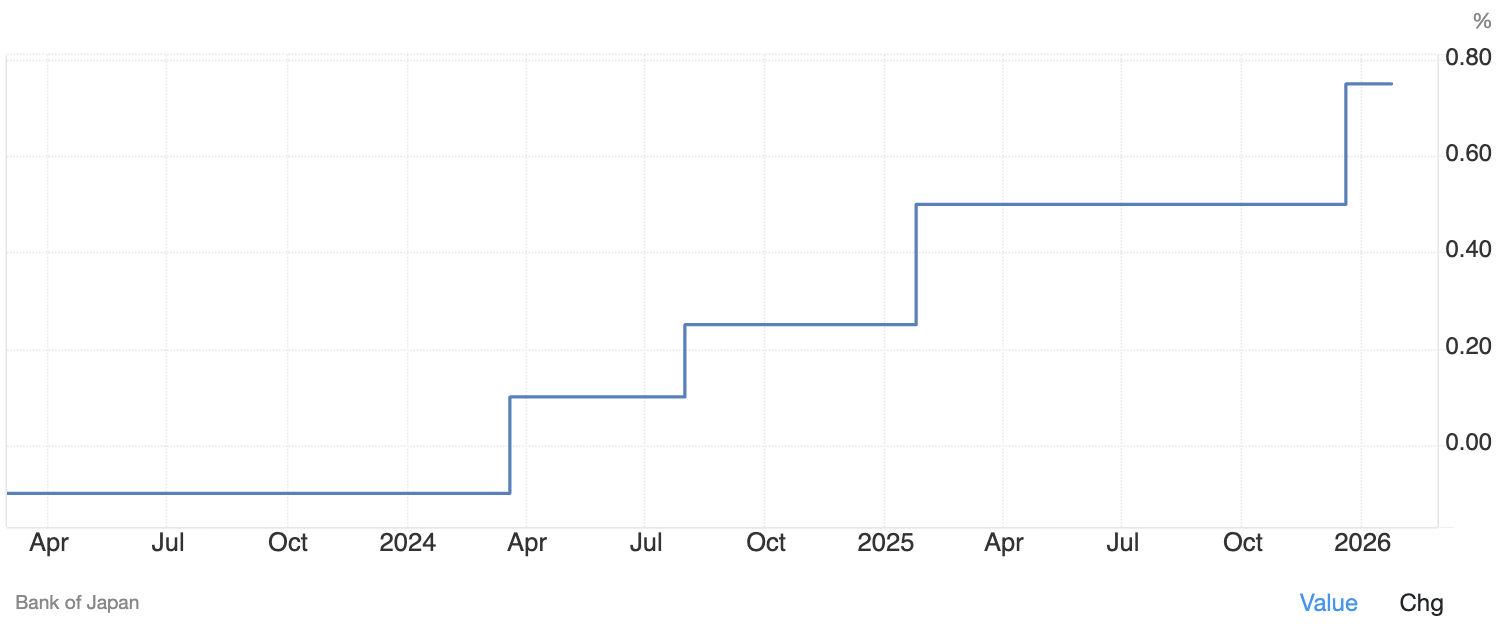
The BOJ’s January policy decision targeted the uncollateralized overnight call rate at around 0.75%, with one dissent favoring 1.0%.
US CPI inflation slowed to 2.4% YoY in January and core CPI was 2.5%.
Japan’s CPI print for January showed headline inflation at 1.5%, but core measures remained at 2.0% and 2.6%, keeping BOJ normalization credible even as headline cooled.
Rates markets also underscore the spread story. The US 10Y yield was 4.03% on Feb 23, 2026. Japan’s 10Y yield was 2.12% on Feb 24, 2026, implying a still-wide long-end differential.
| Metric | US | Japan | Why it matters |
|---|---|---|---|
| Policy rate | 3.50%–3.75% | ~0.75% | Carry incentive and forward-point structure |
| CPI (headline) | 2.4% YoY | 1.5% YoY | Shapes policy credibility and real-rate drift |
| CPI (underlying) | Core 2.5% YoY | 2.0% (ex fresh food), 2.6% (ex fresh food & energy) | Determines whether policy divergence persists |
| 10Y yield | 4.03% | 2.12% | Anchors medium-term spread |
| USD/JPY spot reference | 154.99 (Feb 20) | BOJ central rate 154.82 (Feb 24) | Pricing anchor and market “reality check” |
Japan remains structurally “long foreign assets.” The Ministry of Finance lists Japan’s net international investment position at ¥533,050bn at end-2024. That stock matters because it generates a large stream of overseas income and can support JPY in times of stress.
However, the flow dynamics can be misleading for investors. While Japan’s current account surplus is genuine, it is increasingly driven by investment income, which does not necessarily result in immediate spot yen purchases.
In December 2025, Japan’s balance of payments showed:
Current account: 7,288 (¥100m), or about ¥728.8bn
Primary income: 11,894 (¥100m), or about ¥1,189.4bn
Goods balance: 1,349 (¥100m)
Services balance: -3,401 (¥100m)
Japan’s external surplus is now primarily driven by investment income rather than consistent trade surpluses. Trade data reinforces the point. Japan’s 2025 calendar-year exports were about ¥110.448tn and imports about ¥113.099tn, leaving a trade deficit around ¥2.651tn. A persistent trade deficit reduces the “automatic support” investors associate with older Japan cycles.
If US disinflation continues and the Fed credibly turns more dovish, the front end of the US curve typically does most of the work for USD/JPY. The Fed’s January statement emphasizes a hold at 3.50%-3.75%, but markets remain sensitive to any evidence that the next move is meaningfully lower. If Japan’s inflation stays sticky in underlying terms, the BOJ can keep normalizing. The January BOJ decision and the dissent for a higher target rate keep that possibility alive.
Volatility decides whether the yen behaves as a haven or a funding currency. Risk-off episodes can drive sharp yen rallies via leverage unwind and hedge demand. Risk-on periods can do the opposite, even if the dollar index drifts lower.
When FX swap pricing and hedging economics shift, Japanese institutions can change their hedge ratios or the attractiveness of US bonds on a hedged basis. Because those adjustments often occur via swaps, they can affect USD/JPY without a large spot footprint. The BOJ’s daily turnover numbers make that clear.
| Scenario / regime | Rate-spread compression driver | Risk tone | Likely FX outcome |
|---|---|---|---|
| US disinflation strengthens; Fed priced for deeper cuts | Strong compression from US side | Neutral to mild risk-off | USD/JPY trends lower; JPY outperforms |
| Japan inflation stays firm; BOJ signals further normalization | Compression from Japan side | Mixed | JPY outperforms, especially on crosses |
| Global risk-on rotation out of USD | Limited compression | Low | JPY often lags; USD/JPY can stay high |
| Policy shock raises uncertainty and risk premia | Mixed | High | JPY can rally sharply as haven |
Several developments in 2026 increase the likelihood of significant fluctuations in USD/JPY, even if the USD weaken:
The Fed minutes showed concern that progress toward 2% inflation could be “slower and more uneven,” and the debate around the policy path remains active.
US inflation is cooler on CPI at 2.4%, yet the Fed’s preferred PCE inflation measure showed 2.9% YoY in December, a reminder that policy easing may not be linear.
Japan’s bond market has repriced materially versus prior years. Media coverage has highlighted episodes where JGB yields moved to levels not seen since before the global financial crisis, tightening the global yield differential that supported USD/JPY in earlier cycles.
Japan’s authorities remain sensitive to one-way moves. Market attention to official signals has increased, and episodes of sharp yen moves have been linked to perceived policy scrutiny.
None of these forces guarantee yen strength. They do increase the probability of regime changes, which is when the yen tends to move most decisively.
| Indicator | Current level | What it signals / what to watch | Market implication |
|---|---|---|---|
| Fed policy stance | 3.50%–3.75% | Clear path to a lower terminal rate | Compresses carry and forward points |
| BOJ policy stance | ~0.75% | Guidance that normalization continues | Narrows differential from Japan side |
| US 10Y yield | 4.03% (Feb 23) | Sustained decline on softer inflation | Lowers USD duration premium |
| Japan 10Y yield | 2.12% (Feb 24) | Stable to higher without a growth scare | Raises domestic alternative return |
| US CPI | 2.4% YoY (Jan) | Continued cooling | Supports Fed easing narrative |
| Japan CPI | 1.5% headline, 2.0% core, 2.6% core-core (Jan) | Persistence in underlying inflation | Keeps BOJ credibility intact |
| FX market plumbing | Swaps $66.214bn vs spot $3.837bn | Funding stress or de-risking | Moves positioning quickly into spot |
No. From Feb 20, 2025, to Feb 20, 2026, the broad dollar index fell -7.18%, while USD/JPY rose +3.58%. Broad USD weakness can coexist with yen weakness if yield differentials and risk appetite keep carry trades attractive.
A durable compression in the expected US–Japan rate path. With the Fed at 3.50%–3.75% and the BOJ around 0.75%, the yen needs the differential to narrow meaningfully to win on fundamentals rather than episodic risk-off moves.
Because the surplus is increasingly driven by investment income rather than trade, and income can be reinvested or hedged without creating immediate spot JPY demand. In Dec 2025, primary income was 11,894 (¥100m), compared with a current account surplus of 7,288 (¥100m).
They are central. The BOJ’s daily report showed USD/JPY swap turnover of $66.214bn versus spot turnover of $3.837bn. In a swap-dominant market, hedging and funding conditions can shift USD/JPY without a visible surge in spot flows.
Yes, if higher JGB yields persist and reduce the incentive for Japanese investors to hold foreign bonds, or if they lift Japan’s real-rate profile enough to support a higher policy path. Japan’s 10Y yield was 2.12% on Feb 24, 2026.
A weaker dollar in 2026 does not automatically produce yen outperformance. The yen strengthens sustainably when the US-Japan yield gap compresses, when volatility rises enough to unwind leverage, or when BOJ normalization remains credible while the Fed’s path reprices lower. If USD weakness arrives in a low-volatility, risk-on environment, the yen can lag even as the broad USD trend softens. That is not a paradox. It is how USD/JPY is built.
Disclaimer: This material is for general information purposes only and is not intended as (and should not be considered to be) financial, investment or other advice on which reliance should be placed. No opinion given in the material constitutes a recommendation by EBC or the author that any particular investment, security, transaction or investment strategy is suitable for any specific person.
1) Japan Balance Of Payment (December 2025)
2) FRED