Published on: 2026-05-26
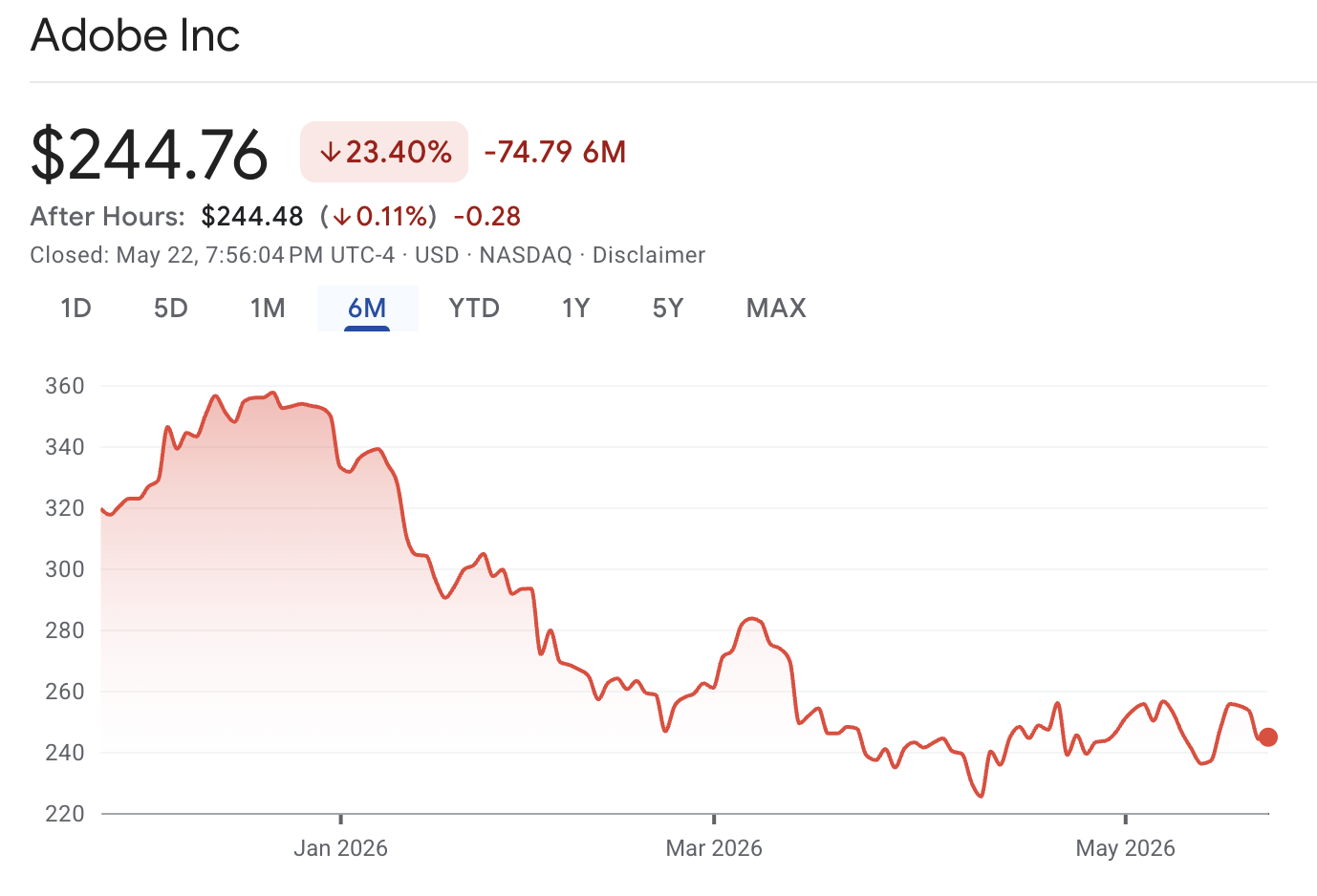
Adobe stock’s multiple compression has become the defining signal in ADBE’s latest reset. The stock fell 3.66% to $244.10 on May 21 and last closed at $244.76 before 26 May, leaving it roughly 42% below its 52-week high of $421.48 even after record Q1 FY2026 revenue of $6.40 billion, 13% subscription revenue growth, and $2.96 billion in operating cash flow.
The divergence between operating performance and market value is a valuation question, not an earnings one. AI ARR must convert into faster recognized revenue, larger contract values, and clearer forward guidance before ADBE can regain a higher multiple.
ADBE fell 3.66% to $244.10 on May 21 and last closed at $244.76 before 26 May, leaving it about 42% below its 52-week high.
Multiple compression remains the main valuation signal. Adobe’s fundamentals remain sound, but the market is paying less for projected growth.
Q1 FY2026 revenue reached $6.40 billion, up 12% year over year, while Customer Group subscription revenue grew 13% to $6.17 billion.
Firefly ending ARR exceeded $250 million, with Firefly subscription and credit pack ending ARR up 75% quarter over quarter.
Operating cash flow reached a Q1 record of $2.96 billion, reinforcing earnings quality and financial flexibility.
Investors need AI ARR to show up in revenue growth, pricing data, and guidance before assigning a higher valuation multiple.
Adobe’s valuation peaked when investors expected high-teens revenue growth and continued dominance across creative software. Those assumptions have since been revised, and the share price reflects a lower growth multiple even though the operating base remains highly profitable.
Two forces drove the reset. Generative AI introduced uncertainty around the defensibility of Adobe’s creative tools. Separately, software investors became more selective about paying premium multiples for growth that has not yet appeared in recognized revenue.
Adobe responded by embedding Firefly across Creative Cloud, Acrobat, Express, and Experience Cloud, placing AI tools inside products customers already use. Subscription revenue growth of 13% confirms that the core base remains stable. What the reported numbers have not yet shown is acceleration in that rate.
| Metric | Latest Reading | Implication |
|---|---|---|
| Stock move, May 21 | Down 3.66% to $244.10 | Selling pressure remains valuation-led |
| Latest close before 26 May | $244.76 | Stock remains near the May 21 reset level |
| 52-week discount | About 42% below $421.48 high | Deep reset in growth expectations |
| Market value | About $100.55B | Valuation already reflects lower growth assumptions |
| Q1 FY2026 revenue | $6.40B, up 12% YoY | Solid growth, still below rerating threshold |
| Customer Group subscription revenue | $6.17B, up 13% YoY | Core base remains healthy |
| Total Adobe ARR / RPO | $26.06B / $22.22B | Revenue visibility remains strong |
| Firefly ending ARR | $250M+, related ARR up 75% QoQ | Adoption strong; revenue conversion developing |
| Operating cash flow | $2.96B, Q1 record | Fundamental support remains intact |
ADBE is deeply discounted, but the chart does not yet show a confirmed reversal. A sustained move above $265 to $270 would improve the setup. A break below $240 to $245 would keep sellers in control.
Firefly ending ARR above $250 million reflects meaningful commercial traction. Firefly subscription and credit pack ending ARR growing 75% quarter over quarter shows that paid adoption is building across the platform. AI-first ARR more than tripling year over year confirms the scale of that adoption.
The valuation issue sits in the gap between ARR and recognized revenue. ARR measures annualized contractual momentum. Revenue measures what Adobe records in the reporting period. When AI ARR rises sharply while total subscription revenue grows 13%, the market sees adoption progress, but not enough top-line acceleration to justify a full rerating.
Closing that gap requires three signals. AI features need to lift average revenue per user. Enterprise contracts need to expand through higher usage and larger seat values. Guidance needs to reflect AI contribution more explicitly in the medium-term revenue model. The pace of conversion into reported revenue remains the market’s central test.
Adobe generated $2.96 billion in operating cash flow in Q1 FY2026, a quarterly record. The company also repurchased 8.1 million shares and ended Q1 with $6.89 billion in cash and short-term investments. Subscription revenue growth of 13% points to a sticky customer base with recurring revenue.
That cash profile separates Adobe from early-stage AI software names. The company funds AI development, infrastructure investment, enterprise sales expansion, and capital returns from internal cash generation, without relying on external financing.
Cash flow supports the valuation base and gives management room to invest through the cycle. A higher multiple still depends on revenue acceleration. Investors are unlikely to reassign a higher growth premium until AI monetization appears more clearly in reported revenue and forward guidance.
| Indicator | Reading | Interpretation |
|---|---|---|
| Latest close before 26 May | $244.76 | Trading near a key support area |
| 52-week discount | About 42% | Structural drawdown remains in place |
| RSI, 14-day | 45.02 | Weak to neutral momentum, not oversold |
| MACD | -0.82 | No bullish crossover confirmed |
| EMA 20 / 50 / 200 | $246.34 / $247.51 / $247.41 | Price remains below key moving averages |
| Support / resistance | $240–$245 / $265–$270 | Recovery needs a sustained break above $265 |
ADBE is trading below key moving averages with no confirmed reversal signal, keeping the technical outlook cautious until price reclaims the $265 resistance zone.
Adobe delivered strong Q1 FY2026 revenue, cash flow, and AI ARR growth. The stock is under pressure because investors are focused on valuation. The market wants evidence that AI products can lift subscription revenue growth, contract values, and guidance.
ARR measures contractual momentum and adoption. Revenue measures what Adobe recognizes in the period. Firefly ARR growth has been strong, but total subscription revenue has not accelerated enough to validate a full multiple rerating.
Yes. Adobe generated a Q1 record of $2.96 billion in operating cash flow and repurchased 8.1 million shares during the quarter. That gives the company flexibility to fund AI development, infrastructure investment, and capital returns.
ADBE needs AI ARR to convert into faster subscription revenue growth, higher enterprise contract values, and clearer guidance contribution. Sustained progress across those areas would give the market a stronger basis to reprice Adobe’s growth profile.
Adobe’s operating results remain strong. Revenue is growing, cash flow is at record levels, and Firefly adoption continues to advance across the platform. The stock’s weakness reflects valuation discipline applied to a business where AI monetization is progressing but has not yet shifted the forward revenue growth rate.
Multiple compression will ease when ARR conversion becomes visible in subscription revenue, contract values, and guidance. Adobe has the distribution, customer base, and cash flow to make that case. Until ARR conversion appears in reported revenue and guidance, Adobe’s cash flow can support the stock, but it is unlikely to restore the old premium multiple.