Published on: 2026-03-16
Updated on: 2026-03-16
Gold and silver are under renewed pressure, despite high geopolitical risk remaining. On the latest market screens, spot gold was priced at around $5,011.80 per ounce, and spot silver at around $79.44, with intraday ranges of $4,968.20 to $5,031.50 for gold and $78.39 to $81.70 for silver.
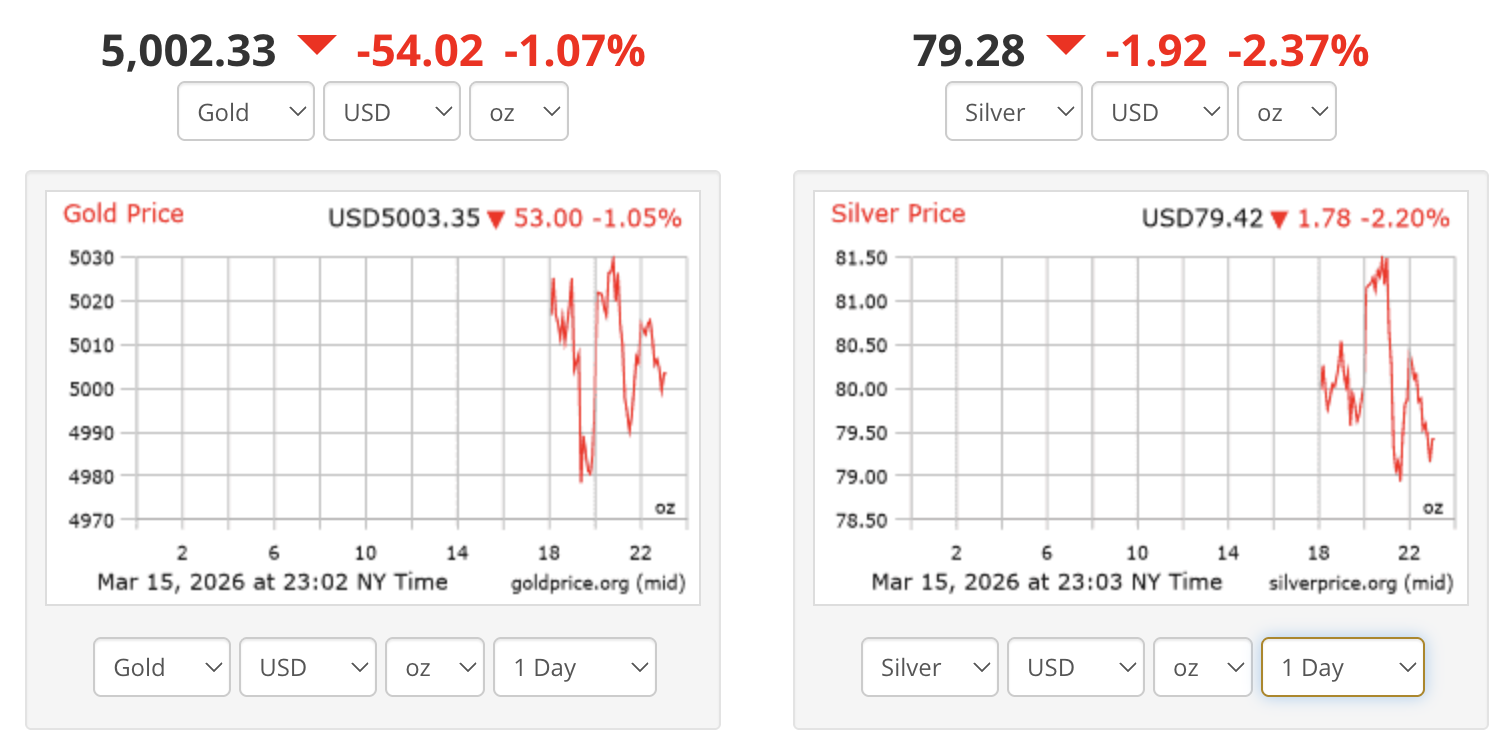
That is not the usual picture traders expect when geopolitical stress and oil-shock headlines are dominating sentiment.
The simplest explanation is that safe-haven demand has not disappeared; it has rotated. In the latest bout of risk aversion, the US dollar has often been the market's first choice, while firmer yields and weaker confidence in near-term Federal Reserve easing have reduced the appeal of non-yielding metals.
Hard catalyst: Oil surged above $100 earlier in the move, reviving inflation concerns and making near-term policy easing look less certain.
Hard catalyst: The US dollar strengthened as markets treated it as the preferred haven during the latest geopolitical shock.
Hard catalyst: Firmer yields reduced the appeal of non-yielding assets such as gold and silver.
Soft catalyst: Traders have been taking profits in metals to raise liquidity elsewhere, a pattern that often appears during stress events.
Soft catalyst: Market volatility remains high due to geopolitical concerns and policy changes.
Gold and silver are slipping because the market is pricing a stronger dollar and stickier real-rate risk more heavily than the usual safe-haven bid. Oil's earlier jump above $100 added to inflation worries, and the policy response now matters almost as much as the geopolitical shock itself.
Silver is being hit harder because it is both a precious metal and an industrial one, so it faces the same dollar and yield pressure as gold, plus extra sensitivity to growth and affordability.
This is the main reason the move looks counterintuitive. Gold usually benefits from fear, but fear does not always send money into gold first. Since the Iran war began, the dollar index has climbed while gold has fallen, suggesting higher rate expectations as the key difference between the two havens.
A firmer dollar and weaker hopes for lower borrowing costs outweighed gold's safe-haven appeal. The current market pricing aligns with that perspective. The dollar index was around 100, and the US 10-year Treasury yield was approximately 4.26% based on the latest data.
That is not an environment that normally flatters non-yielding metals. When traders can hide in both the dollar and higher-yielding US assets, some of the usual gold bid gets crowded out.
The market is also reacting to inflation risk, not just war risk. Oil surged above $100 earlier in the shock, and on March 11, the International Energy Agency said member countries would make 400 million barrels of emergency oil available to the market, the largest coordinated release in its history.
Rather than lifting metals, the oil spike led investors to consider the persistence of inflation and a more cautious response from the central bank. That usually supports the dollar and makes non-yielding bullion less attractive in the short term.
That is why precious metals have sold off even while the news backdrop looks dangerous. The upcoming central bank decisions are a new source of tension, as traders understand that policy language regarding inflation and interest rates can rapidly influence both the dollar and real yields.
Silver is not a pure haven trade. It also trades as a growth and manufacturing metal. J.P. Morgan Global Research indicates that silver's industrial uses will remain a key demand driver in 2026. However, it also warns that rising prices could reduce demand and increase volatility.
That makes silver much more vulnerable than gold when the market starts to worry about tighter policy, slower growth, or reduced affordability for industrial users.
That industrial angle helps explain why silver is down much more sharply than gold over the past week. In simple terms, gold is being hit by the dollar and yields, while the dollar is hitting silver, yields, and growth sensitivity all at once.
The softer side of the move matters too. Last week, gold and silver ETFs surged by up to 7% as the dollar weakened, and traders responded to comments suggesting a potential easing of the Middle East conflict.
A few sessions later, the same market was selling gold and silver because the dollar had firmed again and rate-cut hopes had faded. That is classic fast-money behavior.
In panic phases, investors often sell what has gains to cover losses elsewhere, and gold is one of the easiest assets to liquidate. That does not destroy the long-term case for bullion, but it can absolutely pressure the price for several sessions.
A safer valuation check is to compare today's spot prices with a few defensible historical anchors, rather than over-interpret a single sharp daily move. On that basis, gold remains well above its 2025 average, whereas silver has moved closer to J.P. Morgan's 2026 average price forecast.
| Metric | Gold (XAUUSD) | Silver (XAGUSD) | Why it matters |
|---|---|---|---|
| Latest spot price | $5,011.80 | $79.44 | Current market reference |
| Latest intraday range | $4,968.20 to $5,031.50 | $78.39 to $81.70 | Shows how sharp the daily pullback has been |
| 2025 annual average | $3,431.5 | - | Gold is still far above its 2025 average |
| 2026 bank forecast | - | $81 average price forecast from J.P. Morgan | Silver is trading close to a published 2026 anchor |
| Gold-silver ratio | about 63.1 | - | Silver is still relatively strong versus gold despite the pullback |
The more balanced conclusion is gold's pullback still looks more like a correction inside a strong, longer-term uptrend than a collapse in the bullion thesis. Even after the latest drop, spot gold remains well above the World Gold Council's 2025 annual average of $3,431.5 per ounce.
Silver's decline looks easier to justify on fundamentals because the metal is now trading close to J.P. Morgan's 2026 average-price forecast of $81 per ounce, while still carrying greater industrial-demand sensitivity and higher volatility than gold.
Simply put, silver had moved very fast, and this setback looks more like normalization than thesis failure.
From a technical perspective, both metals are in short-term pullbacks. On the latest Kitco screens, gold traded in a $4,968.20 to $5,031.50 range and silver in a $78.39 to $81.70 range.
| Asset | Latest spot | Near-term support | Range low | Near-term resistance | Range high |
|---|---|---|---|---|---|
Gold |
$5,011.80 | $5,000 area | $4,968.20 | $5,031 area | $5,031.50 |
| Silver (XAGUSD) | $79.44 | $79.00 area | $78.39 | $81.00 area | $81.70 |
For gold, the near-term focus is whether buyers can stabilise the $5,000 area and prevent a deeper move back toward the latest day low. For silver, the tape remains more fragile because the metal is trading much closer to the lower end of its recent daily range.
For bulls, the first requirement is a reclaim of the upper end of the latest range, not just a pause in selling.
For bears, the warning sign is simpler: a clean break below the recent lows would suggest the correction still has room to run.
They are falling because the dollar and rate expectations are overpowering the normal safe-haven bid. Higher oil prices have lifted inflation fears, which have made traders less confident about near-term Fed easing.
Yes, it is the main immediate reason. The dollar has become the safe haven of choice during the latest geopolitical shock, which makes dollar-priced bullion less attractive.
Yes, but the bounce probably needs help from a softer dollar, calmer oil prices, or a more dovish policy tone. Until then, technical rebounds may stay brief and headline-sensitive.
In conclusion, gold and silver are falling not because safe-haven demand has disappeared, but because the market is currently favouring the dollar and pricing in a more cautious rate backdrop.
Investors are more focused on inflation persistence and policy restraint than on the classic safe-haven trade alone. That mix is hurting both metals, with silver taking the bigger hit because it also carries industrial-demand risk.
Disclaimer: This material is for general information purposes only and is not intended as (and should not be considered to be) financial, investment or other advice on which reliance should be placed. No opinion given in the material constitutes a recommendation by EBC or the author that any particular investment, security, transaction or investment strategy is suitable for any specific person.