Published on: 2026-03-10
Updated on: 2026-03-10
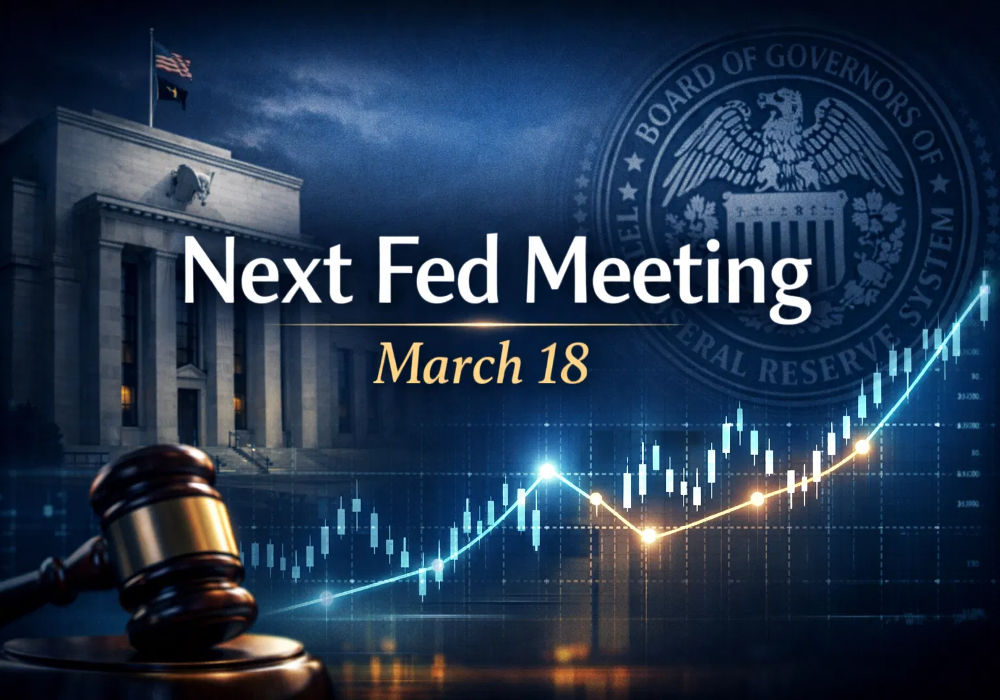
The Federal Reserve's next interest rate decision is set for March 18, 2026, following its two-day meeting on March 17 and 18. The statement will be released at 2:00 p.m. ET, with a press conference scheduled for 2:30 p.m. ET. The federal funds target range is currently 3.50% to 3.75%, and the market is still treating a March cut as a very low-probability event.

FedWatch snapshots indicate a 95.5% to 96.0% probability of holding in March, with only a 4% to 6% chance of a rate cut.
Thus, the more important question is no longer whether the Fed cuts in March. The real question is when the first realistic cut arrives after March. Currently, the answer appears to be that June is the cleanest base case, while July or September remain credible later-cut alternatives if inflationary pressure or energy-driven price risk remains firm.
Overall policy bias: Hold on March 18. The Fed kept rates unchanged in January and said inflation remains somewhat elevated.
Short-term outlook: It is likely a pause, as the CME FedWatch indicates a 95.3% to 96.0% likelihood of no change.
Base case: The first cut is most likely in June if disinflation continues and labour-market weakness broadens beyond temporary distortions.
Alternative path: A July or September cut becomes more likely if oil and inflation risks stay sticky and the Fed wants more confirmation before easing.
Low-probability dovish surprise: A March cut would require a significantly softer inflation reading and a clear decline in labor data before the meeting. That remains possible, but it is not the market's base case.
Key swing factor before the meeting: The February CPI report, scheduled for release on March 11, may affect the outlook ahead of the Fed meeting on March 18. Investors will also receive an updated SEP since March is a Fed projection meeting.
The most positive aspect of the Federal Reserve's outlook is its inflation projection. In January, CPI slowed to 2.4% year-over-year, and core CPI eased to 2.5%. If this trend continues, policymakers may consider rate cuts, though the timing will depend on future inflation data and may not be immediate.
However, the Fed's preferred PCE measure remains elevated, with headline PCE at 2.9% and core PCE at 3.0% in the latest release. This gap suggests rate cuts are unlikely in the near term, as the Fed tends to wait until core inflation is much closer to target.
There is also a timing issue. The latest available PCE data is from December 2025, as the release was rescheduled following the 2025 shutdown. As a result, the March 11 CPI report is especially important, as it is one of the last key inflation indicators before the March 18 decision.
The labour side of the Fed's dual mandate is becoming harder to ignore. February payrolls fell by 92,000, and the unemployment rate rose to 4.4%. That does not force an immediate March cut, but it moves the debate away from "higher for longer" and toward "how long can the Fed wait?"
The Fed will also look through some of the one-off noise. BLS noted that strike activity affected health care employment, suggesting the headline miss may not entirely signal a recession.
Even so, information and federal government payrolls also continued to trend down, which gives the report a broader softening tone.
This is the main reason March remains a hold. The broader economy is not rolling over fast enough. The Atlanta Fed's GDPNow is sitting at 2.1% for Q1. ISM services rose to 56.1, and manufacturing held at 52.4, both above the 50 line that separates expansion from contraction.
The Fed's January statement also said activity had been expanding at a solid pace, while the March Beige Book described growth as slight to moderate across most districts, even though more regions reported flat or declining activity.
That combination is what makes this meeting difficult. Inflation is lower, job growth is slowing, but economic activity remains strong enough for policymakers to wait for more data.
The macro picture is not weak enough to force the Fed's hand, but it is soft enough to keep the easing debate alive. The table below captures the core inputs investors are watching for the March meeting.
These figures reflect the latest official releases and market pricing available ahead of the meeting.
| Indicator | Latest reading | Why it matters for the Fed |
|---|---|---|
| Fed funds target range | 3.50% to 3.75% | Policy is still restrictive |
| Headline CPI | 2.4% YoY | Disinflation continues, but not complete |
| Core CPI | 2.5% YoY | Underlying inflation is still above target |
| Headline PCE | 2.9% YoY | Fed’s preferred gauge remains elevated |
| Core PCE | 3.0% YoY | Strongest argument for patience |
| February payrolls | -92,000 | Labor demand is softening |
| Unemployment rate | 4.4% | Cooling, but not recessionary |
| Average hourly earnings | 3.8% YoY | Wage growth still too firm for comfort |
| Q4 2025 GDP | 1.4% annualized | Growth is slowing materially |
| 2-year Treasury yield | 3.56% | Policy expectations remain restrictive |
| 10-year Treasury yield | 4.12% | Long end still pricing inflation and term premium |
| FOMC meeting | Probability assessment |
|---|---|
| March 17 to 18 | Very low |
| April 28 to 29 | Low |
| June 16 to 17 | Most credible |
| September 15 to 16 | Delay risk |
April is possible, but the market is not treating it as the base case. FedWatch probabilities indicate a 17.3% chance of a cumulative 25-basis-point cut at the April meeting.
That is meaningful enough to keep alive, but far too low to call probable. For April to become the central scenario, the Fed would likely need a clearly softer inflation sequence and another month of weak labour data.
June is the first credible cut window. FedWatch snapshots indicate a 46.8% probability of a cumulative 25-basis-point cut by June. While this isn't a majority, it is significant enough to suggest that the market views midyear as a key decision point.
That timing fits the macro logic. By then, the Fed will have several more inflation prints, additional employment reports, and more evidence on whether the late-2025 growth slowdown is temporary or persistent.
September is the risk scenario, not the base case. If core inflation stalls near current levels, or if energy and service prices keep the inflation trend from moving closer to 2 percent, policymakers can wait longer.
The January CPI report indicated that some persistent components remain, particularly in the shelter and select service categories, despite gasoline contributing positively to the headline number.
February CPI on March 11: This is the last major inflation report before the meeting.
March 18 statement and press conference: The tone matters as much as the rate decision because the market already expects a hold.
Updated SEP: March is one of the Fed's quarterly projection meetings. The dots may matter more than the statement.
Energy and geopolitical risk: Rising oil prices can hinder the progress of cuts, even if the labor market starts to weaken.
Follow-through in jobs data: One weak payrolls report gets attention. Two or three can change policy.
A March 18 cut looks unlikely under current conditions. Market pricing still heavily favors a hold, and the Fed's latest guidance stresses elevated uncertainty, sticky inflation, and a data-dependent approach.
June is the first credible window on current evidence. April remains possible but not probable, because inflation is still above target and wage growth has not cooled enough to make an early cut comfortable.
The February CPI report, scheduled for release on March 11, 2026, is crucial because it arrives one week before the Federal Reserve's decision. This report will help determine whether the Fed views inflation as cooling sufficiently to consider interest rate cuts by mid-year.
In conclusion, the Fed's March 18 meeting still points to a hold rather than a cut. Inflation has improved, and the labor market has softened, but growth and service activity remain firm enough for the Committee to wait for more evidence.
Currently, the most clear answer to "When will the Fed lower interest rates?" appears to be June, with July or September as potential delays.
Disclaimer: This material is for general information purposes only and is not intended as (and should not be considered to be) financial, investment or other advice on which reliance should be placed. No opinion given in the material constitutes a recommendation by EBC or the author that any particular investment, security, transaction or investment strategy is suitable for any specific person.