Published on: 2026-07-08
Updated on: 2026-07-09
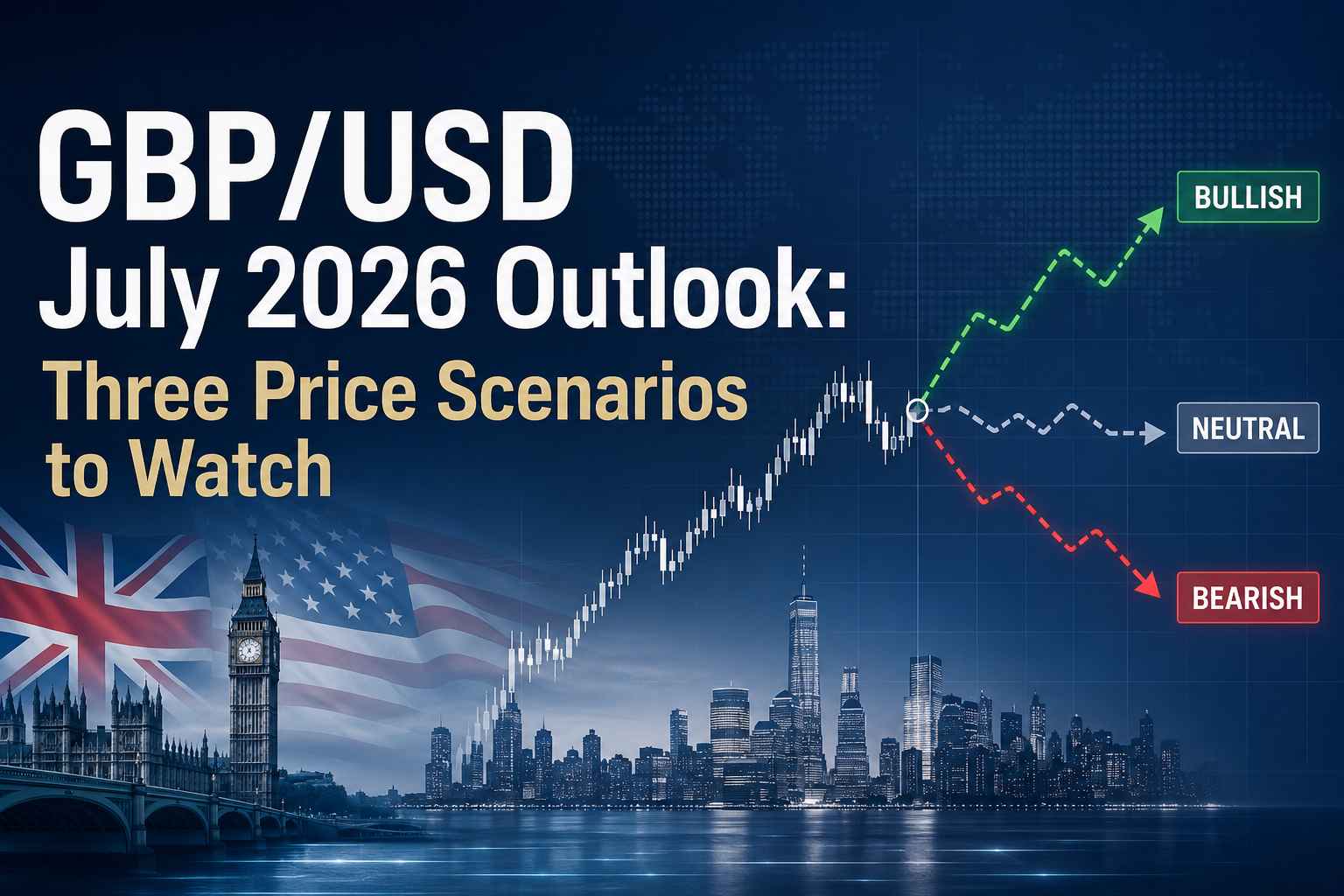
Sticky UK inflation, weakening activity and a mixed dollar backdrop leave cable watching whether 1.35 or the June low near 1.3165 breaks first. GBP/USD begins July around 1.336, below its 2026 average near 1.344 to 1.345, but still above the June low zone around 1.314 to 1.317 and well off the late-January high near 1.382.

That lower-half positioning gives both bulls and bears a case. Sterling still has support from sticky UK inflation and a cautious Bank of England, but softer GDP, labour and services data limit the upside. The cleanest way to read July is through three conditional scenarios rather than one headline forecast.
GBP/USD starts July below its 2026 average near 1.344 to 1.345, but still above the June low zone around 1.314 to 1.317, making 1.35 and 1.3165 the key levels to watch.
The bullish scenario needs sticky UK services inflation, resilient wage growth and a softer dollar to push GBP/USD through 1.35 and toward 1.3650 to 1.3700.
The base case is a choppy 1.32 to 1.35 range because UK inflation remains firm, but GDP, jobs and services activity are weakening.
The bearish scenario depends on weaker UK labour and growth data, with a break below 1.3165 exposing the 1.30 to 1.31 area.
The most important July triggers are UK GDP on 16 July, labour data on 21 July, CPI on 22 July, the Fed decision on 29 to 30 July, and the BoE decision on 30 July.
The three paths below frame July’s main price risks.
| Scenario | Price Zone | Key Support / Resistance | What Has to Happen |
|---|---|---|---|
| Bullish breakout | 1.35 to 1.3650 | Resistance at 1.35 / 1.3550, extension toward 1.3650 to 1.3700 | Services inflation stays sticky, wage growth holds, and the dollar softens |
| Base case range | 1.32 to 1.35 | Support around 1.3200 to 1.3220, resistance around 1.3475 to 1.3550 | Inflation stays firm but growth remains uneven, keeping both the BoE and Fed cautious |
| Bearish breakdown | 1.30 to 1.32 | Break trigger around 1.3165, downside zone 1.30 to 1.31 | Jobs, GDP and the services PMI weaken enough to erode sterling’s rate support |
The pull in two directions is real and measurable. On inflation, the Bank of England held Bank Rate at 3.75% in June by a 7 to 2 vote, with Megan Greene and Huw Pill both voting to hike to 4%, one more hawkish dissent than April’s 8 to 1 vote.
Headline CPI was 2.8% in May, and the Bank expects it to climb again later in the year as the spring energy shock feeds through. Services CPI, the measure the MPC watches most closely, rose to 3.7%, while core CPI sat at 2.6% and goods inflation at 2.0%. In other words, the stickiness is concentrated exactly where it is hardest for the Bank to ignore.
Pulling the other way is activity. Monthly GDP contracted 0.1% in April, dragged down by a 0.2% fall in services output, even as the three-month figure stayed positive at 0.7%.
The labour market is cooling on almost every measure: payrolled employees fell by 138,000 over the year to April and by 53,000 in April alone, the unemployment rate stood at 4.9%, up 0.3 percentage points on the year but down 0.3 points on the quarter; vacancies dropped to 707,000, the lowest since early 2021; and regular pay growth eased to 3.4%.
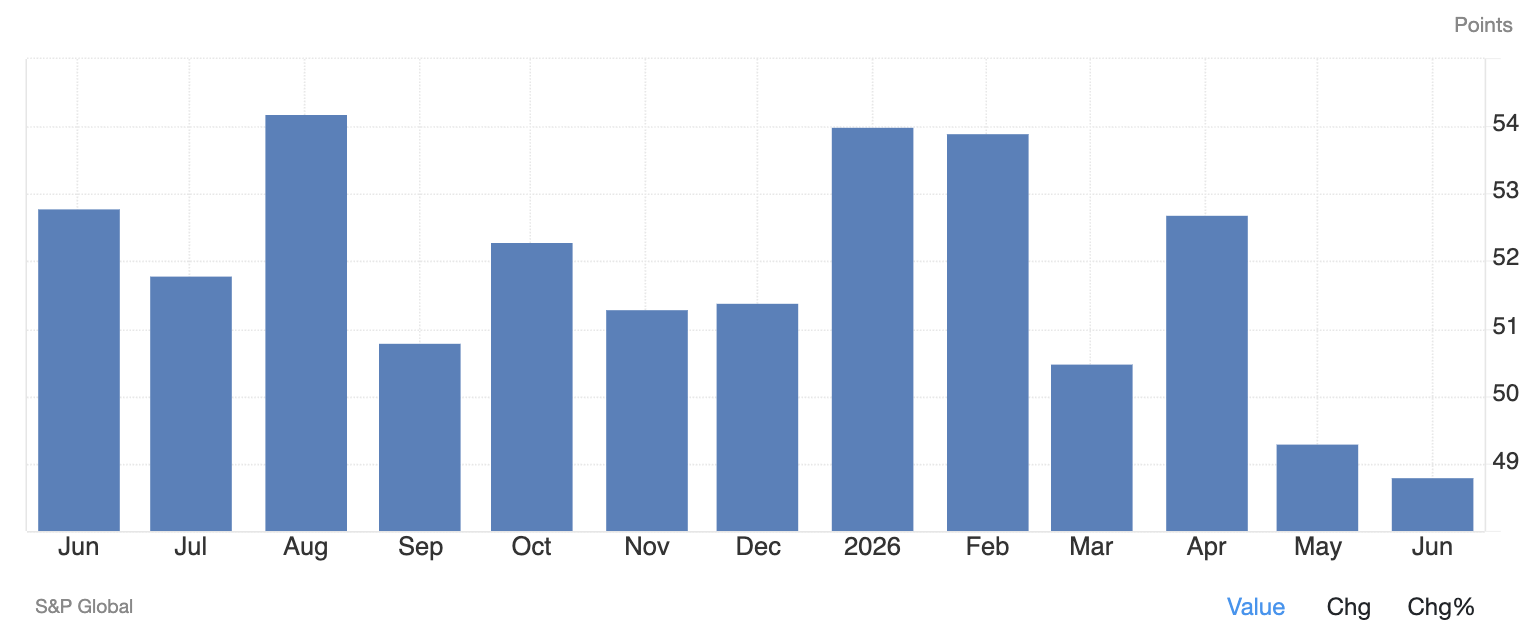
The services PMI, which matters because the UK economy leans so heavily on services, slipped to 48.8 in June, a second month below the 50 line. That is the macro split holding sterling in place.
One backdrop ties both sides together: energy. The Middle East conflict and disruption around the Strait of Hormuz pushed energy risk into inflation pricing before a mid-June ceasefire framework helped pull oil lower. But the Bank still warned that global energy prices remained volatile and above pre-conflict levels, leaving the inflation path uncertain.
The bullish case does not rest on strong UK growth because there is not much of it. It rests on inflation staying sticky enough to keep rate expectations supported while the dollar loses momentum.
That 3.7% services print is the strongest pro-sterling data point available: as long as it holds up, the market can keep pricing a hawkish hold, or even a later hike, and rate differentials lean cable’s way.
The two June dissenters were explicit that they fear the energy shock feeding into wages and price-setting, and every firm inflation reading strengthens their hand.
The confirmation comes from the calendar. If June CPI on 22 July shows services inflation holding, and US inflation or jobs data weaken the dollar into month-end, GBP/USD can test 1.35 first, with a sustained move above 1.3550 offering stronger confirmation before the high-1.36s open up toward 1.3650 to 1.3700.
This scenario needs sticky prices and a soft dollar. One without the other tends to stall around the 1.35 line rather than clear it.
This is the base case, and probably the most likely, precisely because the UK data refuses to resolve. Growth is fading but not collapsing: April’s 0.1% monthly GDP dip sits against a still-positive three-month trend, and retail sales rose 1.2% in May, helped by promotions and warm weather, after a revised 1.0% fall in April. The consumer is wobbling, not breaking.
That mix leaves neither side with enough confirmation. The BoE cannot ignore services inflation, but sterling bulls also cannot ignore weaker output, softer hiring and a sub-50 services PMI.
In this scenario, GBP/USD chops between support around 1.32 and resistance in the 1.3475 to 1.3550 area, reacting to each data release without a sustained close beyond either edge. That is the most realistic outcome if July’s numbers stay as mixed as June’s.
The bearish case is built on the labour market and services, and it is the most data-dependent of the three. The signals are already there: payrolls shrinking by 53,000 in April alone, vacancies at a four-year low, wage growth cooling to 3.4%, and real regular pay barely positive at 0.1%.
The services PMI at 48.8, the sharpest contraction since early 2023, says the economy’s largest sector is shrinking. If wage growth keeps easing and hiring keeps falling, the MPC’s hawks lose their argument, and the rate-support story underpinning sterling weakens with it.
The trigger sequence is specific. If the 21 July labour release confirms more payroll weakness and the 16 July GDP print shows another soft month, cable could break 1.32 and retest the 1.3165 trigger. A decisive move through that June low would open the 1.30 to 1.31 zone and change the character of the whole quarter.
Cable is never only a UK story. The Fed held its funds target at 3.50% to 3.75% in June by a unanimous vote and reiterated that inflation remains elevated relative to its 2% goal. US CPI then jumped to 4.2% year-on-year in May, a three-year high, helped by an energy spike.
Core inflation was a calmer 2.9%. The offset is jobs: June payrolls rose just 57,000, unemployment held at 4.2%, and that soft print recently knocked the dollar back and let sterling rally. The net picture is a dollar that is neither collapsing nor dominant.
Energy-driven inflation keeps a hike on the table, while slowing hiring keeps a cut in the conversation. That is why the GBP/USD outlook stays conditional rather than directional.
The risk is front-loaded into the back half of the month. US CPI on 14 July sets the tone for the dollar. The UK data then lands in quick succession: May GDP on 16 July tests whether April’s weakness carried through, the labour-market release on 21 July covers payrolls, wages and unemployment, and June CPI on 22 July is the single biggest input for BoE pricing.
The month closes with a double-header: the Fed’s decision on 29 to 30 July and the Bank of England’s decision plus a fresh Monetary Policy Report on 30 July.
That last event, with new forecasts and a press conference, is the natural moment for either central bank to signal a change of direction, and the most likely trigger for a break out of the range.
Neither side has full control. Cable is best read as a three-scenario setup, with 1.35 as the upside test and 1.3165 as the downside level to watch.
Services inflation, wage growth, unemployment, GDP and the services PMI matter most. Together, they decide whether the Bank of England leans toward inflation risk or growth weakness.
A sustained close above 1.35, ideally confirmed above 1.3550, backed by sticky inflation or a softer dollar, validates the bullish case. A break below 1.3165, the June low, brings the 1.30 to 1.31 area into focus.
GBP/USD enters the second half of July with a clear decision map. A hold above 1.32 keeps the range intact; a break above 1.3550 gives bulls a cleaner route toward 1.3650, and a move below 1.3165 shifts attention to 1.30 to 1.31.
The deciding factor is whether July’s UK inflation and labour data push the Bank of England back toward price risk or closer to growth concern.
When cable breaks its range, execution matters. Trade GBP/USD with EBC Financial Group; institutional-grade liquidity, tight spreads and fast execution averaging around 20ms across MT4 and MT5.