Published on: 2026-07-07
Updated on: 2026-07-07
TeraWulf stock is being repriced after a 20-year Anthropic deal expected to generate about $19B in contracted revenue, its largest AI infrastructure commitment to date.
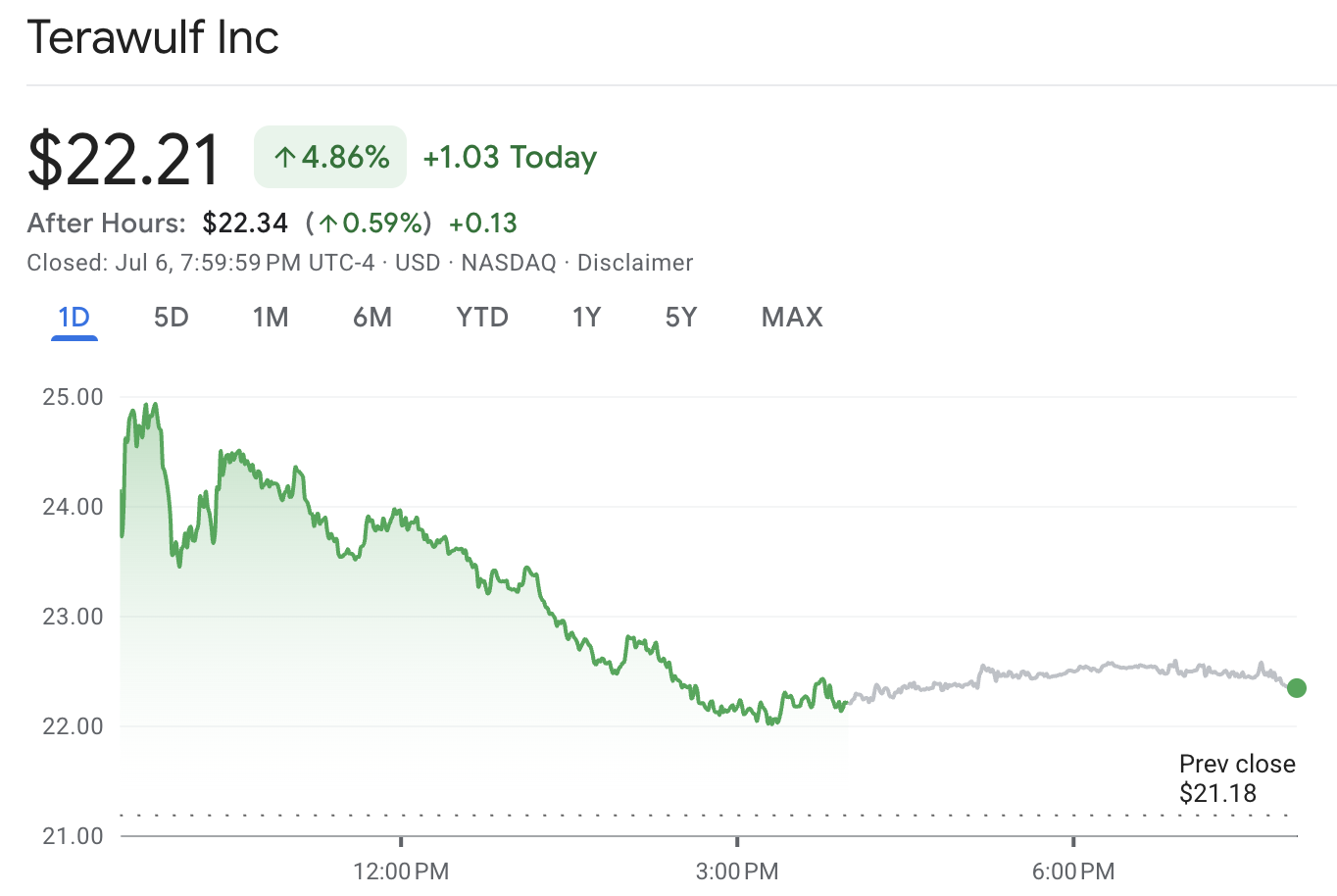
WULF stock rose about 4.8% on the day the Anthropic deal was announced, closing near $22.21.
The $19B AI deal covers TeraWulf’s Justified Data campus in Kentucky, an AI data center built to support about 401 MW of critical IT load.
Initial capacity is expected in H2 2027, with full ramp targeted by early 2028.
The TeraWulf Anthropic lease shifts the WULF stock narrative from bitcoin miner to AI infrastructure operator.
For WULF stock, the main risks are now execution, financing and data center power delivery rather than only bitcoin volatility.
TeraWulf stock is being pulled into the AI trade, but the core asset behind the $19B Anthropic deal is power.
The shares rose about 4.8% on the day the lease was announced [3]. WULF is no longer judged only as a bitcoin miner. Investors are now asking a different question: can TeraWulf turn access to energy into durable, long-term AI infrastructure revenue?
On July 6, 2026, TeraWulf announced a 20-year lease with Anthropic at its Justified Data campus in Hawesville, Kentucky. The agreement is expected to generate roughly $19B in contracted revenue, tied to a campus designed to support about 401 MW of critical IT load [1][2].
| Detail | Anthropic Lease |
|---|---|
| Tenant | Anthropic PBC |
| Site | Justified Data campus, Hawesville, Kentucky |
| Lease term | 20 years, with extension options of up to 10 additional years |
| Contracted revenue | Approximately $19B over the initial lease term |
| Capacity | Approximately 401 MW of critical IT load |
| Development | Phased build-out |
| Initial capacity | Expected in late 2027 / H2 2027 |
| Full ramp | Expected by early 2028 |
| Credit support | Payment obligations expected to be supported by an investment-grade credit |
| Implied annual revenue | Approximately $950M per year, based on straight-line averaging |
| Implied revenue density | Approximately $2.37M per MW per year, or about $197 per kW per month |
That announcement forces a reset in how the stock is evaluated. Bitcoin miners are usually priced on hash rate, the bitcoin price and operating costs, while infrastructure companies are valued on power access, tenant quality, contract duration and the ability to execute.
TeraWulf now sits between those two frameworks, and the early trading reflected the tension. WULF closed July 6 at $22.21, up about 4.8%, after touching an intraday high of roughly $27.48 before drifting back [3]. That fade from the highs suggests investors can see the opportunity clearly without yet being convinced the company will deliver on it.
The Anthropic agreement is being framed as an AI partnership, though the asset that actually underpins it is physical infrastructure rather than software or models. AI workloads need land, cooling, transmission capacity and, above all, reliable power delivered on schedule, and without that foundation the rest of the stack does not function.
The market is starting to value TeraWulf as a supplier of that infrastructure layer rather than as an AI developer, and the distinction carries real weight for the multiple.
If WULF keeps being treated as a bitcoin miner, its valuation stays tethered to crypto cycles; if the market leans toward the infrastructure read, attention moves to contract durability, tenant credit and long-term cash flow.
The company is clearly encouraging the second interpretation, positioning itself around large-scale infrastructure for AI and high-performance computing, built on power availability and scalable campus development [1].
The $19B headline is large, but the underlying math gives it clearer shape. Spread over 20 years, the lease implies roughly $950M in annual contracted revenue. Across 401 MW, that works out to about $2.37M per MW per year, or approximately $197 per kW per month.
Framing it this way moves the conversation past the headline number. Investors can start to weigh how much revenue each megawatt is expected to produce and whether that revenue can turn into meaningful cash flow.
That figure is revenue, not profit, and it says nothing about capital expenditure, operating and power costs, financing terms or the risk of delay. The question that matters is whether TeraWulf can build and run the infrastructure at a cost that leaves attractive margins once all of that is accounted for.
Alongside the Anthropic announcement, TeraWulf disclosed that it is selling its 50.1% stake in the Abernathy Joint Venture to a group led by Fluidstack. The project was developing a 168 MW AI data center campus in Texas.
TeraWulf said the sale monetizes its approximately $450M investment at a premium, while the Form 8-K lists aggregate consideration of about $530M, payable in installments [1][2]. That capital is earmarked for redeployment into wholly owned projects.
This reads as more than a portfolio adjustment. Joint ventures can limit control and dilute long-term returns, so by concentrating on assets it fully owns, TeraWulf is setting itself up to keep more of the economics that AI infrastructure generates.
If it can repeat that pattern across several campuses, the company starts to look like an infrastructure platform rather than a legacy crypto miner.
For now, WULF trades on expectations rather than any current earnings from the Anthropic deal. Initial capacity is not due until the second half of 2027, with full ramp in early 2028 [1][2], so investors are effectively pricing future execution into the stock today.
That changes the character of its volatility. Instead of moving mainly with the bitcoin price, the shares now respond to assumptions about construction timelines, financing conditions and long-term contract performance.
The early reaction captured that shift: the scale of the deal drove the enthusiasm, but the long lead time leaves the valuation sensitive to any hint of delay or cost pressure.
TeraWulf’s risk profile has changed without disappearing. The earlier worry was bitcoin exposure, since mining economics can turn quickly on price, network difficulty and energy costs. The risks now are more operational and financial.
The company has to deliver large-scale data center capacity on time, secure equipment, manage power supply and keep construction costs in check, and financing is just as important given the heavy upfront capital these projects demand.
The Anthropic lease improves visibility, but it does not guarantee returns; TeraWulf still has to convert contracted revenue into operating assets and sustainable cash flow.
The next phase of the story will come down to execution, and three variables stand out. Financing is the first, since the structure and cost of capital will decide how much of the contracted revenue ultimately reaches shareholders.
Construction progress is the second, with milestones on site development, power delivery and build-out showing whether the campus is on track. Customer expansion is the third: further leases or expansions with Anthropic would reinforce the infrastructure narrative, while their absence could leave the stock trading with a hybrid identity still tied to its mining past.
The stock moved higher because the lease introduces a large, long-term revenue stream tied to AI infrastructure, expanding the company’s valuation story beyond bitcoin mining.
TeraWulf has mining roots, but its strategy is shifting toward AI and high-performance computing infrastructure, with power and data centers becoming central to the business.
It secures a major AI customer under a long-term contract and highlights how much AI growth now depends on power and deliverable data center capacity.
The main risks are construction delays, financing costs, power availability and whether the project delivers the expected returns once expenses are counted.
TeraWulf stock is no longer just a bitcoin-mining story. The $19B Anthropic deal marks a shift toward power-driven AI infrastructure, where grid access and data center capacity are the assets that carry the value.
The opportunity is significant, though far from guaranteed. TeraWulf still has to deliver its Kentucky campus on schedule, manage costs and secure financing on workable terms. The market has recognized the potential, but the long-term value will depend on execution.
TeraWulf Inc., Investor Relations, “TeraWulf Announces Anthropic Lease at Justified Data Campus and Sale of Majority Interest in Abernathy Joint Venture to Fluidstack,” July 6, 2026.
TeraWulf Inc., Form 8-K, current report filed July 6, 2026, including the Justified Data campus lease and Abernathy transaction details.
WULF market data, latest available stock price, intraday high/low and market capitalization, July 6, 2026.