Published on: 2025-04-23
Updated on: 2025-11-03
The British pound sterling (GBP) has shown notable strength against the U.S. dollar (USD) through 2025, driven by diverging central-bank policies, resilient UK capital flows, relative inflation dynamics, and shifting investor positioning.
In short, the market is presently favouring GBP due to a combination of policy differences, unexpected data, and capital flows, rather than one specific macroeconomic event.
The article below explains the primary drivers sustaining the GBP's strength relative to the USD with the latest data, economic insights, and central bank policies.
| Metric / Policy | Latest Data (as of Oct 31, 2025) | Details |
|---|---|---|
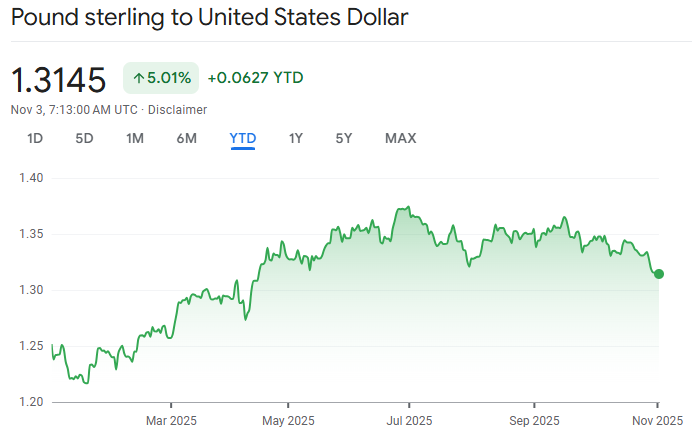
| Spot Rate (GBP/USD) | ≈ 1.315 | — |
| Recent Range | 1.29 – 1.34 | — |
| Bank of England (BoE) Policy | Rate: 4.00% | Cut from 4.25% on Aug 7, 2025 (5–4 vote); held in Sept (7–2 vote) [1] |
| Federal Reserve Policy | 3.75% – 4.00% | Cut by 25 bps in Oct 2025; further easing possible |
| U.K. Inflation (CPI) | 3.8% (Sept 2025) | Unchanged from Aug; nearly double BoE’s 2% target |
These policy and inflation dynamics create a relative yield advantage favoring GBP, at least in the near term.
Currencies ultimately reflect where investors expect real yields to go.
Since mid-2025, markets have shifted sharply toward expecting deeper U.S. rate cuts, while believing the BoE will remain restrictive longer due to stubborn UK inflation.
Carry dynamics: If U.S. yields fall faster than UK yields, GBP assets become more attractive, prompting inflows.
Yield-curve effects: The October Fed cut steepened U.S. short-term curves and diminished the dollar's yield advantage.
Market pricing: Futures now suggest at least two additional Fed rate cuts in the first half of 2026, while the BoE's trajectory is less certain and more gradual, supporting sterling. [2]
Although elevated inflation often weakens a currency, high real yields can have the opposite effect.
With the UK CPI at 3.8% and the policy rate at 4%, real short-term yields remain positive, unlike in the U.S., where real yields have declined following recent reductions.
BoE's cautious stance: Policymakers remain reluctant to ease prematurely; MPC member Catherine Mann even opposed the August cut, warning inflation may prove persistent.
Market takeaway: Investors expect the UK to deliver stronger real returns in the near term, enhancing its attractiveness.
The pound also benefits from cyclical risk-on flows and portfolio adjustments:
Foreign portfolio inflows: Increased investor enthusiasm for UK energy, infrastructure, and financial shares has bolstered the value of sterling.
ETF and index rebalancing: Passive funds increasing UK exposure generate mechanical GBP demand.
USD positioning: The Fed's October cut triggered a broad unwind of crowded long-USD positions, lifting the pound.
In short, when global investors add risk exposure, GBP-denominated assets attract a share of those inflows.
Trade flows and commodity dynamics subtly support sterling:
Energy and regional balance: Stable European energy prices and improved trade receipts reduce risk premia on European currencies, including GBP.
Services exports: The UK's services-heavy economy benefits from global recovery, especially in finance, tourism, and professional services.
Relative growth: Stronger-than-expected U.K. PMI and retail data in Q3 2025 have surprised to the upside versus U.S. metrics, modestly reinforcing the currency.
FX markets are often path-dependent, and technical positioning can amplify fundamental moves:
Unwinding of long-USD trades post-Fed cut
Stop-loss and options clusters near key GBP/USD levels (e.g., 1.30, 1.34)
Liquidity factors at month-end and quarter-end rebalancing
These momentum dynamics magnify rallies but can also reverse quickly if data or sentiment shift.
| Date | GBP/USD Estimate | Key Drivers |
|---|---|---|
| Jan 2025 | ~1.22 | Post-pandemic recovery baseline |
| Jun 2025 | ~1.34 | BoE rate hikes; Fed pause |
| Oct 2025 | ~1.31 – 1.34 | Fed cut → USD softness; sticky UK inflation |
| Forward View (2026) | 1.33 – 1.38 (forecast) | Policy divergence; capital flows; technicals |
Two concrete events illustrate the events:
October Fed cut to 3.75–4.00% reduced short-term U.S. yields and raised the probability of further cuts; markets sold USD and bid up risk assets. GBP rose as a direct FX reaction.
UK inflation stickiness (Sept CPI ~3.8%) kept the BoE on a cautious path, supporting sterling by preserving UK real yields relative to the U.S. even as the Fed eased. [3]
As a result, GBP/USD traded near 1.315 on Oct 31 2025, within its yearly range.
2025 high: ~1.3789 (on July 1, 2025).
2025 average: ~1.3176
Sterling's rally is conditional. Key downside triggers include:
BoE signals earlier-than-expected cuts
U.S. data surprises that reflate the dollar
UK fiscal shocks or political risk
Commodity or external shocks that drive safe-haven USD flows
Positioning unwind
Not permanently. Short-term yield and sentiment dynamics favour GBP, but long-term fundamentals (growth, productivity, fiscal position) still favour the USD.
Markets anticipate possible easing by mid-2026, yet ongoing 3.8% inflation makes the BoE wary in the short term.
Analysts see moderate further gains as possible, but risks such as UK political uncertainty or a global slowdown could limit appreciation.
In conclusion, sterling's strength against the dollar in late 2025 reflects a mix of policy dynamics and market positioning. However, this does not imply a lasting one-way trend, as unexpected data or policy shifts could quickly reverse the direction.
For traders and treasurers, the most effective strategy is to focus on the five key watchlist items, size positions prudently, and employ hedges that guard against sudden reversals.
Disclaimer: This material is for general information purposes only and is not intended as (and should not be considered to be) financial, investment or other advice on which reliance should be placed. No opinion given in the material constitutes a recommendation by EBC or the author that any particular investment, security, transaction or investment strategy is suitable for any specific person.
[1] https://www.bankofengland.co.uk/monetary-policy-summary-and-minutes/2025/september-2025
[2] https://www.reuters.com/business/fed-in-fog-it-heads-toward-another-rate-cut-2025-10-29/
[3] http://reuters.com/world/uk/uk-inflation-holds-38-september-2025-10-22/