Published on: 2026-08-18
Updated on: 2026-08-18
Headline regular pay rose to 3.5%, but private-sector pay slowed to 2.8% while public-sector pay accelerated above 6%. The two components moved in opposite directions.
Unemployment held at 4.9% rather than edging down as consensus expected, with payrolled employment 78,000 below a year earlier.
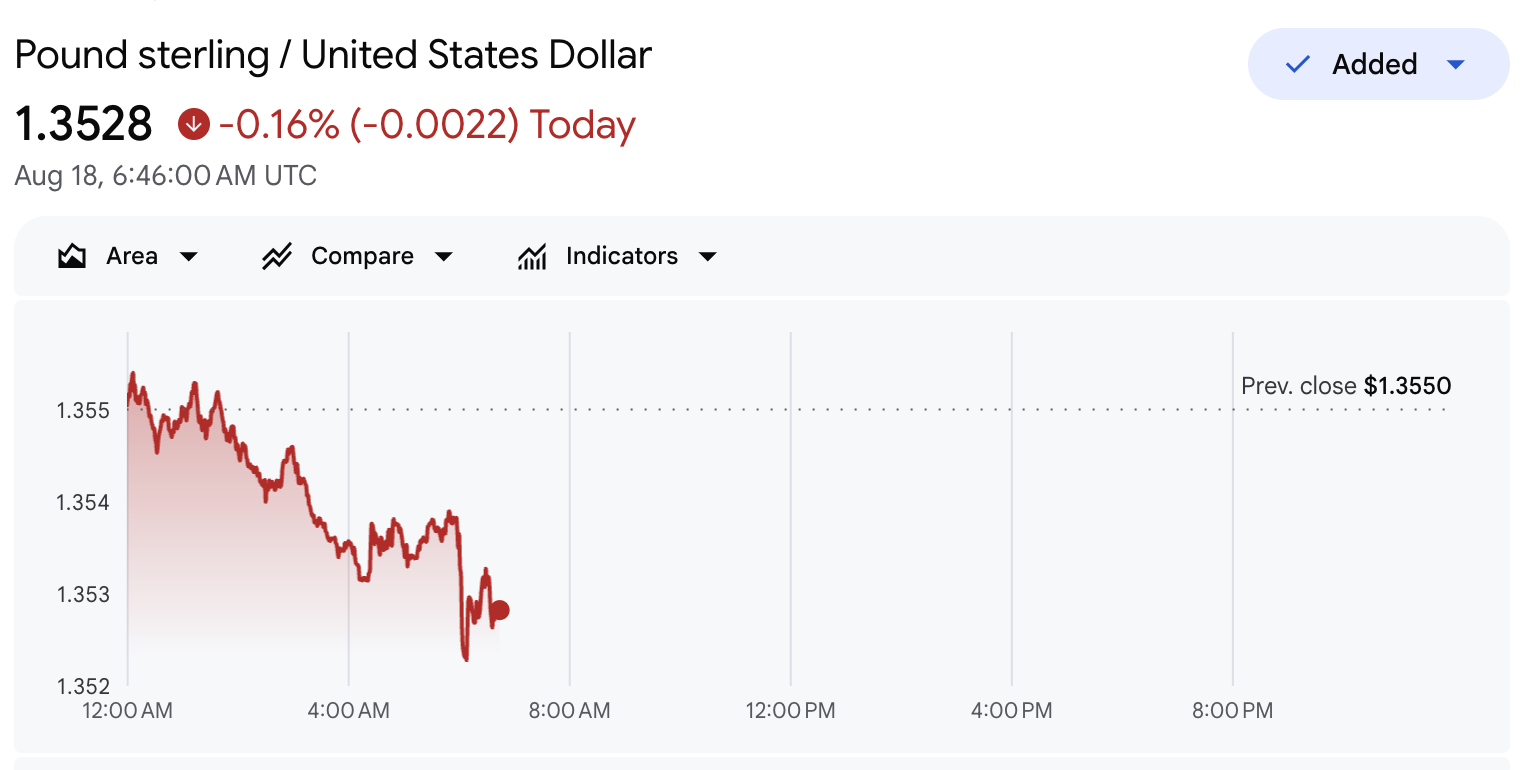
GBP/USD is holding 1.3500 without extending Monday’s breakout, leaving the level intact but unconfirmed.
The Bank’s hawkish minority now has a headline number that supports it and a private-sector number that does not.
UK wage growth accelerated this morning, and the pound went nowhere. Both facts trace to the same release, and the number doing the work is not the one in the headline.
Regular pay rose to 3.5% in the three months to June, which on its own reads as a point for the Bank of England’s hawks. The composition undercuts it. Private-sector pay slowed again to 2.8% while the public-sector rate accelerated above 6%, meaning the acceleration everyone will quote came from the timing of state pay awards rather than from employers competing for staff. GBP/USD sits near 1.3524, a fraction below Monday’s three-month peak at 1.3571, holding 1.35 without earning much more.

| Indicator | Latest | Prior |
|---|---|---|
| Unemployment rate | 4.9% | 4.9% |
| Regular pay, excluding bonuses | 3.5% | 3.4% |
| Private-sector regular pay | 2.8% | 2.9% |
| Public-sector regular pay | Above 6% | 5.5% |
| Payrolled employees, y/y | -78,000 | -71,000 |
| Vacancies | ~707,000 | 712,000 |
Unemployment held at 4.9% rather than edging down as consensus had leaned, payroll employment stayed 78,000 below where it was a year ago, and vacancies slipped again to their lowest in several years, extending a decline that has run with barely a pause for two years.
None of that describes a labour market in distress. It describes one that stopped deteriorating quickly some months ago and has not started recovering, which is roughly where the Bank expected to find it. What makes the release worth reading twice is the split underneath the pay line.
A public-sector rate above 6% against a private rate of 2.8% is doing all the work in that 3.5% headline. Public pay reflects the timing of settlements and awards rather than any competitive pressure for staff, which is why the ONS attaches the same caveat to the series month after month. Private pay is the number that responds to how hard employers are actually having to bid, and it has now fallen for a second consecutive reading.
The Committee’s interest in that distinction is not academic. With UK productivity growth close to zero, nominal pay growth passes into unit labour costs almost one for one, and unit labour costs set the floor under services inflation. Services is the domestically generated component of the index, the part policy can actually reach, so private pay that keeps sliding is services inflation losing its underpinning.
Against the Bank’s central estimate of roughly 3.25% for wage growth consistent with 2% inflation, 2.8% sits clearly below the line, which would settle the argument if the Bank read the raw number. It does not.
Average weekly earnings is a mean across employees rather than a measure of what anyone is paid, and the ONS notes the series reflects changes in workforce structure as much as pay rises, so a shift in industry mix toward lower-paying sectors drags the average down when no individual wage has moved.
The June minutes put that compositional drag at around half a percentage point, which lifts 2.8% back to roughly 3.3% and leaves adjusted private pay sitting almost exactly on the target-consistent rate rather than beneath it.
The Bank held Bank Rate at 3.75% on 30 July for a fifth consecutive meeting, but the vote tightened to 6-3 from 7-2 in June, with Megan Greene, Catherine Mann and Huw Pill preferring an immediate move to 4.00%.
Their case was never built on the current inflation print, which fell to 2.6% in June. It rested on second-round effects: whether firms raise prices and workers seek larger settlements once the energy shock works through, and on the July projection of headline inflation climbing back toward 3.2% later this year.
This morning hands that argument a headline it can cite and a private-sector series it cannot, which is why Wednesday’s consumer price data will settle more than the jobs report did. Services inflation is the line to watch there, for the same reason private pay is the line to watch here. The next decision comes on 17 September.
Cable reached 1.3571 on Monday without domestic help, and the reason lies in Washington. July US retail sales fell 0.6%, the first monthly decline in nine months, with sales excluding motor vehicles down 0.3%. The producer price and consumer sentiment readings either side of them pointed the same way, sentiment dropping to 51.0 from 55.2.
Money markets now price roughly 21 basis points of Federal Reserve tightening through year-end, with September odds around a third against roughly half a week earlier.
Spot rates respond to revisions in the expected policy path rather than to the level of rates, which is why that repricing moved cable while the Bank of England did nothing at all, and why the minutes of the 29 July meeting on Wednesday afternoon carry more weight for this pair than they would in a quieter month.
| Technical Reading | Level |
|---|---|
| Daily RSI (14) | Near 65 |
| Immediate support | 1.3500–1.3504 |
| Secondary support | 1.3416 |
| Deeper support | 1.3378 |
| Immediate resistance | 1.3600 |
The former descending trend line sits around 1.3504, converging with the psychological figure to make 1.3500 the level that defines the week. Holding it through a mixed domestic print is a modest point in sterling’s favour, though failing to extend on it is the more telling detail, and momentum near 65 leaves room in either direction without pointing decisively.
Our July outlook identified 1.3475 to 1.3550 as the zone cable had to clear before a larger move could develop. The pair traded through the upper edge on Monday and has not established distance above it since, which is the cleanest summary of where this rally stands. EUR/GBP near 0.855 supports reading the advance as a dollar move rather than a repricing of the pound.
The vulnerability is the source of the rally itself. If US employment or inflation data revive September hike expectations, the differential that lifted cable narrows quickly and without reference to anything happening in Britain, which is the risk in holding a currency that rose on someone else’s numbers.
Wednesday’s UK inflation print cuts the other way, because a cooler reading alongside private pay at 2.8% would leave the hawkish trio arguing from a headline everyone can see is a public-sector artefact.
Energy sits behind both. Traffic through the Strait of Hormuz has collapsed to a handful of crossings a weekend, down from more than a hundred vessels a day before the conflict, and while that has not yet reached the inflation data, it is precisely the channel the dissenting members have been warning about.
The dollar handed sterling 1.35. This morning’s data gave its first answer, and it was not a clear one.