Published on: 2026-08-17
Updated on: 2026-08-17
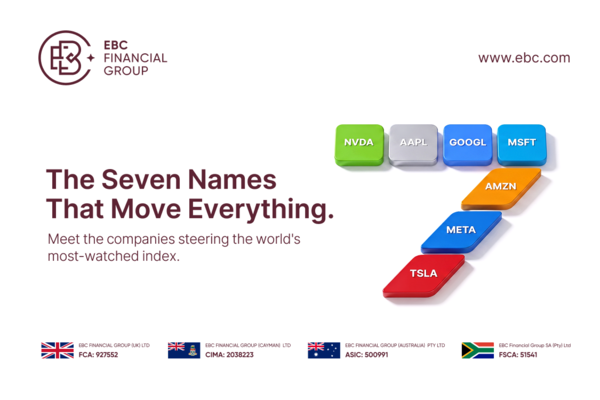
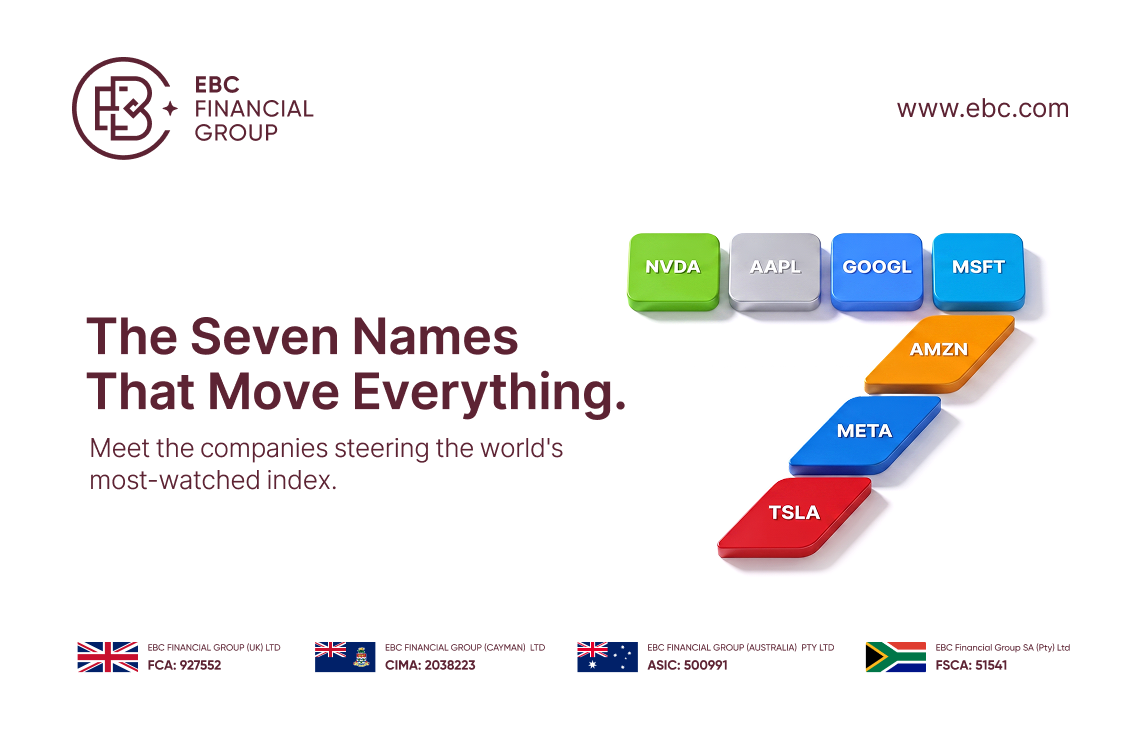
Seven companies that account for roughly one-third of the entire value of the United States’ S&P 500 index, the US’ top 500 listed companies. Roughly one dollar in every three invested into the S&P 500, is dedicated to tracking the fortunes of just these stocks: Apple, Microsoft, Alphabet, Amazon, Nvidia, Meta and Tesla. Markets call them the Magnificent Seven; a title coined during the technology rally of the early 2020s.
What’s the key takeaway here? Simply put, it’s a matter of weight watching. A portfolio that appears to be diversified across five hundred businesses may perform like a portfolio heavily dominated by seven. When the seven perform well, the index may be lifted accordingly. When they don’t, the index may drop even on days when many of its members are rising.
In this article we delve into various ideas, including how the Magnificent Seven gained outsized influence over major US indices, why shared expectations might pull these different businesses in similar directions, and the nature of broad-market exposure.
A broad US market fund could hold hundreds of companies, yet its daily direction can depend heavily on a much smaller group. The companies commonly called the Magnificent Seven are Alphabet, Amazon, Apple, Meta, Microsoft, Nvidia, and Tesla.
In the SPDR S&P 500 ETF Trust holdings, those seven companies, counting both Alphabet share classes, represented roughly one-third of the entire index fund, across mid-2026. This is one of the reasons why moves concentrated in a few companies may influence the wider benchmark followed around the world.
Their influence arises from index construction. The S&P 500 is weighted by float-adjusted market capitalisation, so companies with a larger value in publicly available shares receive a larger weight. A one-day move in a very large constituent would therefore have greater effect on the index than the same percentage move in a much smaller constituent.
This structure has allowed investors to participate when the largest companies have led the market. It also concentrates more of the index in the companies whose valuations have already risen the most. As a company’s valuation climbs, its market value, and therefore its weight in the index, rises with it, subject to the index rules and changes in public float.
The Magnificent Seven falls under the general label of “Big Tech”, but the nature of these businesses and how they profit are seven distinct stories of success.
Apple combines consumer hardware with a large services business. Its reported sales categories are iPhone, Mac, iPad, wearables, Home and Accessories, and Services. Most of its revenue comes from premium hardware, with high-margin services such as the App Store, Apple Music, iCloud, and Apple Pay reinforcing and monetising the wider ecosystem. Among the Magnificent Seven, Apple stands apart in the AI race. Rather than committing hundreds of billions of dollars to hyperscale infrastructure, it has focused on on-device AI, its Private Cloud Compute architecture, and partnerships with frontier model providers such as OpenAI, integrating advanced capabilities into its products instead of building data centre capacity on the industrial scale of Microsoft, Amazon, Alphabet, or Meta.
Microsoft reports through Productivity and Business Processes, Intelligent Cloud, and More Personal Computing: giving investors exposure to Microsoft 365, LinkedIn, Dynamics, Azure, Windows, gaming, search, and devices. Its early partnership with OpenAI placed it at the centre of the generative AI build-out, and it has since become one of the largest corporate backers of AI infrastructure. It has committed roughly US$180 billion in capital expenditure for 2026 to expand data centres, networking capacity, and AI accelerators.
Alphabet reports Google Services, Google Cloud, and Other Bets. Google Services covers Search, YouTube, Android, Maps, Play, devices, subscriptions, and advertising, while Google Cloud spans infrastructure, platforms, Workspace, and other enterprise services. The parent of Google and YouTube still earns most of its revenue from digital advertising, but heavy spending on AI infrastructure, including Google Cloud, data centres, custom chips, and Gemini, has made it one of the sector's biggest capital spenders, with guidance of up to US$205 billion for 2026.
Amazon spans online and physical retail, advertising, subscriptions, logistics, and Amazon Web Services, reporting across three segments: North America, International, and AWS. The business has always been capital-intensive, built upon continuous investment in fulfilment networks, logistics, and AWS. AI has added a further layer, with up to US$220 billion in capital expenditure committed for 2026 to expand data centres, custom chips, and cloud capacity.
Meta reports Family of Apps and Reality Labs. Family of Apps includes Facebook, Instagram, Messenger, WhatsApp, and related services, while Reality Labs covers virtual and augmented reality hardware, software, and content. Advertising accounts for the overwhelming majority of Meta's revenue. To strengthen those advertising systems and expand consumer products such as Meta AI and the Llama models, it has committed roughly US$120 billion in capital expenditure for 2026 to build out data centres, networking, and AI compute.
Nvidia reports Compute and Networking alongside Graphics. The first segment covers data-centre accelerated computing, networking, AI software, and automotive platforms. The second covers gaming and professional graphics. Nvidia holds a distinct position among the Magnificent Seven. Much of the capital that Microsoft, Amazon, Alphabet, Meta, and other hyperscalers pour into AI data centres flows back to Nvidia through its sales of AI chips and systems. Rather than competing directly in the infrastructure spending race, Nvidia supplies much of what it runs on.
Tesla reports two segments: Automotive, Energy Generation, and Storage. The business also spans charging, insurance, used vehicles, services, autonomous-driving software, and robotics. Those lines have driven sustained investment in AI computing, robotics, and manufacturing capacity.
Market-cap weighting does not treat every company equally. When the largest constituents rise, their gains may lift the index even when many smaller companies are flat or falling. When those same constituents decline together, strength elsewhere may be insufficient to offset their decline.
An equal-weight version of an index answers a different question. S&P Dow Jones Indices gives every constituent in its equal-weight indices the same weight at the relevant rebalance, rather than weighting each company by float-adjusted market value. Comparing capitalisation-weighted and equal-weighted performance may therefore help to reveal whether the largest companies or the typical constituent is driving the move.
This tends to affect a broad fund’s valuation. Owning a fund that follows the S&P 500 provides exposure to many industries and companies, but the contribution from each holding is uneven. The number of names in the fund does not describe how much each name influences the result.
The Magnificent Seven does not follow any one single business model. They include consumer devices, enterprise software, cloud computing, digital advertising, semiconductors, online retail, electric vehicles, and energy storage. Even so, several of them may become linked when investors focus on similar assumptions.
AI has been central to the Magnificent Seven narratives. Microsoft said the scaling of AI infrastructure affected its cloud gross-margin percentage in the 2025 financial year. Alphabet reported US$91.4 billion of capital expenditure in 2025, primarily for technical infrastructure. Amazon attributed part of its AWS cost growth to additional technology infrastructure, and Meta listed AI and infrastructure capacity among its 2026 investment areas.
On the other side of that spending sits Nvidia. Its filing says that fiscal 2026 revenue growth was driven by data-centre computing and networking for accelerated computing and AI, while also warning that customers need sufficient data-centre capacity, energy, and capital to continue building out the infrastructure.
This has resulted in an entire chain of market expectations. Cloud companies spend on data centres and chips; Nvidia and other suppliers depend on that demand; and finally, the market gauges if new AI products can produce enough revenue and profit to justify the costs. A change in confidence at one point in the chain can affect valuations across several companies. Apple’s reported sales remaincentered around devices and services, while Tesla’s reported segments are automotive and energy. Their shares may still respond to AI enthusiasm, interest rates, and market sentiment, but their immediate operating drivers differ from those of a cloud platform or semiconductor supplier.
Investors tend to compare a company’s reported figures with the assumptions already reflected in its share price. Revenue may rise while the share price falls if: margins weaken; spending increases faster than expected, guidance is reduced, or the expected payoff moves further into the future.
Capital expenditure makes this risk especially acute. Money spent on servers, data centres, networking equipment, factories, and other long-lived assets can support future capacity, but it also uses cash before the investment has proved that it can earn an acceptable return. The market therefore examines both the size of the spending and management’s explanation of how it will generate future revenue or lower costs.
This is why an earnings report cannot be judged by revenue alone. Operating margins, free cash flow, capital-spending plans, product demand, and management guidance may affect valuations, not just the headline sales figure. The larger the expectations built into the valuation, the less room there may be for delays or weaker returns.
Holding a position in one company concentrates on the outcome of that company’s earnings, products, management decisions, regulations, and valuation. The connection to the other six may be strong during market-wide technology moves, but company-specific news could still produce different outcomes.
A fund or product following the S&P 500 spreads exposure across many sectors, although its largest constituents retain greater influence. The Nasdaq-100 follows 100 of the largest non-financial companies listed on Nasdaq and uses a modified capitalisation-weighted approach, so it also provides substantial exposure to large technology and growth companies.
A product focused on the Magnificent Seven removes much of the broader market exposure. For example, the Roundhill Magnificent Seven ETF offers equal-weight exposure to the seven companies and rebalances quarterly. That structure distributes weight differently from the S&P 500, but it remains concentrated in seven names and a limited set of themes.
Contracts for difference, or CFDs, may be used to follow the price of an individual stock or ETF without owning the underlying asset. CFDs use leverage, so a smaller deposit controls a larger position,and both gains and losses are magnified. The choice between a company, a broad ETF, and a concentrated basket changes the source of risk even when several of the same names appear in each.
| Check | Question |
|---|---|
| Weight | How much of the product is allocated to each company? |
| Overlap | Do several holdings depend on the same AI, cloud, advertising, consumer, or interest-rate assumptions? |
| Method | Is the product market-cap weighted, modified market-cap weighted, or equal weighted? |
| Instrument | Does it provide ownership, or does it follow the price through leveraged derivatives such as contracts for difference (CFDs)? |
| Costs and Risks | What spreads, commissions, overnight charges, margin requirements, and loss limits apply? |
EBC is currently offering zero commission and zero swaps on eligible US Stock and ETF CFDs during the campaign period from 12 June to 11 September 2026 (UTC+3). Official campaign rules, product and regional availability, order limits, position limits, platform conditions, and rules for positions opened or closed outside the campaign period apply.