Published on: 2025-12-05
Updated on: 2025-12-05
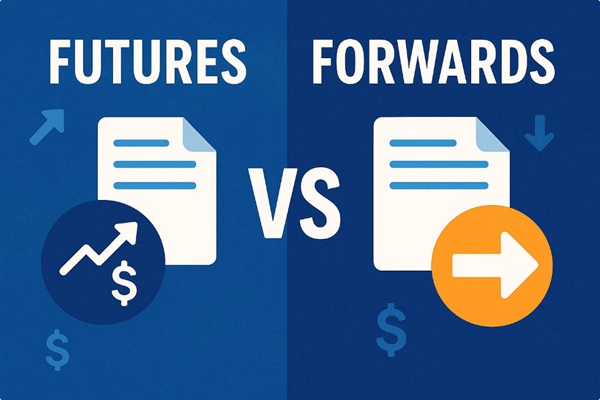
Futures are standardised and exchange-traded, offering liquidity and lower counterparty risk, while forwards are customised, private agreements better suited for hedging specific exposures.
Understanding the distinctions between these two derivative contracts is essential for investors, traders, and corporations aiming to manage risk effectively or capitalise on market opportunities.
Below, this guide explores futures vs forward contracts in depth, providing clear insights into how each works, when to use them, and which aligns best with your financial goals.
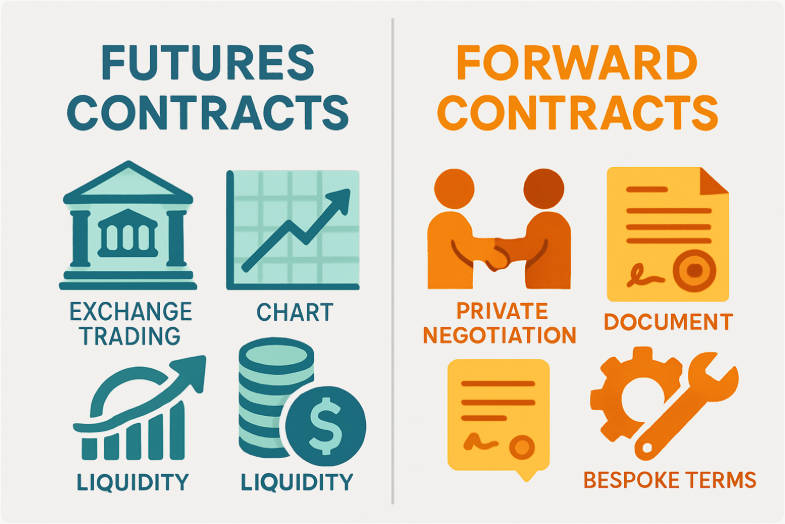
A futures contract is a standardized agreement to buy or sell an asset at a specified price on a set future date. It is traded on regulated exchanges, which provides transparency and a guaranteed framework. Futures are commonly used for commodities, currencies, interest rates, and stock indices. Their standardized nature makes them ideal for traders seeking liquidity and consistent terms.
In contrast, a forward contract is a private agreement negotiated between two parties. It allows full customization of contract terms, including the delivery date, quantity, and quality of the asset. Forwards are often used by corporations managing specific financial exposures or international trade risks, where standardization may not meet unique requirements.
The essential distinction is that futures prioritize liquidity and standardization, while forwards prioritize flexibility and tailored agreements.
Futures contracts are traded on regulated exchanges like CME or ICE. These exchanges standardize contract specifications, including asset type, size, and expiry dates. Standardization ensures market transparency and facilitates active trading, allowing participants to enter and exit positions quickly without negotiating terms.
Forwards, on the other hand, are private contracts conducted over-the-counter (OTC). Because they are negotiated individually, both parties can agree on unique terms that suit their specific needs. While this offers flexibility, it also reduces market transparency and liquidity, making these contracts harder to transfer or settle early.
Overall, the choice between futures and forwards often comes down to whether you value trading convenience and liquidity (futures) or customization and privacy (forwards).

One of the key differences between futures and forwards is how and when settlement occurs.
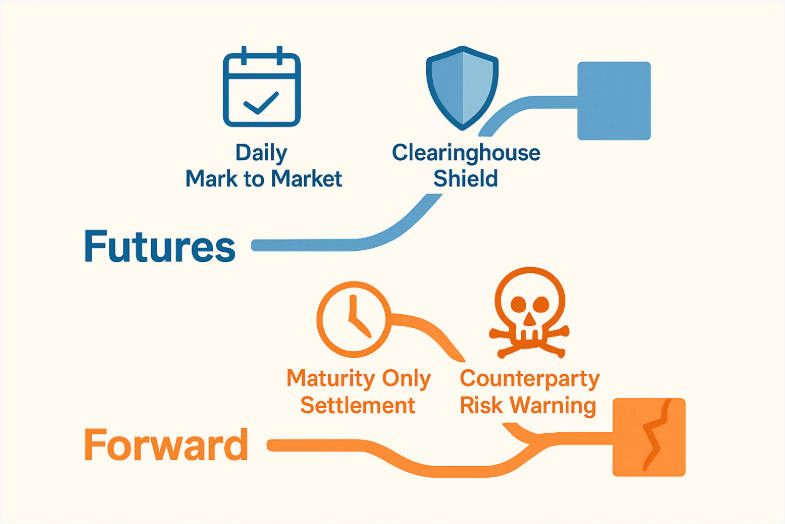
Futures contracts are marked to market daily. This means that gains and losses are calculated each day, and the necessary adjustments are made to margin accounts. This daily settlement reduces the risk of large losses at contract maturity and ensures that the clearinghouse guarantees performance.
Forward contracts, in contrast, settle only at maturity. No daily adjustments are made, so the entire profit or loss is realized at the end. While this structure can be beneficial for long-term hedging, it also exposes participants to higher counterparty risk, as one party may fail to meet obligations.
In practice, daily mark-to-market in futures makes them safer for general trading, whereas forwards require confidence in the counterparty’s reliability.
Futures are inherently safer from a counterparty perspective. Because they are traded on exchanges, a clearinghouse guarantees performance. This eliminates the risk of the other party defaulting and provides regulatory oversight. Traders can therefore engage in large or frequent positions with confidence.
Forwards carry more risk. Being private contracts, they rely entirely on the trustworthiness and financial stability of the counterparties involved. This higher risk is manageable for corporations or institutional investors who have the capacity to assess creditworthiness and negotiate protective clauses.
In summary, futures reduce credit risk and provide regulatory safeguards, while forwards offer flexibility but require careful counterparty evaluation.
Liquidity is another major consideration. Futures markets are highly liquid, especially for major commodities, indices, and currencies. The presence of a large number of buyers and sellers allows for rapid entry and exit, making futures ideal for traders and speculators.
Forwards are much less liquid. Since they are customized and traded privately, there is often no secondary market. Exiting a forward position before maturity may require negotiation or may not be possible at all. This makes forwards more suitable for corporate hedges or bespoke financial arrangements rather than frequent trading.
Futures are versatile and widely used:
Speculators use futures to profit from anticipated price movements.
Investors hedge standardized exposures, such as stock indices or interest rates.
Traders rely on regulated exchanges for predictable and transparent trading.
Forwards are more specialized:
Corporations hedge foreign exchange or commodity risks in international trade.
Financial institutions manage bespoke exposures that do not fit standardized contracts.
Businesses needing specific delivery dates, quantities, or quality preferences benefit from forward contracts.
Choosing the right instrument depends on the nature of your exposure and trading goals.

Futures:
Pros: High liquidity, standardized contracts, daily settlement, low counterparty risk.
Cons: Limited flexibility, cannot tailor delivery terms, may require margin maintenance.
Forwards:
Pros: Fully customizable, private, ideal for specific hedges.
Cons: Higher counterparty risk, low liquidity, limited regulatory oversight.
The trade-off is clear: futures offer safety and convenience, whereas forwards offer flexibility and personalization.
| Feature | Futures Contract | Forward Contract |
|---|---|---|
| Trading Venue | Exchange-traded on regulated markets | Private, over-the-counter (OTC) agreements |
| Standardization | Standardized contract size, expiry, and quality | Fully customizable to meet parties' specific needs |
| Liquidity | Highly liquid due to active exchange trading | Low liquidity; difficult to exit before maturity |
| Settlement | Daily mark-to-market; gains/losses settled daily | Settled at maturity; full gains/losses realized at end |
| Counterparty Risk | Low, guaranteed by clearinghouse | High; depends on counterparty reliability |
| Regulation | Subject to exchange and regulatory oversight | Minimal regulatory oversight; private arrangement |
| Flexibility | Limited; must adhere to standardized terms | High; terms, delivery date, and quantity negotiable |
| Use Cases | Speculation, hedging standardized exposures | Hedging specific corporate exposures or international trade risks |
| Cost & Margin | Requires margin accounts and possible daily adjustments | Typically no margin; may require upfront agreement or collateral |
| Transparency | High; prices and trades publicly visible | Low; private terms and pricing not publicly available |
No. Futures are standardized and exchange-traded, while forwards are private, customizable contracts between two parties.
Forwards carry higher risk, as performance depends on the counterparty. Futures are backed by clearinghouses, reducing default risk.
Not typically. Forwards lack standardization and liquidity, making early exit or resale difficult.
Futures are suitable for liquidity, standardization, regulatory oversight, and lower credit risk, especially for traders and speculators.
Forwards are ideal for bespoke hedges, customized delivery dates, quantities, and private agreements for corporate or financial exposures.
Selecting between futures and forward contracts depends on your priorities. Futures are ideal for traders and investors seeking liquidity, standardized terms, and regulatory protection. Forwards are better suited to corporations or institutions that require customized hedging solutions.
By understanding the differences in structure, settlement, risk, and application, you can choose the contract that aligns with your strategy, manages risk effectively, and maximizes potential benefits.
Disclaimer: This material is for general information purposes only and is not intended as (and should not be considered to be) financial, investment or other advice on which reliance should be placed. No opinion given in the material constitutes a recommendation by EBC or the author that any particular investment, security, transaction or investment strategy is suitable for any specific person.