Published on: 2025-12-29
Updated on: 2025-12-29
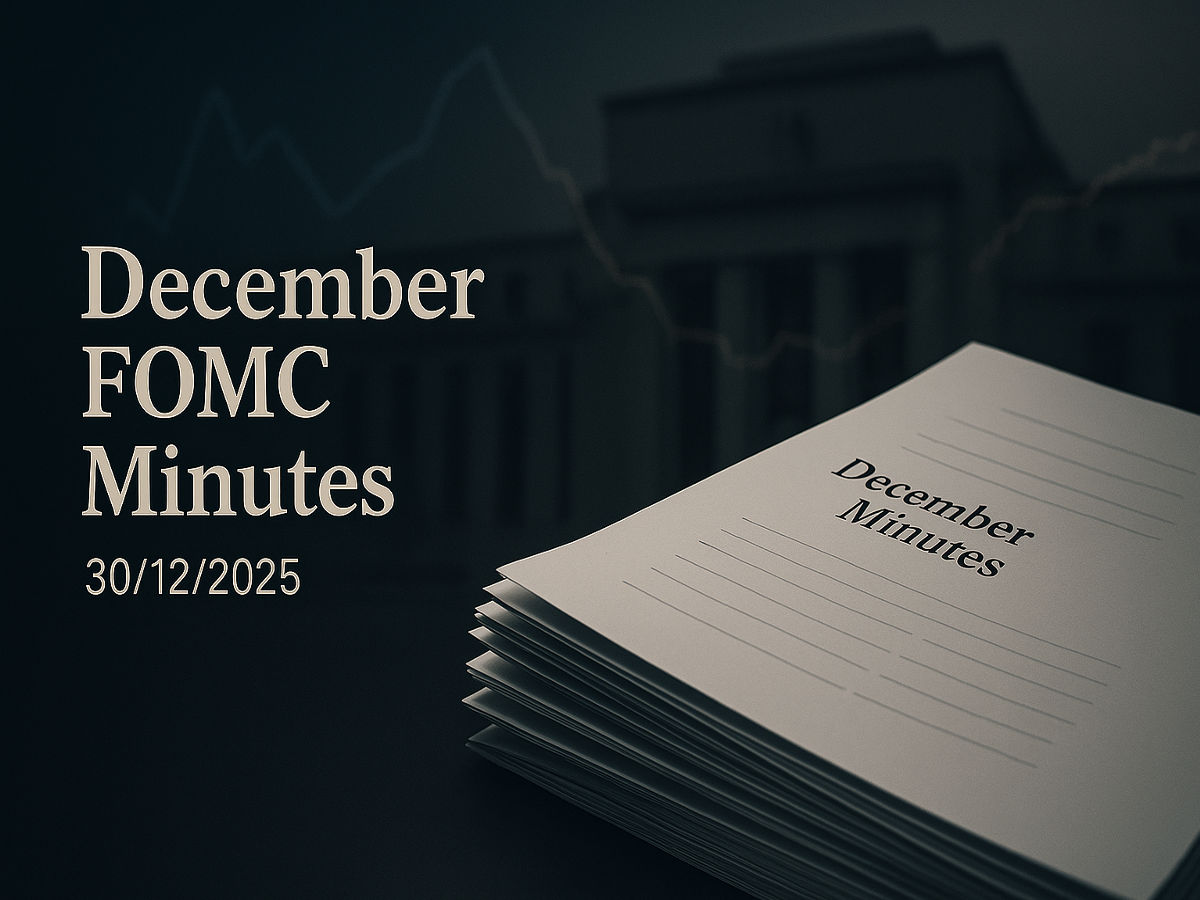
The Federal Reserve will publish the FOMC minutes for the 9–10 December meeting on Tuesday, 30 December 2025, at 2:00 p.m. Eastern Time.
The FOMC minutes are often the market's real "second decision". The statement gives you the headline. FOMC Minutes are typically published three weeks following the policy decision, aligning with the standard schedule.
For December, the setup is unusually sensitive because the Fed's December 9–10, 2025, meeting delivered a 25 bp cut to a target range of 3.50%–3.75%, and investors are now trying to map the pace of 2026 easing without misreading one noisy inflation or jobs print.
As noted above, the minutes from the FOMC meeting held on December 9–10, 2025, will be released on Tuesday, 30 December, 2025, at 2:00 p.m. ET.
| Location | Local release time | Date |
|---|---|---|
| New York (ET) | 2:00 p.m. | Tue, 30 Dec 2025 |
| London (GMT) | 7:00 p.m. | Tue, 30 Dec 2025 |
| Tokyo (JST) | 4:00 a.m. | Wed, 31 Dec 2025 |
The December meeting was not a quiet one. The Committee cut rates by 25 basis points and set the target range for the federal funds rate at 3.5% to 3.75%.
The announcement also noted that inflation has risen since the start of the year and remains relatively elevated, language you don't usually see when rate cuts are expected to run on autopilot.
The split vote is the real headline hiding in plain sight, because it shows just how far the internal debate has widened.
| Position | Count | What it signals |
|---|---|---|
| Supported the 25 bp cut | 9 | A large group agreed the balance of risks had shifted. |
| Wanted a bigger 50 bp cut | 1 | At least one voter thought the labour risk was rising fast. |
| Wanted no change | 2 | A meaningful minority still prioritised inflation caution. |
Minutes matter most when the Committee is split, because the market wants to know whether the split is about timing, data, or the bigger direction for 2026.
The December statement did not indicate that inflation was improving comfortably. It highlighted that inflation has increased and remains relatively high.
In the minutes, traders should look for how many participants see inflation pressure as temporary versus persistent.
What to Watch for in the Wording
If the minutes repeat "elevated" but add more detail on why inflation should cool, that usually reads as mildly supportive for risk assets.
If the minutes describe inflation as broadening, sticky, or tied to expectations, the tone can turn more restrictive quickly.
The announcement indicated that negative risks to jobs have increased in recent months, marking a significant shift in focus.
The minutes should clarify what shaped that view, and whether it reflected a broad consensus or the concerns of just a few members.
Practical Tell
If "many" participants worry about labour weakness, the market will assume the bar for future cuts is lower.
If only "some" participants worry, the market will assume the Fed can pause.
A 25 bp cut can mean two very different things:
It can act as a safeguard, promoting growth while the Fed observes inflation.
It can be the first step in a sequence that continues into 2026.
The minutes should show which story has the most support, especially among the voters who backed the cut.
Markets care about one question more than any other: How restrictive does the Fed think policy still is?
If the minutes suggest participants believe the policy rate is still meaningfully restrictive, more cuts become easier to justify.
If the minutes argue policy is already close to neutral, the case for a pause strengthens.
Two voters wanted no change, and that matters because it suggests a real group is worried about easing too soon.
The minutes will answer whether those concerns were shared quietly by others who still voted for the cut.
It is one of the most tradable signals.
A larger pause camp usually supports the USD and front-end yields, because traders price fewer cuts.
The December statement included a line that caught attention: it said reserve balances have declined to ample levels and that the Fed will initiate purchases of shorter-term Treasury securities as needed to maintain ample reserves.
This isn't the start of a new easing cycle, but it still matters for money-market conditions and short-term liquidity.
In the minutes, traders should watch for:
How serious is the Fed about reserve scarcity?
Whether the Committee sees any risk to market functioning.
How does this interact with its balance sheet plans?
Minutes often include comments on equities, credit spreads, the USD and broader conditions, even when the statement remains generic.
If the minutes suggest conditions have eased too much, the Fed can lean against market optimism without changing rates.
In recent months, the data flow has been unusually choppy, and prior minutes indicated the Fed focused on heightened uncertainty and on how markets were pricing the next policy moves.
If the minutes stress uncertainty and patience, the market usually reads that as "cut less, and later."
| What you see in the minutes | What it usually means | Typical first reaction |
|---|---|---|
| "Many" want to be patient due to inflation | The pause camp is strong. | USD firmer, yields higher, gold softer. |
| "Many" worry about jobs downside risk | The cut path stays open. | USD softer, yields lower, equities steadier. |
| Inflation described as broadening or sticky | The Fed is uneasy. | Higher volatility, weaker risk mood. |
| Clear comfort that inflation will cool | The Fed can keep easing later. | Risk-on tone holds, $ stays heavy. |
| Reserve and liquidity concerns highlighted | Liquidity story matters more. | Bigger move in front-end rates and funding proxies. |
These are tendencies, not rules, but they help you react without speculation.
The minutes are not the last word. They are a guide to how the Fed was thinking three weeks ago.
After the release, markets immediately shift to:
The next wave of inflation and labour data.
Fed speaker commentary that either confirms or contradicts the minutes.
Positioning for the January 27–28 FOMC meeting.
If the minutes reveal a divided and uncertain Committee, traders should be prepared for more two-way volatility into early 2026.
The minutes for the 9–10 December meeting are scheduled for 2:00 p.m. ET on Tuesday, 30 December 2025.
They cover the FOMC meeting held on 9–10 December 2025, when the Committee cut rates by 25 basis points.
Because they reveal the debate behind the decision, including how confident or divided policymakers were, and what risks they prioritised.
US Treasuries, especially the 2-year sector, often react first because the minutes directly influence the expected policy path.
The next scheduled meeting is January 27–28, 2026, with the policy decision due on January 28.
In conclusion, the December FOMC minutes are not just a recap. They are a stress test for the 2026 narrative.
If the minutes reveal a bigger pause camp than the market expects, the $ can firm and yields can rise. If the minutes lean harder into labour risk, the market will factor more into 2026 cuts.
The smartest approach is simple: decide which signal you trust most, then size the trade to withstand year-end volatility.
Disclaimer: This material is for general information purposes only and is not intended as (and should not be considered to be) financial, investment or other advice on which reliance should be placed. No opinion given in the material constitutes a recommendation by EBC or the author that any particular investment, security, transaction or investment strategy is suitable for any specific person.