Published on: 2026-07-09
Updated on: 2026-07-09
BABA rose 11.05% to $108.98 on 8 July 2026, adding $10.84 in one session. [1]
The move formed part of a broader China tech and AI rally, not an isolated Alibaba event. [1]
Alibaba’s company-specific case came from Qwen AI, Alibaba Cloud and rising AI-related cloud revenue.
Cloud Intelligence revenue rose 38% year over year to RMB41.63 billion in the March quarter. [2]
AI-related cloud product revenue reached RMB8.97 billion and delivered triple-digit growth for the eleventh straight quarter. [2]
The re-rating case is still unfinished because fiscal 2026 operating income fell 64% and operating margin compressed to 5%. [2]
Alibaba stock surged with China tech names, but BABA’s larger move showed investors were also testing a company-specific idea: whether Qwen AI and Alibaba Cloud can give Alibaba a valuation case beyond e-commerce.
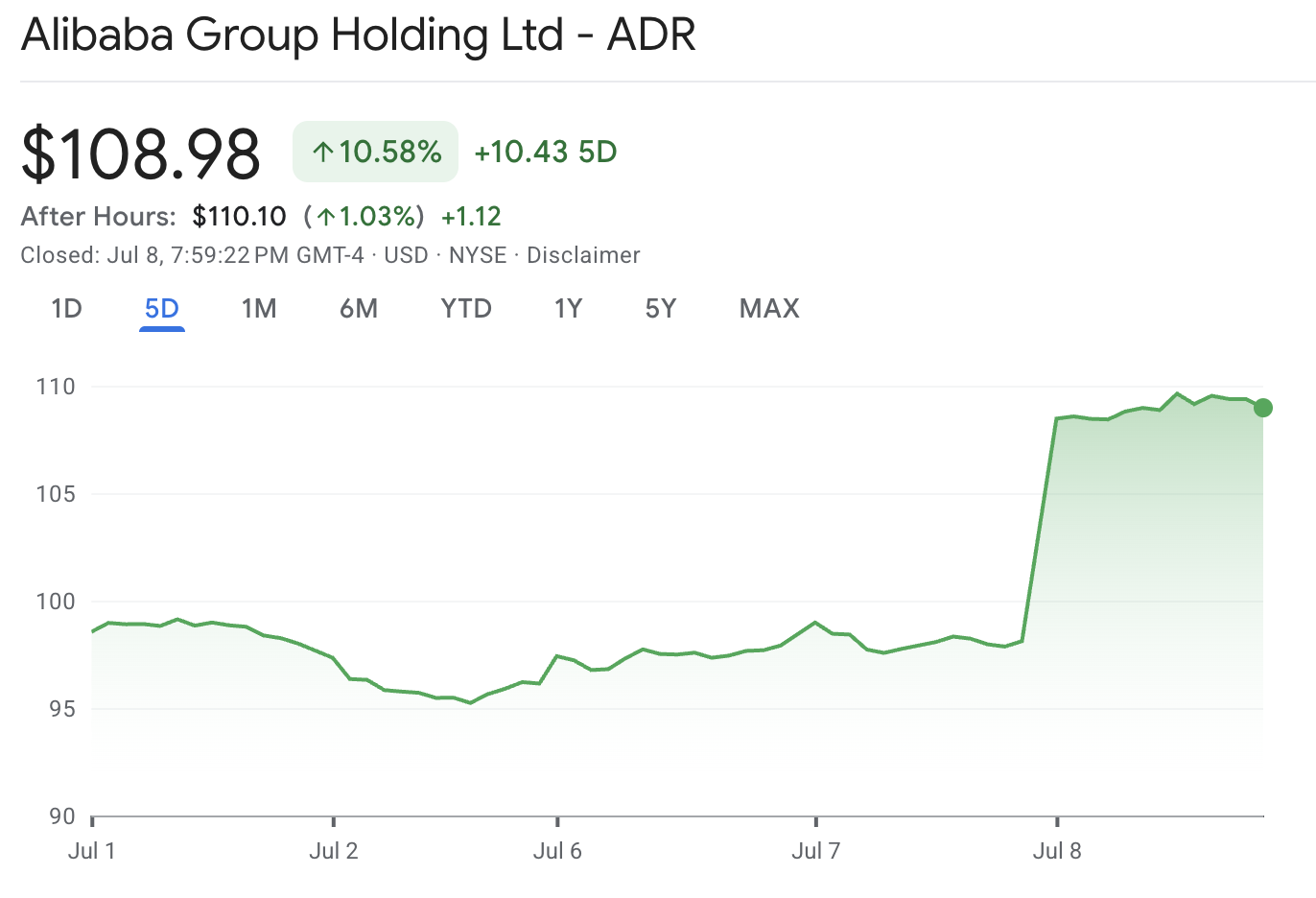
BABA jumped 11.05% on 8 July 2026, closing at $108.98 after ending the previous session at $98.14. The move added $10.84 to the US-listed ADR price in one session and pushed the stock back near the $109 level. It also carried technical weight, with BABA moving above its 21-day moving average for the first time since May. [1]
| Metric | Latest Figure |
|---|---|
| Closing price | $108.98 |
| One-day move | +11.05% |
| Previous close | $98.14 |
| Fiscal 2026 operating margin | 5% |
| Fiscal 2026 adjusted EBITA | RMB76.42 billion |
| Adjusted EBITA growth | -56% YoY |
Baidu and JD.com also gained during the same China tech and AI rebound, so the first read is straightforward: investors were buying Chinese technology risk again. Alibaba’s extra angle was the AI-cloud case attached to Qwen, Alibaba Cloud growth and improving cloud profitability.
BABA’s 11.05% gain was partly a sector move. Chinese technology and AI-linked names rallied together, with Baidu up nearly 5% and JD.com also higher. The stock was not rising in isolation. Investors were rotating back into parts of the China internet trade after a weak stretch. [1]
Alibaba had more than sector sentiment behind it. The stock had been weighed down by concerns over Chinese consumption, heavy spending, quick-commerce investment and margin pressure. The 8 July rally suggested investors were willing to revisit that view as Alibaba’s AI and cloud assets gained more attention.
A one-day sector rebound can lift BABA quickly. A lasting re-rating needs more proof. Investors still need to see whether Qwen and Alibaba Cloud can support revenue quality, earnings conversion and stronger margins over time.
Taobao, Tmall, merchant activity, consumer demand and competition from JD.com and PDD still matter to Alibaba’s earnings base. A rally in BABA cannot be separated from the wider health of Chinese consumption.
The valuation lens is broader now. Alibaba describes itself as a company focused on “AI + Cloud and consumption,” and says Qwen powers services across enterprise solutions, e-commerce and other internet platforms. [3]
That gives BABA a wider story than a standard retail recovery. E-commerce stabilisation depends on spending appetite, pricing discipline and margin control. The AI-cloud case depends on whether Alibaba can turn model adoption, enterprise usage and infrastructure demand into higher-quality revenue.
Qwen is not just a standalone chatbot. Alibaba can place it across cloud products, enterprise tools, merchant services, Taobao, Tmall and other platform functions. The company has also integrated Taobao and Tmall services into the consumer-facing Qwen app and launched a Qwen Shopping Assistant. [2]
That distribution gives Alibaba a cleaner China AI angle. It does not need to monetise AI from a cold start because cloud customers, merchants, consumers and business users are already inside its ecosystem.
For investors, the test is practical. Qwen needs to support cloud demand, enterprise adoption, customer retention, merchant tools or margin expansion. Without that, it remains a strong AI label but not yet a proven earnings driver.
Alibaba Cloud is the clearest financial base behind the rally. In the March quarter, Cloud Intelligence revenue rose 38% year over year to RMB41.63 billion, while external cloud revenue grew 40% as public cloud demand and AI-related product adoption increased. [2]

AI-related product revenue reached RMB8.97 billion, accounted for 30% of external cloud revenue and delivered triple-digit growth for the eleventh consecutive quarter. Cloud adjusted EBITA rose 57% year over year to RMB3.80 billion, showing that the segment is starting to generate operating leverage rather than only revenue growth. [2]
Those figures make the AI story more credible than branding alone. Alibaba has a growing cloud platform, measurable AI-related revenue and improving cloud profitability. The question is whether cloud can become large enough to offset pressure elsewhere in the group.
Fiscal 2026 shows why investors may not give Alibaba a full AI re-rating yet. Income from operations fell 64% year over year to RMB50.15 billion, while operating margin compressed to 5% from 14%. Adjusted EBITA fell 56% to RMB76.42 billion, mainly because Alibaba was investing heavily in quick commerce, user experience and technology businesses. [2]
Sales and marketing expenses rose from RMB144.02 billion in fiscal 2025 to RMB245.02 billion in fiscal 2026, increasing from 14.5% of revenue to 23.9%. Product development expenses also rose to RMB66.53 billion, or 6.5% of revenue. Those figures show that Alibaba is still spending aggressively to defend and expand its platform, even as cloud and AI revenue grow. [2]
Alibaba Cloud is growing quickly, and Qwen gives the company a sharper AI identity. The harder test is whether that growth can repair group-level earnings quality. If AI infrastructure, Qwen adoption costs and instant-commerce spending continue absorbing cash flow, investors may treat the growth as impressive but expensive.
ADR sentiment, China regulation, geopolitical tension and access to Advanced AI infrastructure also remain part of the risk picture. These issues do not cancel the AI-cloud case, but they explain why one strong rally is not enough to prove a durable valuation reset.
The $108 to $110 zone: This range matters because it marks the level BABA reached after the rally. A quick move back below it would make the jump look more like relief than a sustained re-rating attempt. [1]
Cloud operating leverage: Cloud revenue needs to stay strong, while adjusted EBITA should keep growing faster than revenue. That would show AI workloads are improving cloud economics, not just lifting sales. [2]
Spending discipline: Sales and marketing reached 23.9% of revenue, while operating margin fell to 5%. Slower quick-commerce losses, controlled infrastructure spending or better Qwen monetisation would strengthen the earnings-conversion case. [2]
Peer confirmation: JD.com, Baidu and wider China-tech peers remain useful checks. If BABA only moves with the group, the rally is sector-led. If Alibaba keeps outperforming, investors may be giving more value to its AI-cloud assets.
BABA jumped during a broader China tech and AI rally, helped by renewed investor interest in Alibaba’s Qwen AI model, Alibaba Cloud growth and signs that spending pressure may be easing in some areas.
Alibaba is still heavily tied to e-commerce, but Qwen and Alibaba Cloud give it a stronger AI profile than a pure online retail company.
Alibaba Cloud is the clearest financial base for the AI case. Cloud Intelligence revenue rose 38% year over year to RMB41.63 billion, while AI-related cloud product revenue reached RMB8.97 billion. [2]
The biggest risk is earnings conversion. Alibaba’s cloud growth is strong, but fiscal 2026 operating income fell 64%, adjusted EBITA dropped 56% and operating margin compressed to 5%. [2]
BABA’s 11.05% jump did not prove a completed re-rating. It showed that investors were willing to look at Alibaba through a wider lens than e-commerce alone.
Cloud Intelligence revenue rose 38%, external cloud revenue grew 40%, AI-related cloud product revenue reached RMB8.97 billion and cloud adjusted EBITA rose 57%. Those figures give the AI-cloud case a financial base, not just a narrative. [2]
The constraint is still earnings conversion. Fiscal 2026 operating income fell 64%, adjusted EBITA dropped 56%, and sales and marketing expenses climbed to 23.9% of revenue. Until Alibaba proves that Qwen AI and cloud growth can improve group-level margins and cash flow, the AI-cloud re-rating remains promising but unfinished.