Published on: 2026-08-20
Updated on: 2026-08-20
Interest rates usually fall in a recession, yet mortgage rates, long-term Treasury yields and other borrowing costs can stay high even while the Fed cuts rates. Markets often move before policymakers do, while inflation or credit risk can push some rates in the opposite direction.
The 2-year Treasury often moves first, while long-term yields, mortgages and loan rates can stay high or even rise.
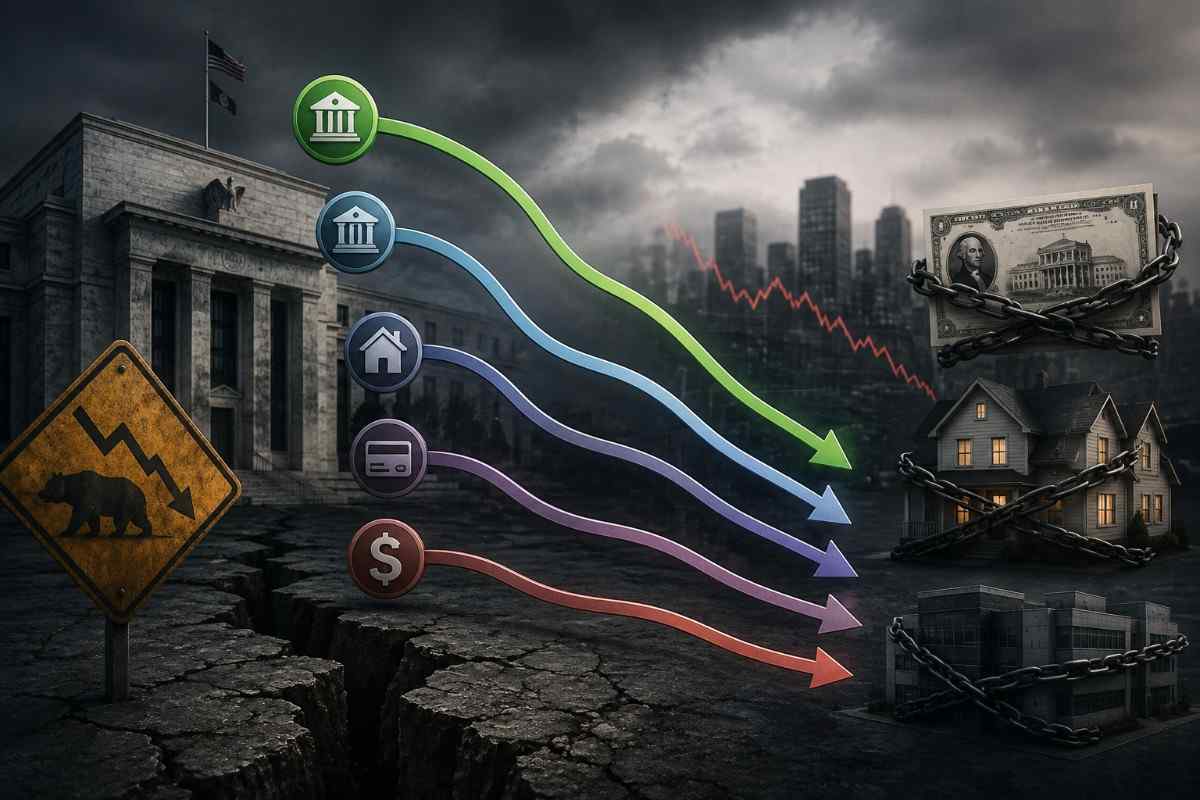
The federal funds rate usually falls in recessions, but the 1973–75 and 1980 downturns show that high inflation can delay cuts.
The 2-year Treasury often moves first because markets price future Fed policy before the Fed changes rates.
The 10-year Treasury can rise during a recession when inflation expectations or the term premium remain elevated.
Mortgage rates do not follow Fed cuts one-for-one because Treasury yields and mortgage spreads also drive pricing.
Loan rates can stay high even as the Fed cuts when rising default risk and lender spreads offset lower benchmark rates.
Policy rates usually fall as recessions weaken growth and inflation pressure. The farther a rate sits from direct central-bank control, the less predictable the move becomes because market expectations, credit risk and lender spreads start to matter.
| Rate | Typical move | Before Fed? | Main obstacle |
|---|---|---|---|
| Fed funds | Falls | No | Inflation |
| 2-year Treasury | Often falls | Yes | Sticky inflation |
| 10-year Treasury | Often falls | Yes | Term premium |
| Mortgage | Falls unevenly | Often | Mortgage spreads |
| Loans | May lag | Sometimes | Default risk |
The Fed can cut quickly while long-term yields, mortgage rates and other borrowing costs remain elevated.
The 2-year Treasury yield can fall before the Federal Reserve cuts rates because bond markets price where policy is expected to go, not only where it stands today. Weaker employment, softer inflation or slower activity can pull the yield lower as expectations for future Fed policy shift.
By the time the Fed announces its first cut, short-term Treasury yields may already reflect much of the expected easing. The market move can therefore begin well before the policy decision itself.
The 10-year Treasury does not have to follow short-term rates lower. Its yield also includes a term premium, the extra return demanded when inflation and future rates are unusually uncertain.
The 1973–75 recession shows how far long rates can diverge from the usual pattern. The 10-year Treasury yield averaged 6.73% when the recession began in November 1973 and climbed to 8.04% in August and September 1974 while the economy was still contracting.
The pattern repeated in 1980, when the 10-year yield rose from 10.80% in January to 12.75% in March before falling to 10.25% by July.
Weak growth pulls long-term yields lower, while inflation and a rising term premium can push in the opposite direction.
Mortgage rates are not set by the federal funds rate. The 30-year fixed mortgage rate is tied much more closely to longer-term Treasury yields and mortgage-backed securities.
Freddie Mac research has found a very close historical relationship between changes in the 10-year Treasury yield and 30-year mortgage rates. Mortgage rates can still stay elevated when the spread between mortgages and Treasuries widens, leaving borrowing expensive even while the Fed cuts.
A Fed rate cut does not guarantee cheaper loans. Lenders also price the risk that debts will not be repaid, and that risk usually rises when the economy weakens.
During the 2020 recession, Federal Reserve surveys showed banks tightening lending standards across business, housing and consumer loans. Banks also widened spreads and charged larger premiums on riskier loans even after policy rates fell close to zero.
Credit cards, personal loans and riskier business borrowing can therefore stay expensive when wider credit spreads offset the decline in benchmark rates.
High inflation can keep interest rates rising even after a recession begins. Economic contraction does not guarantee rate cuts when inflation remains the larger threat.
The 1980 recession gives the clearest example. The effective federal funds rate rose from 13.82% in January to 17.61% in April while the economy was already contracting, then fell to 9.03% by July.
An inflationary recession can therefore begin before the rate-cutting cycle does.
Expected Fed cuts only become broad monetary easing when long-term yields and borrowing spreads fall as well. If mortgage rates, long-term Treasury yields or credit spreads remain high, lower policy expectations are not yet translating into cheaper borrowing.
The distinction is important because monetary easing can begin in one part of the rate system while remaining absent in another.
Usually. Savings and CD rates tend to decline when the Fed lowers short-term interest rates because banks no longer need to pay as much to attract deposits. Competition for deposits can slow the decline, so individual banks may cut rates at different speeds.
Credit-card rates often fall after Fed cuts because most variable APRs are linked to the prime rate. The decline may be small relative to the total APR because lender margins remain large and can rise when default risk increases.
No. A fixed-rate loan keeps the interest rate agreed when the loan was issued. Lower market rates affect new loans and refinancing opportunities, not the rate on an existing fixed-rate mortgage, auto loan or personal loan.
Yes. Persistent inflation can prevent the Fed from cutting quickly, while long-term yields and borrowing spreads can remain elevated for separate reasons. A recession creates downward pressure on rates, but it does not determine when every rate must fall.
A recession usually creates pressure for lower interest rates, but the adjustment rarely reaches every market at once. Short-term rates may fall first while mortgages, long-term yields and loan costs remain elevated because inflation, risk premiums or credit spreads are moving the other way.
The strongest signal of broader easing comes when lower policy expectations are matched by falling long-term yields and cheaper borrowing costs. A Fed cut changes the policy rate. A broad decline across market and loan rates shows that money has actually become cheaper.