Published on: 2026-08-19
Spoofing and layering use orders to create a misleading picture of buying or selling interest. Spoofing commonly involves orders that are not intended to trade, while layering uses multiple orders across different price levels to distort apparent supply or demand. The difficulty is separating manipulation from ordinary trading, where orders are routinely placed, changed and cancelled.
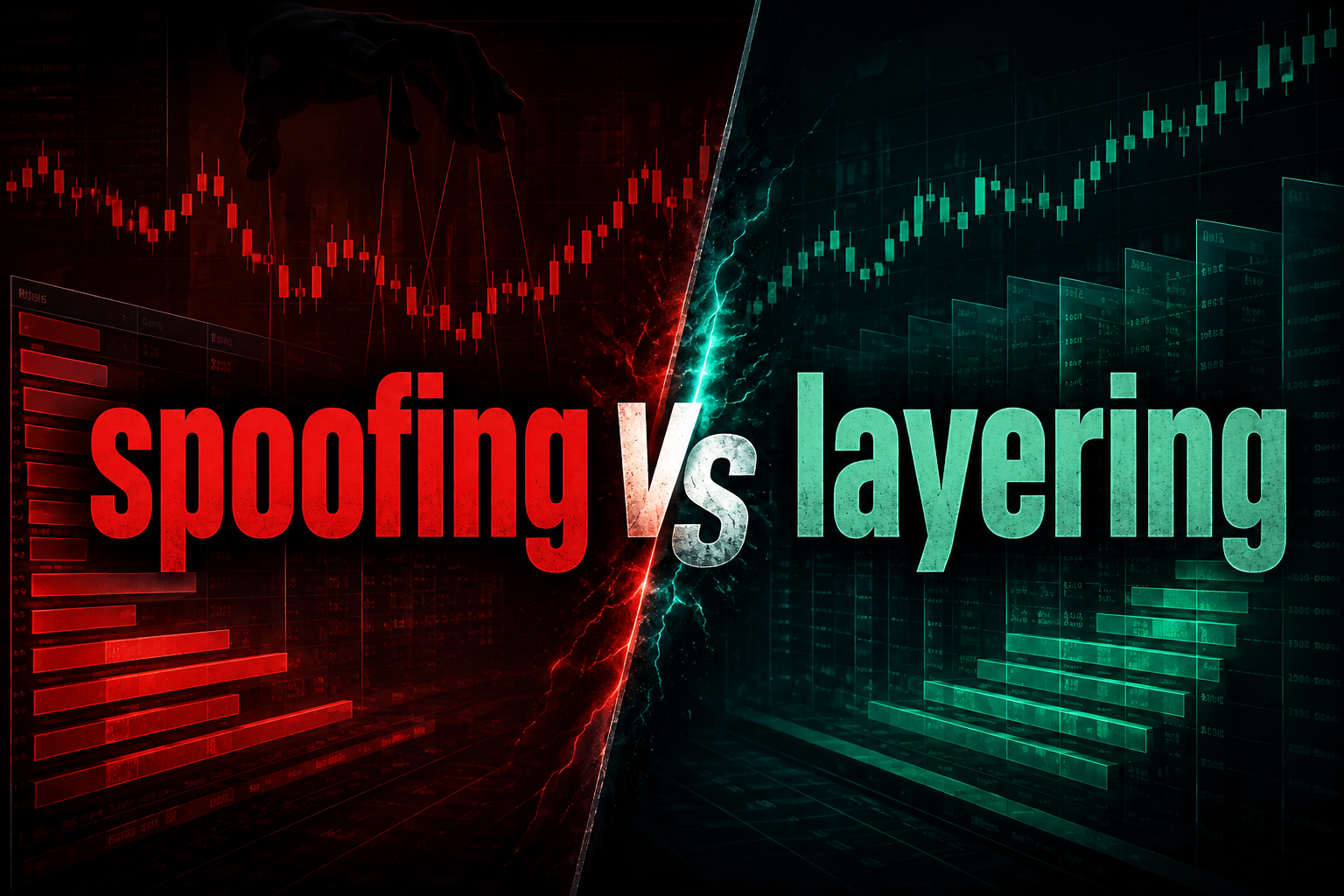
Spoofing generally involves deceptive orders; under U.S. futures law, it specifically means bidding or offering with the intent to cancel before execution.
Layering uses multiple baiting orders at different prices to create an artificial change in displayed supply or demand.
Cancelling an order is not automatically manipulation. The legal test depends on the market and the behaviour surrounding the orders.
Displayed liquidity shows orders currently available, not a guarantee that every quoted order will remain available or execute.
Spoofing centres on deceptive order placement, while layering involves multiple baiting orders placed across different price levels.
Under U.S. futures law, spoofing is defined as bidding or offering with the intent to cancel before execution. FINRA describes layering in equities as placing multiple orders on one side of the market at various prices to create an apparent change in supply or demand, then executing on the opposite side and cancelling the baiting orders.
| Spoofing | Layering | |
| Orders | Can involve one or more deceptive orders | Uses multiple baiting orders |
| Placement | Does not require several price levels | Typically spread across several prices |
| Effect | Creates false market interest or pressure | Creates false depth or supply/demand |
| Typical outcome | Orders are cancelled rather than genuinely traded | Opposite-side trade occurs and layers are removed |
Both can mislead participants about what the market is actually offering or demanding. The main practical difference is the multi-level order structure that characterises layering.
A cancellation becomes problematic when it forms part of conduct prohibited by the rules governing that market. Cancellation itself is normal trading behaviour.
For U.S. futures, the key element of spoofing is intent to cancel before execution. The CFTC says legitimate, good-faith cancellations or modifications do not violate the spoofing provision. A partial fill also does not automatically make an order legitimate if it was originally entered with an intention to cancel rather than genuinely trade.
The equity layering framework differs slightly. FINRA Rule 5210 addresses a frequent pattern in which multiple orders change displayed supply or demand, an opposite-side order executes, and the original orders are cancelled. FINRA’s rule does not contain the same express intent requirement as the federal futures spoofing provision.
No single test applies the same way in every market.
They make the order book show buying or selling interest that doesn't reflect a genuine willingness to trade. For example, someone wants to buy while several large sell orders suddenly appear above the market. That added supply can make selling pressure look stronger and may cause other participants to adjust their prices.
A layering sequence can look like this:
Large sell layers appear → apparent supply increases → opposite-side buy executes → sell layers disappear
FINRA describes layering as artificially changing displayed interest, while CFTC guidance identifies multiple orders used to create false market depth as a possible form of spoofing. The manipulation works before the baiting orders themselves need to trade: their presence changes the information other participants see.
Regulators compare orders, cancellations and executions to determine whether suspicious behaviour forms a wider pattern.
They can examine order size and timing, cancellations, opposite-side trades, price effects, and the participant’s wider trading history. CFTC guidance specifically says market context, trading patterns and fill characteristics can help distinguish legitimate activity from spoofing. FINRA surveillance similarly tracks the sequence of baiting orders, opposite-side executions and cancellations associated with layering.
The Michael Coscia prosecution shows why the pattern matters. Prosecutors said his automated programs placed orders intended to be cancelled to create an illusion of market interest while other orders obtained executions. In 2015, he became the first person convicted in a federal prosecution under the U.S. anti-spoofing provision.
An order book shows current displayed interest, not guaranteed future liquidity.
A large buy or sell order can disappear before another participant trades against it, and that alone does not prove manipulation. Limit orders themselves are not guaranteed to execute.
The more useful lesson is to avoid treating a large order or “wall” as definite evidence of future price direction. Order books show what is being quoted at that moment; they cannot show the intention behind every order.
No. The practices are closely related, but layering specifically involves multiple baiting orders at different price levels to distort displayed supply or demand. Spoofing is a broader term for deceptive order activity and has a specific statutory definition in U.S. futures law.
Not by itself. Under U.S. futures rules, legitimate good-faith cancellations are allowed. The relevant question is whether the order was originally entered with the prohibited intent to cancel before execution.
Yes. The CFTC states that a partial fill does not automatically prevent an order from being classified as spoofing. Investigators can still examine the original intent and surrounding trading behaviour.
You may notice unusual order behaviour, but an order-book view alone cannot establish intent or prove manipulation. Regulators can examine much broader order, cancellation and execution histories when investigating suspicious activity.
Spoofing and layering distort the information orders convey. Spoofing can involve deceptive orders intended to be cancelled, while layering uses multiple baiting orders across price levels to create misleading supply or demand. The exact legal test depends on the market, so a cancelled order alone is not enough to label activity manipulative. What matters is the behaviour surrounding the orders and whether it matches a prohibited pattern.