Published on: 2026-08-19
Updated on: 2026-08-19
SOXX’s NAV fell 5.02% on August 18 even as major technology companies kept large infrastructure budgets that support AI demand. The decline spread across chipmakers and semiconductor-equipment stocks, even as the ETF entered the session with an 85.92% 2026 return through August 17. No single fundamental trigger explains the move: higher long-term yields made elevated valuations less forgiving, while market commentary also pointed to profit-taking and machine-driven selling in light mid-August trading.

SOXX’s NAV fell 5.02% to $531.13 on August 18 after gaining 85.92% in 2026 through August 17.
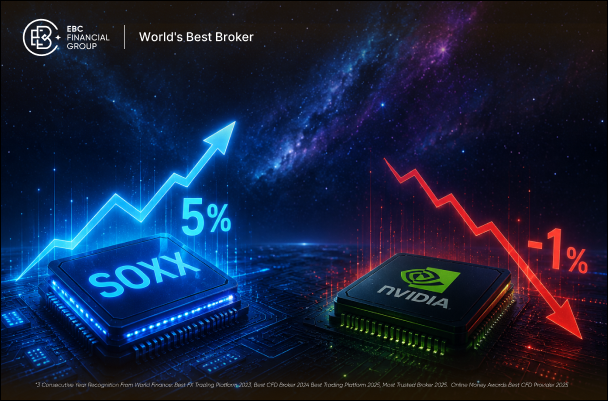
Nvidia fell 2.3%, while Micron lost 7%, Marvell 7.8%, Intel 6.6% and AMD 4.3%, spreading the decline well beyond SOXX’s largest holding.
Alphabet, Meta and Microsoft have not cut the large infrastructure budgets supporting AI demand. Alphabet raised 2026 capex guidance to $195–205 billion, while Meta expects $130–145 billion.
Nvidia reports on August 26, providing the next major read on AI compute demand and whether Nvidia's strength can still lift the wider semiconductor ETF.
The August 18 move was broad. The Philadelphia Semiconductor Index fell 5%, reversing a 1.6% gain from Monday. Nvidia fell 2.3%, Micron dropped 7%, AMD 4.3%, Intel 6.6%, Marvell 7.8%, and networking-chip supplier Credo 13%.
SOXX’s August 17 holdings show why Nvidia alone could not determine the ETF’s performance.
Holding |
SOXX weight |
Aug. 18 move |
Nvidia |
8.77% |
-2.3% |
Micron |
8.58% |
-7.0% |
AMD |
8.07% |
-4.3% |
Broadcom |
7.23% |
-3.2% |
Intel |
5.37% |
-6.6% |
Marvell |
4.71% |
-7.8% |
Credo |
2.40% |
-13.0% |
SOXX’s top ten positions accounted for about 60.9% of the portfolio before the selloff. Its exposure spans processors, memory, networking, and semiconductor equipment, so weakness across several parts of the industry can outweigh a smaller move in Nvidia.
The selloff did not coincide with a broad cut in data-centre investment. Alphabet raised its 2026 capital-expenditure guidance from $180–190 billion to $195–205 billion, saying the increase mainly reflected faster capacity deployment to meet growing demand. The vast majority of its $44.9 billion second-quarter capex went to technical infrastructure supporting its AI investments.
Meta expects $130–145 billion of 2026 capex, including principal payments on finance leases. Microsoft spent $41 billion in its latest quarter, with roughly two-thirds directed to shorter-lived assets, primarily CPUs and GPUs. Microsoft said those assets support both AI and non-AI infrastructure.
These figures should not be treated as pure AI-spending totals. They show that the major hyperscalers have not pulled back the broader infrastructure investment supporting semiconductor demand. Tuesday’s decline therefore looks more like a repricing of semiconductor stocks than a sudden deterioration in AI infrastructure demand.
SOXX entered August 18 with an 85.92% YTD NAV return. BlackRock also reported a portfolio P/E ratio of 67.69 as of August 17, underscoring how elevated its published valuation measure had become after the rally.
That P/E should not be read as a conventional forward earnings multiple. BlackRock’s standard iShares methodology bases each holding’s P/E on its latest 12 months of earnings, excludes negative earnings and extraordinary items, and caps individual P/E observations above 60.
Strong infrastructure spending can continue while an ETF falls if prices already assume even faster earnings growth. Applying the 5.02% August 18 decline to the prior day’s YTD return leaves SOXX approximately 76.6% above its year-start level.
The size of that remaining gain makes profit-taking a plausible part of Tuesday’s move. The market was cutting exposure after one of 2026’s strongest sector runs rather than repricing a semiconductor ETF that had gone nowhere.
The 30-year U.S. Treasury yield reached 5.333% on August 18, its highest since 2007, before easing to 5.284% later in the session. The 10-year traded around 4.70%. Higher long-term yields raise the discount rate applied to future earnings and increase the yield available from government bonds, creating a tougher backdrop for high-valuation equities.
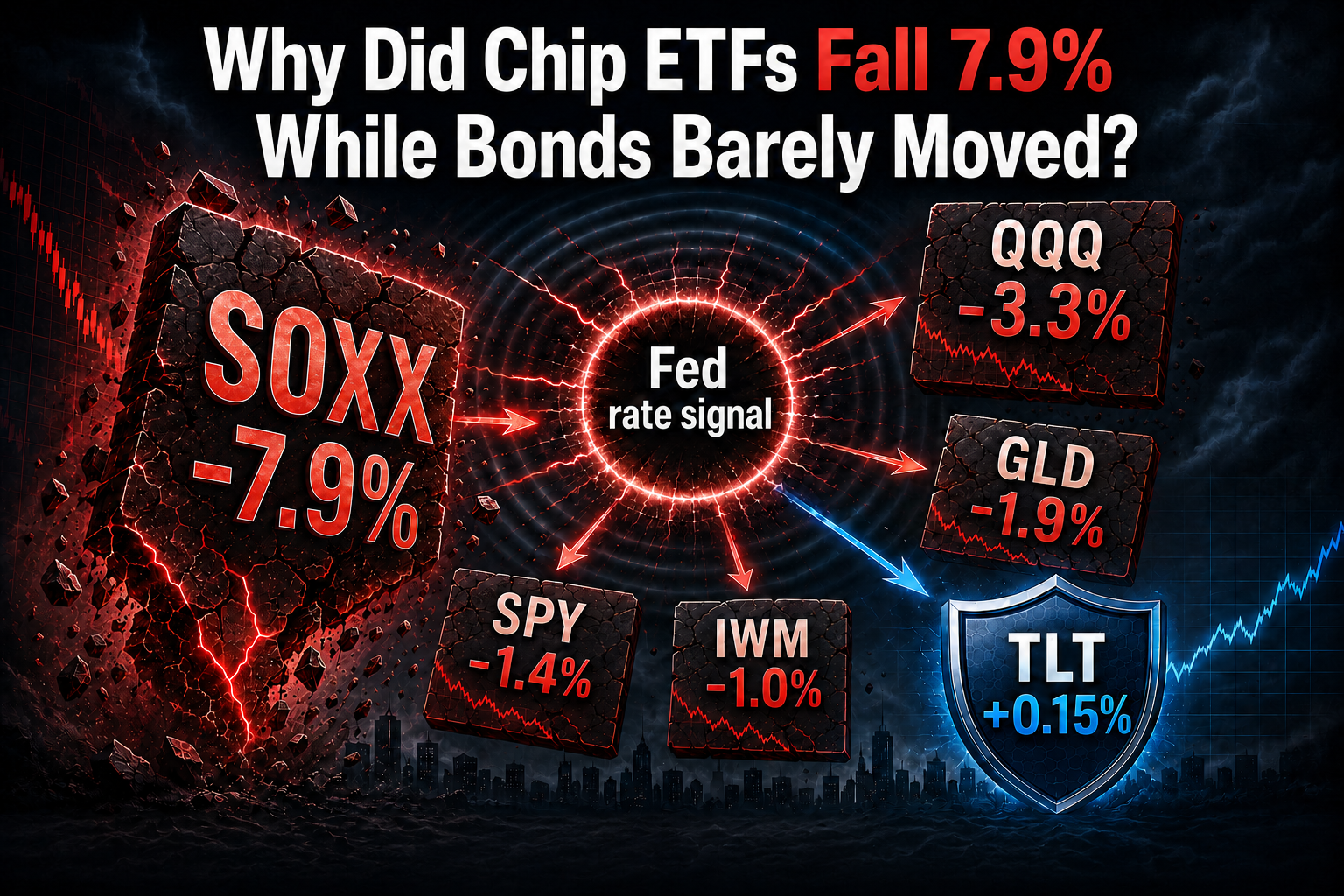
SOXX’s decline was still far larger than the broader market move. The Nasdaq Composite fell 1.33%, the S&P 500 0.69% and the Dow 0.22%, compared with roughly 5% declines in SOXX and the Philadelphia Semiconductor Index. Macro pressure weighed on the broader market, while semiconductor selling was several times more severe.
No single catalyst accounts for the full gap. Mizuho trading-desk analyst Jordan Klein attributed the chip decline to machine trading while volumes were generally low in mid-August. MarketWatch also cited pressure in Asian technology shares, elevated Treasury yields and profit-taking after recent AI-hardware gains. Higher yields made semiconductor valuations less forgiving, while profit-taking and momentum selling intensified the reversal.
Nvidia reports second-quarter FY27 results on August 26 at 2 p.m. Pacific Time. At 8.77% of SOXX on August 17, Nvidia was the ETF’s largest holding, and its report will provide a major update on accelerator demand and AI infrastructure momentum.
The report cannot validate the entire ETF. SOXX also owns memory producers, equipment manufacturers, networking suppliers and other chipmakers with different earnings drivers. The more useful signal will be whether a strong Nvidia report lifts the broader basket. Nvidia rising while SOXX remains flat or weak would show that strong AI compute demand is no longer enough to lift every semiconductor exposure.
No. SOXX is an unleveraged iShares ETF designed to track the NYSE Semiconductor Index. It held 30 positions as of August 17, so its August 18 decline came from movements in the underlying semiconductor holdings rather than embedded leverage.
Yes. SOXX’s NAV had gained 85.92% through August 17. Applying the next day’s 5.02% decline leaves the ETF approximately 76.6% above its year-start level, based on BlackRock’s reported NAV returns and simple compounding.
SOXX held 30 positions as of August 17. BlackRock classified 78.13% of market value as semiconductors and 21.73% as semiconductor equipment, giving the ETF exposure to more than just AI processor designers.
SOXX is concentrated in one industry and had a three-year equity beta of 2.08 as of July 31. On August 18, its roughly 5% decline far exceeded the Nasdaq Composite’s 1.33% loss as semiconductor selling intensified.
SOXX’s 5% decline was not matched by a comparable pullback in the infrastructure budgets supporting AI demand. The move exposed how high expectations had become after an 85.92% YTD rally and how quickly semiconductor momentum could reverse when yields and positioning turned against it. Nvidia’s August 26 report is the next major test of whether strong AI compute demand can still lift the wider ETF.