Published on: 2026-08-20
Updated on: 2026-08-20
Moderna added roughly $44 billion in market value before detailed Phase 3 efficacy data were released. Yes, MRNA still has upside after its 177% surge, but the next leg will be harder to earn. Detailed melanoma results, regulatory progress and success across its broader cancer pipeline now have to support expectations embedded in a roughly $69 billion company.
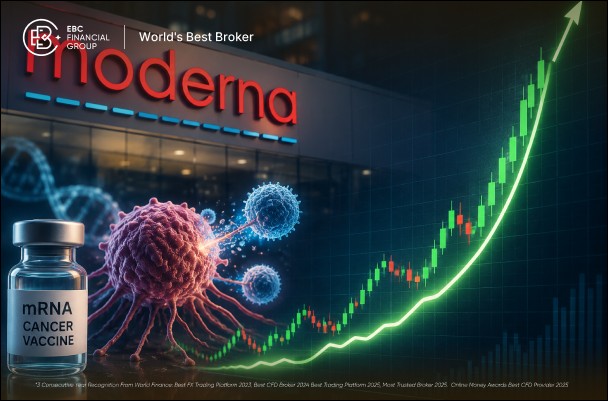
INTerpath-001 succeeded in 1,137 melanoma patients, but detailed Phase 3 efficacy figures remain undisclosed. The size of that benefit is now the most important near-term clinical signal.
Earlier data showed a 49% lower risk of recurrence or death and a 59% lower risk of distant metastasis or death. The Phase 3 details now face an unusually high benchmark.
Intismeran is being tested across nine Phase 2 and Phase 3 studies, putting lung, bladder and kidney cancer at the center of Moderna’s remaining oncology upside.
Selected post-readout targets span $89 to $170 against MRNA’s $174.38 close. The market has repriced Moderna faster than Wall Street has agreed on what the company is worth.
About 13.5% of Moderna’s free float was sold short before the Phase 3 readout. Forced covering likely amplified the rally, so the 177% gain should not be read as a one-day measure of newly created fundamental value.
A single melanoma indication cannot explain that one-day revaluation. The rally also assigned substantial value to the possibility that Moderna’s personalized mRNA platform can work across multiple cancers.
Short covering amplified the move. About 13.5% of Moderna’s free float was sold short before the readout, leaving one of the largest short bases among major U.S. companies exposed as MRNA surged. The 177% move was not a pure measure of new fundamental value.
Intismeran is already being tested across nine Phase 2 and Phase 3 studies spanning melanoma, non-small-cell lung cancer, bladder cancer and renal-cell carcinoma. The next major revaluation depends on whether the personalized mRNA approach can succeed across more than one tumor type.
Lung cancer offers the clearest scale advantage. The potential adjuvant population is estimated at more than 100,000 patients across the U.S. and EU, compared with roughly 30,000 in the high-risk melanoma setting. One post-readout model raised projected 2035 intismeran sales from $7.2 billion to $16.8 billion after increasing its assumptions for melanoma, lung, kidney and bladder cancer.
Moderna would not keep all of that economics. Merck and Moderna split program costs and profits equally. Success in a cancer population several times larger than melanoma could still expand intismeran’s contribution materially.
INTerpath-001 succeeded, but the numbers showing how strong that success was have not been released. Moderna and Merck have not disclosed the Phase 3 hazard ratios, absolute recurrence differences or mature overall-survival results.
At five years, the Phase 2b study showed a 49% lower risk of recurrence or death and a 59% lower risk of distant metastasis or death versus Keytruda alone.
A Phase 3 effect close to those levels would strengthen the regulatory case and support broader development. A materially weaker effect would make the 177% revaluation harder to defend before intismeran proves itself in other cancers.
The complete INTerpath-001 results will be presented at an upcoming international medical meeting and shared with regulators. Moderna and Merck also plan to engage authorities on filing submissions, but no FDA filing date, accepted application or approval deadline has been announced.
The efficacy details come first. They will show whether Phase 3 approaches the strength seen in Phase 2b and give regulators a clearer basis for judging the treatment. A formal filing would then move intismeran from clinical validation toward a defined commercial pathway.
Each intismeran treatment is designed from the mutational profile of an individual patient’s tumor and can encode up to 34 neoantigens. Turnaround time, manufacturing capacity and cost therefore remain part of the commercial equation even after regulatory approval.
Moderna has already begun supplying clinical batches from its dedicated Marlborough, Massachusetts facility, which was built around automation, faster production and commercial scale.
The company has also been working to shorten turnaround times and reduce manufacturing costs. Larger cancer populations will test whether that personalized model can preserve the economics now being built into long-term forecasts.
Every selected post-readout target in this group sits below Moderna’s $174.38 close.
| Firm | Target | vs. $174.38 |
|---|---|---|
| BofA | $170 | -2.5% |
| Piper Sandler | $167 | -4.2% |
| Morgan Stanley | $89 | -49.0% |
BofA and Piper Sandler raised their targets sharply after the readout, while Morgan Stanley more than doubled its target from $39 to $89. Even the highest selected target remained below the closing price.
The new valuation also sits far ahead of Moderna’s current earnings base. Q2 2026 revenue was $145 million against an $815 million operating loss, leaving much of today’s valuation dependent on future oncology revenue rather than current profitability.
The $81 spread between BofA and Morgan Stanley shows that the clinical result is clearer than the valuation it created. Stronger efficacy and broader cancer success can push valuation models higher. Weaker results would not erase the melanoma win, but they would shrink the premium attached to everything beyond it.
Yes, but further gains require new evidence. Strong Phase 3 efficacy, regulatory progress and success in larger cancers could support more upside, while the initial melanoma success is already heavily reflected in the price.
No FDA approval date or PDUFA deadline has been announced. Moderna and Merck still need to present the complete INTerpath-001 data and progress through regulatory filing discussions before an approval timetable becomes clearer.
Moderna and Merck share development costs and profits equally. A large intismeran franchise could materially increase Moderna’s value, but headline sales forecasts should not be treated as revenue flowing entirely to Moderna.
Yes. The share price now reflects expectations beyond melanoma. Weaker Phase 3 efficacy, slower regulatory progress, manufacturing constraints or failed expansion into larger cancers could remove much of that platform premium without changing the fact that INTerpath-001 succeeded.
Because biotech valuations price future pipeline value, not current revenue alone. Moderna’s roughly $69 billion valuation now assumes substantial future contribution from intismeran and other products, making execution far more important than today’s revenue base.
More upside remains possible, but Moderna now has far less room for merely good news. The stock has already priced in melanoma success, broader cancer potential and a faster path toward commercialization. After a 177% rally, Moderna no longer needs another headline win. It needs the numbers behind this one to support the future already priced in.