Published on: 2026-05-06
The euro has a moderate path to strengthen against the dollar in 2026, but EUR/USD still needs a confirmed break above 1.2000 before the bullish case becomes dominant. As of 6 May 2026, the pair is trading near 1.17, above its March low of 1.1476 and below its January peak near 1.1974. This keeps the structure constructive, though not yet decisive.
The forecast depends on three forces: Federal Reserve policy, ECB inflation pressure and the eurozone’s ability to absorb higher energy costs without deeper growth damage. EUR/USD has bullish momentum, but the dollar still carries support from higher U.S. rates, stronger relative growth and safe haven demand.
The euro is expected to strengthen moderately if EUR/USD holds above 1.1680 and later clears 1.2000 with conviction. The forecast is not purely bullish because the dollar still benefits from higher U.S. yields and better growth momentum.
The most balanced outlook is a gradual move toward 1.18 to 1.22. A stronger rally toward 1.25 would require weaker U.S. inflation, softer Treasury yields, stable energy prices and a less defensive global risk environment.
EUR/USD is trading with a constructive technical setup. Price is trading around the 20-day, 50-day and 200-day exponential moving averages, leaving the pair in a trend confirmation zone rather than a clean breakout phase. Momentum indicators lean positive, although short-term exhaustion is visible.
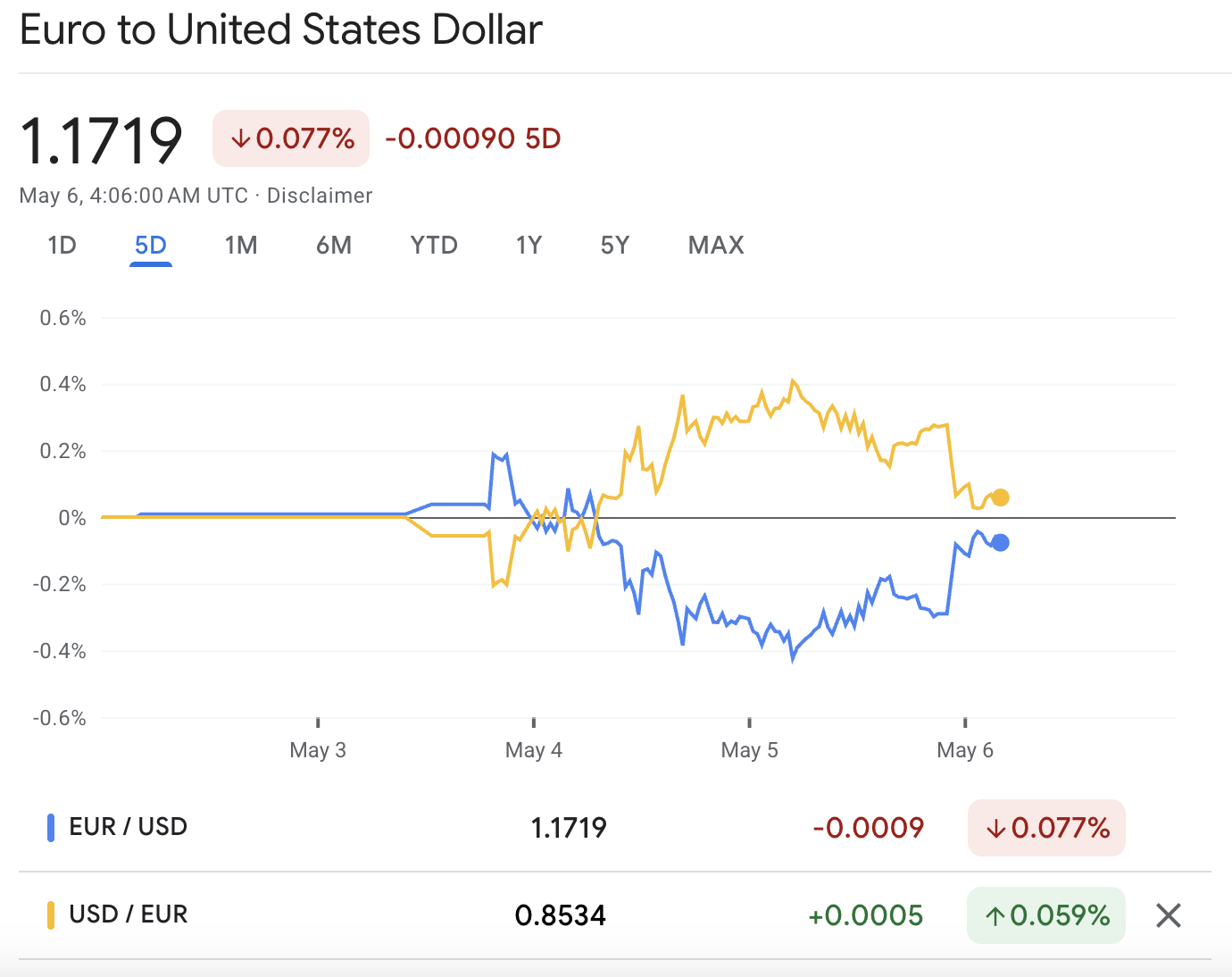
The following readings reflect the daily EUR/USD technical setup as of 6 May 2026.
| EUR/USD indicator | Latest signal | Technical reading |
|---|---|---|
| Spot price | Near 1.17 | Holding above short-term support |
| RSI 14 | Around 64 | Bullish, but approaching stretched levels |
| MACD | Buy signal | Upside momentum remains active |
| ADX 14 | Around 33 | Trend strength is firm, while direction needs price confirmation |
| StochRSI | Above 80 | Short-term overbought risk |
| EMA 20 | Near 1.1705 | Immediate dynamic support |
| EMA 50 | Near 1.1704 | Medium-term bias remains positive |
| EMA 200 | Near 1.1716 | Long-term trend test is active |
| Support | 1.1680, 1.1550, 1.1476 | Key downside levels |
| Resistance | 1.1800, 1.1974, 1.2000 | Breakout confirmation zone |
The technical structure favors euro strength while price remains above 1.1680. A failure below that area would expose 1.1550, followed by the March low at 1.1476. A break below 1.1476 would weaken the bullish thesis and shift attention back to 1.12 to 1.15.
On the upside, 1.1800 is the first resistance zone. The larger test sits between 1.1974 and 1.2000. A daily close above 1.2000 would likely trigger trend-following demand and open the path toward 1.22.
The dollar still benefits from a higher interest-rate floor. The Federal Reserve held rates at 3.50% to 3.75% in April, while U.S. inflation remains too firm for an aggressive easing cycle. March CPI rose 3.3% year over year, with energy prices adding fresh pressure.
This keeps the dollar supported through yield carry. EUR/USD usually struggles when U.S. real yields remain elevated, especially if Treasury yields hold firm during periods of global stress.
The ECB faces a more complex situation. Its deposit rate is lower at 2.00%, but eurozone inflation has moved back to 3.0%. Energy inflation near 10.9% reduces the likelihood of quick policy easing. That gives the euro some interest-rate support, even though the broader economy remains fragile.
This is the central tension in the 2026 EUR/USD forecast. The euro can rise if the rate gap narrows, but the dollar can stay resilient if U.S. yields remain attractive.
The less discussed risk is that energy inflation can lift the euro through ECB repricing while weakening it through growth expectations. Higher oil and gas prices may delay ECB cuts, but they also raise import costs, compress industrial margins and reduce household purchasing power.
EUR/USD benefits only if markets view the energy shock as manageable rather than recessionary. Higher inflation is not automatically bullish for the euro. It supports the currency only when markets believe the ECB can keep policy firm without forcing a deeper downturn.
The eurozone economy is already growing slowly. First-quarter eurozone GDP expanded only 0.1% quarter over quarter, while U.S. GDP grew at a 2.0% annualized pace, keeping the growth comparison tilted toward the dollar. This growth gap keeps EUR/USD from turning fully bullish, even when the chart improves.
The base case favors moderate euro appreciation. EUR/USD can retest 1.1974 and move into the 1.20 to 1.22 zone if U.S. inflation cools, Fed cut expectations increase and the ECB remains cautious.
This is the most balanced forecast because it respects both the bullish technical trend and the dollar’s yield advantage. It also reflects the likelihood that EUR/USD may advance through range expansion rather than a one-way rally.
The bullish case requires a confirmed close above 1.2000. This scenario becomes stronger if U.S. data weakens, Treasury yields fall and energy prices stabilize. A calmer geopolitical backdrop would also reduce safe haven dollar demand.
In this setup, EUR/USD could extend toward 1.22 and possibly 1.25. The move would likely be gradual, with pullbacks toward moving averages attracting demand.
The bearish case begins with a daily close below 1.1680. A further break below 1.1550 would place the March low near 1.1476 in focus.
This scenario becomes more likely if U.S. inflation stays sticky, the Fed delays cuts, Treasury yields rise or eurozone growth deteriorates under energy pressure. Renewed geopolitical stress could also lift the dollar through safe haven flows.
The most important confirmation level is 1.2000. EUR/USD has already shown resilience near 1.17, but a break above 1.20 would signal that the market is willing to reprice the euro into a higher range.
Until then, 1.1680 remains the immediate technical pivot. Holding above it keeps the bullish structure alive. Losing it would turn the forecast more neutral.
The euro is expected to strengthen moderately in 2026 if EUR/USD holds above 1.1680 and breaks above 1.2000. The strongest forecast range is 1.18 to 1.22.
The main resistance zone is 1.1974 to 1.2000. A daily close above this area would confirm a stronger bullish breakout.
Sticky U.S. inflation, higher Treasury yields, stronger dollar safe haven demand and weaker eurozone growth could limit euro strength.
EUR/USD is technically bullish above 1.1680, but not fully confirmed until it breaks above 1.2000.
The euro has a credible path to strengthen against the dollar in 2026, but the forecast remains conditional. Technical momentum favors EUR/USD while the pair holds above 1.1680, and the broader structure points toward a possible 1.20 retest.
The base case remains moderate euro strength, with 1.18 to 1.22 as the central forecast range. A sustained close above 1.2000 would open the door to 1.22 to 1.25. A break below 1.1476 would invalidate the bullish setup and shift the outlook back toward dollar strength.