Published on: 2026-05-20
The EURO STOXX 50 Index has recovered in May, but the rebound still looks more like a repair trade than a confirmed return to broad European equity strength. The Eurozone blue-chip index, tracked as INDEXSTOXX:SX5E, traded near 5,851.16 on May 20 after opening at 5,857.75, with the session range moving between 5,843.59 and 5,910.48.

A relief rally can come from positioning, softer energy prices or improved geopolitical headlines. A durable advance needs stronger earnings breadth, firmer technical confirmation and wider sector participation. For now, the EURO STOXX 50 has stabilised, but it has not fully reclaimed the momentum that defined Europe’s strong 2025 rally.
The EURO STOXX 50 is trading near 5,851, still below its 52-week high of 6,199.78, keeping the recovery constructive but incomplete.
Recent data show a modest 2026 gain of around 1%, following a much stronger 18.29% advance in 2025.
Technical momentum remains mixed, with the index holding above its 50-day moving average but struggling near its 20-day and 100-day averages.
ASML, LVMH, Siemens, SAP, TotalEnergies and major Eurozone banks remain central to index direction.
The next phase depends less on headline optimism and more on earnings breadth, sector rotation and resistance breaks.
Europe’s 2025 rally raised a difficult question: had the market rediscovered structural support, or had investors simply crowded into a temporary valuation catch-up trade? The region benefited from cheaper relative valuations, a stronger euro narrative and renewed interest in select blue-chip names, but the foundation was never without cracks.
Those cracks have not disappeared in 2026. They have shifted form. Tariff risk, sluggish industrial activity, uneven Chinese demand and fragile earnings momentum still sit beneath the surface. The EURO STOXX 50 is no longer trading purely on the optimism that carried parts of 2025. It is now being judged on whether that optimism can translate into a broader earnings cycle.
That is why the current move is best described as a repair trade. The index has recovered from earlier volatility, but it has not yet delivered the kind of confirmation that would turn a rebound into a clean continuation trend. The market is improving, but still asking for proof.
The EURO STOXX 50 is the Eurozone’s leading blue-chip equity benchmark. It tracks 50 large and liquid companies across eight Eurozone countries, making it one of the most widely followed gauges of European equity performance.
That construction matters because the index is not a simple reading of the Eurozone economy. It is a concentrated basket of global businesses with heavy exposure to technology, luxury, industrials, financials and energy. ASML drives much of the technology sensitivity. LVMH and other luxury names reflect discretionary demand and China exposure. Siemens and Schneider Electric capture the industrial cycle. Banks and insurers respond to ECB policy expectations, credit conditions and yield-curve shifts.
This composition gives the index institutional relevance, but it also creates concentration risk. A few heavyweight sectors can stabilise the benchmark without proving that European equities are broadly healthy.
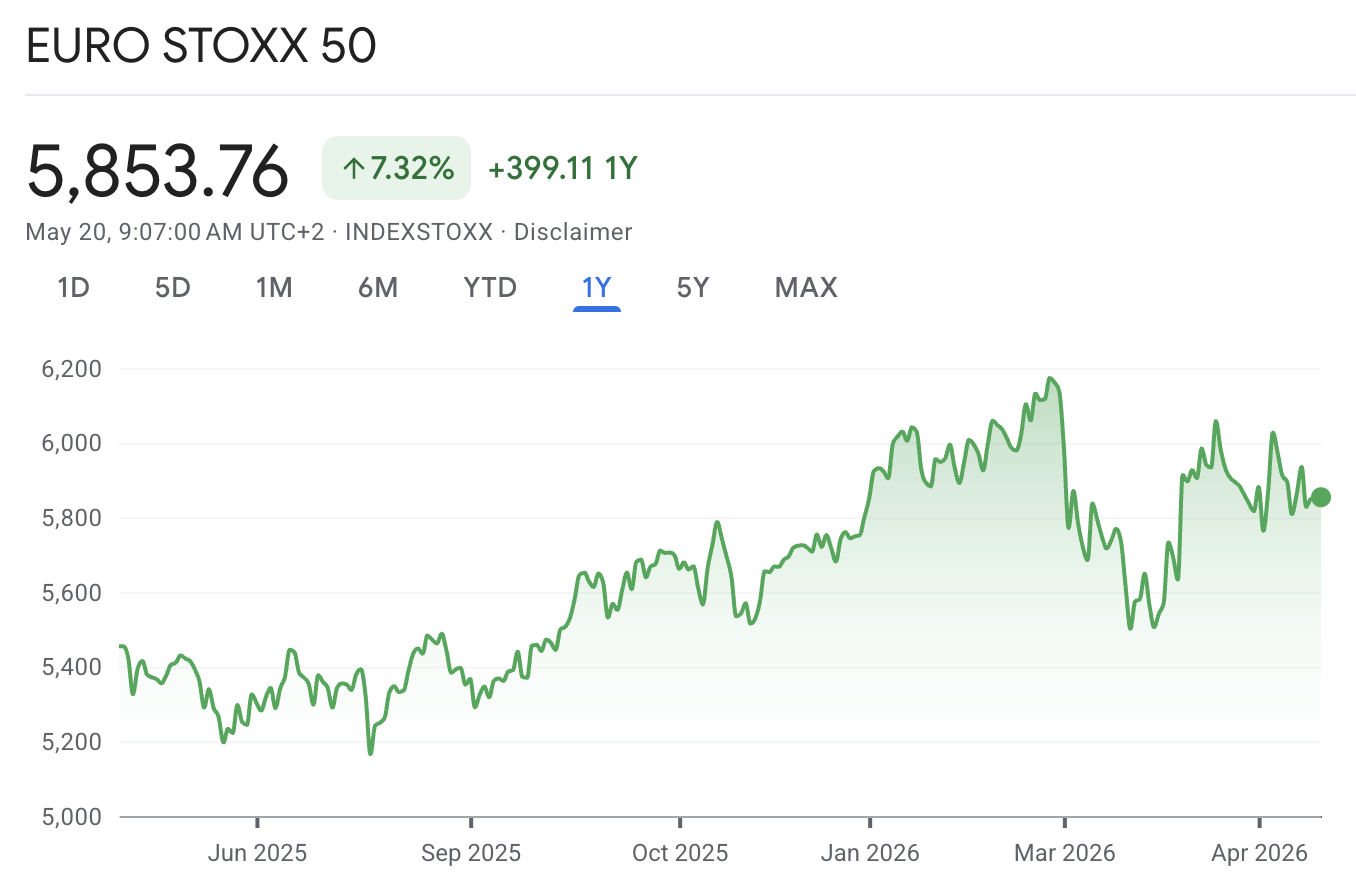
The EURO STOXX 50’s technical profile is balanced. The index is trading near 5,851, above the lower end of the day’s range but below the intraday high of 5,910.48. That shows buyers are defending dips, but not yet forcing a decisive break higher.
| EURO STOXX 50 Market Snapshot | Latest Reading |
|---|---|
| Last quoted level | 5,851.16 |
| Opening level | 5,857.75 |
| Daily high | 5,910.48 |
| Daily low | 5,843.59 |
| 52-week range | 5,154.83 to 6,199.78 |
| 2025 performance | +18.29% |
| Recent 2026 performance | Modest gain around 1% |
| RSI 14 days | 47.51 |
| 20-day moving average | 5,887.27 |
| 50-day moving average | 5,799.89 |
| 100-day moving average | 5,887.24 |
The index remains above its 50-day moving average near 5,800, which preserves the recovery structure. Yet the 20-day and 100-day moving averages are clustered near 5,887, close to the recent intraday ceiling. That creates a narrow technical test: the market has repaired enough to avoid renewed downside pressure, but not enough to establish clear upside leadership.
RSI near 47.51 reinforces the same message. Momentum is neither deeply oversold nor convincingly bullish. It reflects hesitation rather than stress. For the EURO STOXX 50 to strengthen its profile, buyers need to absorb supply between 5,887 and 5,910 and hold above that area on a closing basis.
Sector rotation is the most important test beneath the headline index level. A recovery led by only one or two heavyweight groups may stabilise the benchmark, but it does not prove that European equities are gaining broad sponsorship.
Technology remains critical because of ASML and SAP. Luxury is still tied to global wealth effects and China-sensitive demand. Industrials depend on capex confidence and trade stability. Financials need a policy backdrop that supports profitability without choking credit demand. Energy adds another layer because softer oil prices can support industrial margins and consumer sentiment while weighing on oil-linked constituents such as TotalEnergies.
That is why the index reaction to geopolitical relief is not one-dimensional. Lower energy risk can lift the broader market, but it can also reduce the contribution from energy heavyweights. A more durable advance would require technology, industrials, financials and consumer names to participate together.
The Eurozone equity case remains constrained by slow growth. Europe is not trading as a crisis market, but neither is it enjoying the kind of macro acceleration that would justify indiscriminate multiple expansion. Growth remains uneven, manufacturing signals are still fragile, and earnings momentum has yet to broaden convincingly across the index.
Europe’s valuation discount remains a support, but discounts alone do not re-rate markets; earnings delivery must close the gap between cheapness and confidence.
This is where the 2026 story differs from 2025. Last year’s rally could lean on valuation appeal and renewed global interest in European blue chips. This year, that argument is not enough. Investors need evidence that earnings can absorb higher index levels, particularly if global trade risks, energy shocks or policy uncertainty return.
The European Central Bank also remains central to the equity narrative. Stable inflation and a predictable policy path would support valuation repair. Renewed inflation pressure from energy or wages would complicate that picture, especially for rate-sensitive sectors such as banks, real estate-linked businesses and cyclicals.
The EURO STOXX 50 does not need a dramatic breakout to improve its technical and fundamental profile. It needs confirmation across three areas.
First, the index must hold above the 5,800 region and reclaim the 5,887 to 5,910 zone. That would show the rebound has moved beyond defensive stabilisation.
Second, sector leadership must widen. A market carried only by ASML, SAP, luxury or banks remains vulnerable to single-sector disappointment. Broader participation would signal healthier demand for European equity risk.
Third, earnings must support the move. Without stronger profit delivery, the rebound remains exposed to disappointment. The index can trade higher on sentiment for a period, but it needs earnings confirmation to sustain higher levels.
The index has recovered from earlier volatility, but the move is not yet broad or technically decisive. A repair trade reflects stabilisation after weakness, while a stronger bull phase requires momentum, earnings breadth and sustained sector participation.
ASML, LVMH, Siemens, SAP, TotalEnergies, Allianz, Schneider Electric and major Eurozone banks are among the most influential names. Their weight means sector-specific moves can have a large impact on the headline index.
The 5,800 area remains the key support region because it aligns with the 50-day moving average. The 5,887 to 5,910area is the immediate resistance zone that buyers need to reclaim to improve the short-term structure.
The EURO STOXX 50 has repaired part of the damage from earlier 2026 volatility, but the recovery is not yet complete. The index is holding above important support, yet still lacks the technical force and earnings breadth needed to confirm a stronger continuation phase.
That makes the current rally a test rather than a verdict. If the index clears resistance, broadens beyond a handful of heavyweights and receives firmer earnings support, Europe’s blue-chip market can regain credibility. If the move remains narrow, the one-hit-wonder question from 2025 will not be resolved. It will simply be deferred into another test of earnings breadth and investor conviction. The rebound is credible only if it broadens.