Published on: 2026-09-09
Updated on: 2026-09-09
TLT holds Treasury bonds that eventually mature, but owning TLT for 20 years isn't the same as buying a single 20-year Treasury and waiting for repayment. An individual bond moves toward a contractual maturity date, while traditional bond ETFs such as TLT, SHY and AGG regularly adjust their holdings to preserve a particular type of bond-market exposure. The securities inside the funds can mature, but the funds themselves have no common maturity date.
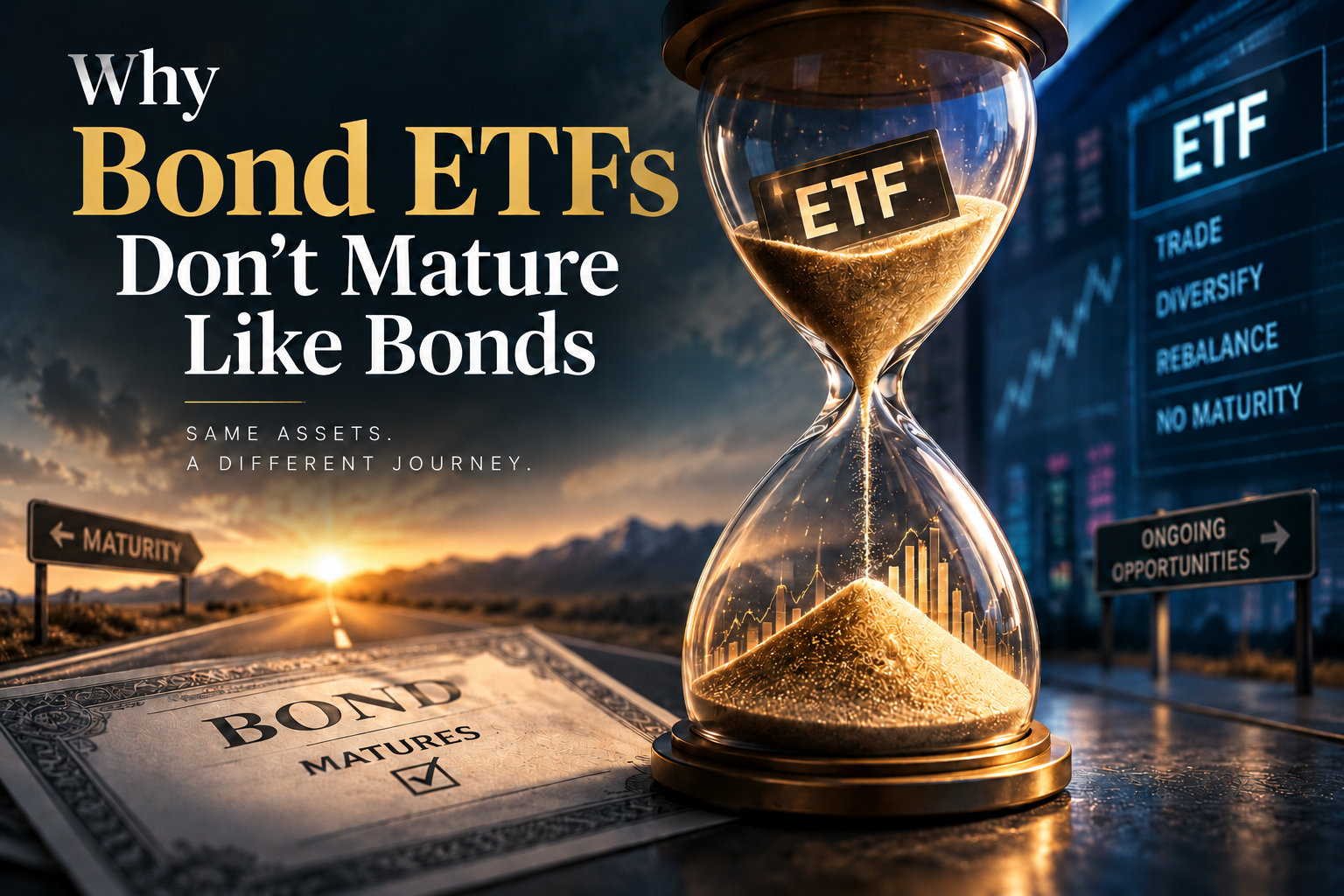
Individual bonds have contractual maturity dates, while traditional open-ended bond ETFs such as TLT, SHY and AGG do not have one final maturity date.
TLT remains concentrated in long-dated Treasuries because bonds eventually leave its eligible universe as their remaining maturity shortens.
A longer holding period does not create a future date when TLT must repay the price an investor originally paid for the ETF.
SHY follows a similar fund structure but stays in short-term Treasuries, giving it much lower sensitivity to interest-rate changes than TLT.
Defined-maturity bond ETFs are an exception because they are designed to terminate around a particular year, although their final value per share is not predetermined.
Consider an investor who buys one 20-year Treasury. As the years pass, the bond’s remaining maturity falls until the Treasury repays its face value at maturity, assuming the government makes all promised payments. The amount repaid should not be confused with the investor’s purchase price because Treasury securities can trade above or below face value in the secondary market.
TLT works differently. The iShares 20+ Year Treasury Bond ETF tracks an index of Treasury bonds with more than 20 years remaining to maturity. A bond cannot stay in that universe forever because each passing year reduces its remaining maturity.
As securities cease to meet the index requirements, the portfolio can remove them while gaining exposure to newer qualifying Treasuries. Without those changes, a portfolio originally filled with 20- and 30-year bonds would eventually become an intermediate-term, then short-term, bond portfolio.
The bond ages. The ETF maintains exposure.
That is why TLT does not gradually become a short-term Treasury fund simply because its holdings are getting older.
Maturity gives an individual bondholder a contractual endpoint. If the issuer fulfils its obligations, the holder receives the bond’s face value at maturity regardless of where that bond traded during much of its life.
TLT shareholders have no equivalent repayment date. The ETF continues to own long-term Treasuries whose market prices respond to prevailing yields, so its share price can remain above or below the level at which an investor originally bought it.
A rise in long-term Treasury yields can push down the value of existing long-duration bonds. If yields later decline, those bonds can appreciate again. Distributions also contribute to the investor’s total return over time.
A longer holding period can therefore improve or worsen the final outcome depending on income received and subsequent market conditions. No maturity event requires TLT to return to an investor’s original purchase price.
SHY makes the maturity issue easier to separate from interest-rate risk. The iShares 1-3 Year Treasury Bond ETF tracks Treasuries with roughly one to three years remaining to maturity, whereas TLT focuses on securities with more than 20 years remaining.
That gap produces very different price behaviour. Long-term bonds generally react more sharply to yield changes because more of their cash flows lie further in the future. SHY stays much closer to maturity and therefore tends to experience smaller price movements from comparable interest-rate changes.
Both ETFs continue operating without a final fund maturity date. TLT retains long-duration exposure, while SHY remains concentrated at the short end of the Treasury market.
Feature |
TLT |
SHY |
|---|---|---|
Main exposure |
U.S. Treasuries with 20+ years remaining |
U.S. Treasuries with 1–3 years remaining |
Fixed ETF maturity |
No |
No |
Rate sensitivity |
Higher |
Lower |
What changes over time |
Individual holdings |
Individual holdings |
Exposure retained |
Long-term Treasuries |
Short-term Treasuries |
The comparison also shows why the absence of a fund maturity date does not automatically imply high volatility. The maturity profile of the underlying bonds remains the more important driver of rate sensitivity.
AGG extends the idea beyond Treasury-only funds. The iShares Core U.S. Aggregate Bond ETF tracks the Bloomberg U.S. Aggregate Bond Index and provides broad exposure to U.S. investment-grade fixed income, including Treasuries, mortgage-backed securities and corporate bonds.
AGG is more complicated than TLT or SHY because its holdings do not all share the same cash-flow characteristics. Mortgage-backed securities, for example, can return principal through borrower prepayments, while corporate bonds introduce credit risk alongside interest-rate risk.
Those differences affect AGG’s performance, but they don't give the ETF a single maturity date. The fund continues to represent the broader investment-grade bond market while individual securities mature, repay principal, or leave the benchmark.
With an individual bond, a long holding period can have a clearly defined destination: maturity. The remaining time declines until the issuer becomes contractually due to repay principal.
A traditional bond ETF has no comparable finish line. Holding TLT, SHY, or AGG for ten or twenty years means staying invested through years of distributions, portfolio changes, and market repricing.
Time can still play an important role in returns. Income accumulates and the yields available within the portfolio change as the interest-rate environment changes. Time does not create a contractual date at which the ETF must repay the investor’s original capital.
For that reason, “holding a bond ETF for the long term” and “holding a bond to maturity” describe different approaches to fixed-income exposure.
The maturity structure can influence which format fits a particular financial objective. Someone matching an investment to a known future cash requirement may value an individual bond's specified maturity and principal payment, provided the issuer meets its obligations.
Bond ETFs provide continuous access to a market segment without requiring the holder to buy replacement securities as individual bonds age. TLT offers long-term Treasury exposure, SHY focuses on short-term Treasuries, and AGG covers a much broader investment-grade bond universe.
Individual bond |
Traditional bond ETF |
|---|---|
Has a stated maturity date |
Fund has no common maturity date |
Has a contractual face-value repayment |
No predetermined repayment of the ETF purchase price |
Exposure naturally shortens as maturity approaches |
Fund continues targeting its chosen market segment |
Usually concentrated in one issuer/security unless several bonds are purchased |
Provides a diversified portfolio |
Investor handles reinvestment after maturity |
Fund manages portfolio turnover internally |
The practical distinction is therefore tied to function. An individual bond can align with a particular date, whereas a traditional bond ETF provides ongoing market exposure.
Defined-maturity bond ETFs operate differently. These funds hold securities concentrated around a specified maturity year and are designed to terminate after that period rather than continue indefinitely.
The iShares iBonds Dec 2030 Term Treasury ETF, or IBTK, is one example. Its prospectus states that the fund is scheduled to cease operations and liquidate by December 15, 2030. During its final year, maturing securities can leave the portfolio increasingly concentrated in cash equivalents ahead of liquidation.
A defined-maturity ETF still should not be treated as one individual Treasury bond. At termination, shareholders receive their share of the fund’s remaining net assets after liabilities rather than a guaranteed face value attached to each ETF share.
The distinction is straightforward: traditional open-ended bond ETFs such as TLT, SHY, and AGG continue indefinitely unless the fund sponsor decides otherwise, while defined-maturity funds are deliberately built to wind down around a stated year.
Yes. Individual bonds keep their own maturity dates, although an ETF may sell or remove a security before maturity when it no longer qualifies for the fund’s benchmark or strategy.
SHY holds Treasuries with much shorter remaining maturities. Shorter-duration bonds generally experience smaller price changes when yields move than the long-term Treasuries held by TLT.
No. They provide a defined termination year, but shareholders do not receive a predetermined face value per ETF share when the fund liquidates.
TLT, SHY, and AGG own securities with maturity or repayment schedules, but the funds themselves do not move toward a single common repayment date. Their portfolios still represent specific areas of the bond market even as individual holdings age or mature.
An individual bond therefore offers a maturity mechanism that a traditional bond ETF does not. A bond ETF can still be held for many years and generate returns through income and market-price changes, but those returns depend on an ongoing portfolio rather than a final contractual repayment.