Cocoa prices have fallen sharply from the extreme highs that shocked commodity markets in 2024 and 2025, but chocolate prices remain elevated. The gap looks irrational at first glance. In reality, it shows how slowly commodity shocks move through the consumer economy.

Futures markets reprice expectations almost instantly. Chocolate prices do not. They move through forward purchases, hedging contracts, seasonal production, retailer negotiations, packaging, wages, freight, and margin protection. A cocoa futures crash can appear on a trading screen months before checkout prices respond.
Cocoa traded near $3,883 per metric ton on May 4, 2026, up from earlier-year lows but still more than 55% lower year over year and far below the December 2024 record near $12,906. The crisis has cooled, but the cost reset has not fully reached the shelf.
Cocoa futures have normalized from panic levels, but prices remain above much of the pre-crisis range.
The 2027 cocoa price outlook points to a higher new normal, with major forecasts ranging from roughly $4,200 to $6,000 per metric ton.
Retail chocolate prices lag cocoa futures because manufacturers buy, hedge, process, and package cocoa months before final sale.
The ICCO revised the 2024/25 cocoa balance to a 75,000-tonne surplus, with production at 4.728 million tonnes and grindings at 4.606 million tonnes.
West Africa remains the central cocoa supply risk, with Côte d’Ivoire and Ghana accounting for roughly 60% of global output.
The cocoa market has moved through three phases. The first was scarcity. Poor weather, crop disease, aging trees, underinvestment, and disrupted harvests in West Africa created a historic supply squeeze. Cocoa futures surged above $12,000 per metric ton as buyers feared a physical shortage.
The second phase was demand destruction. High cocoa costs forced chocolate companies to raise prices, reduce promotions, adjust product mix, and reformulate some products. Consumers responded by trading down, buying less, or shifting toward non-chocolate confectionery.
The third phase is whiplash. Supply expectations improved, demand softened, and cocoa futures fell hard. Prices dropped sharply in early 2026 as better West African weather improved the crop outlook and weaker demand reduced pressure on physical supply.
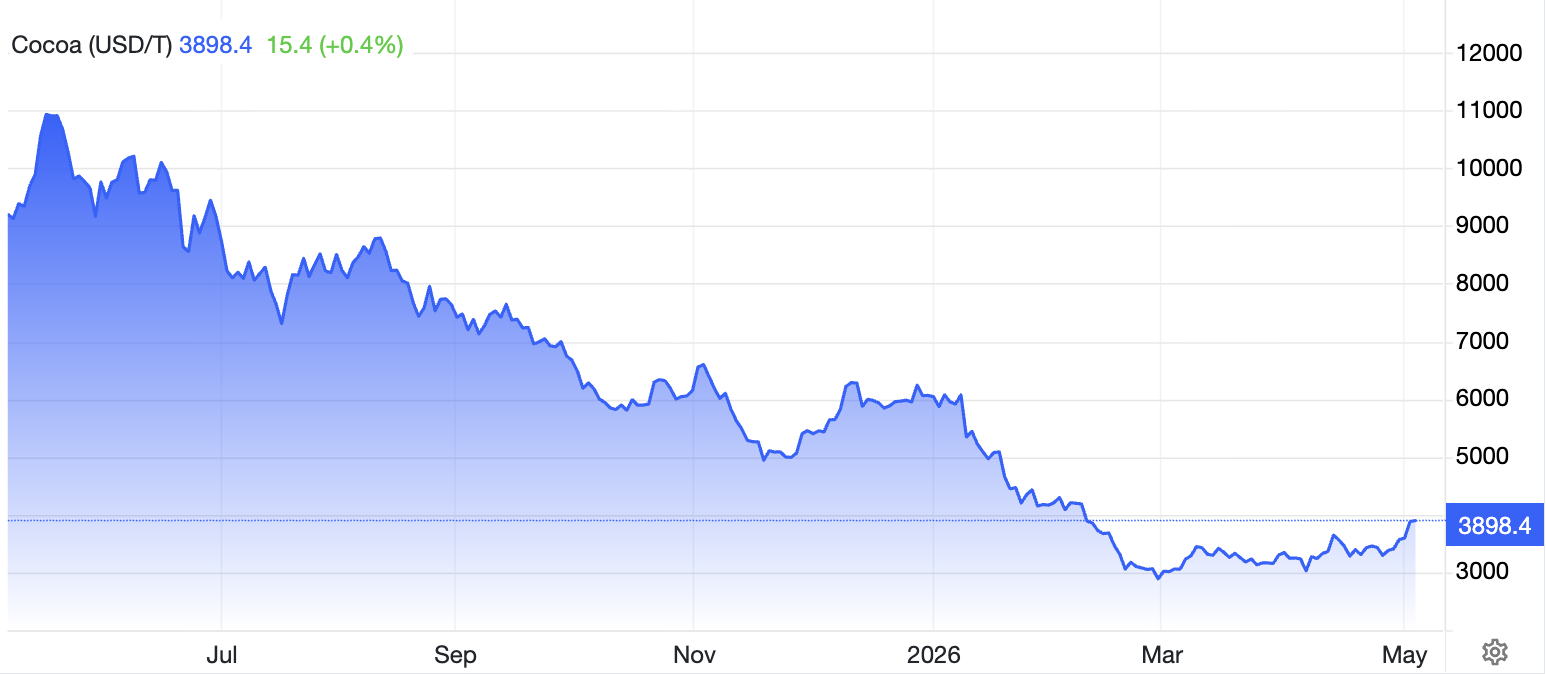
The crisis has moved from acute shortage to unstable normalization. Cocoa is no longer priced as if the market is running out of supply, but it has not returned to the old low-cost environment that supported the chocolate industry before the shock.
| Cocoa Market Indicator | Latest Reading | Market Signal |
|---|---|---|
| Cocoa price, May 4, 2026 | ~$3,883/MT | Rebound from local lows, far below peak |
| December 2024 record | ~$12,906/MT | Panic pricing during supply crisis |
| World Bank 2026 forecast | ~$3,800/MT | Normalization, not cheap cocoa |
| World Bank 2027 forecast | ~$4,200/MT | Stabilization above 2026 average |
| ICCO 2024/25 production | 4.728 million tonnes | Supply recovery |
| ICCO 2024/25 grindings | 4.606 million tonnes | Demand weakened |
| ICCO market balance | +75,000 tonnes | Surplus restored |
The revised supply balance explains why cocoa futures retreated. Production recovered, grindings fell, and the market moved into surplus after a severe shortage. For chocolate buyers, however, a bearish futures shift was not an immediate guarantee of lower retail prices.
Chocolate companies do not buy cocoa on Monday and sell finished chocolate bars on Tuesday. Beans must be sourced, shipped, processed into liquor, butter, and powder, blended into recipes, manufactured, wrapped, transported, listed with retailers, and placed on shelves.
Seasonal chocolate makes the lag longer. Easter, Halloween, Christmas, and Valentine’s Day products are planned and produced months ahead of sale. A chocolate egg sold in spring 2026 may reflect cocoa costs locked in during 2025, when market stress was much higher.
Hedging slows the pass-through as well. Large manufacturers use cocoa futures and supply contracts to reduce volatility. When cocoa rises, hedging can delay the pain. When cocoa falls, hedging can delay the benefit.
Retail negotiations add another delay. Shelf prices reflect contracts, promotional calendars, retailer margins, slotting decisions, and category strategy. Once prices rise, companies often wait before cutting them, especially if sales volumes remain resilient.
Chocolate companies absorbed a historic cost shock. Many raised prices, reduced discounts, changed pack sizes, and shifted portfolios toward items that use less cocoa. Lower cocoa futures now give those companies room to repair margins before they pass savings back to consumers.
Food prices often rise faster than they fall because the final product includes more than the raw commodity. Chocolate prices also reflect sugar, dairy, nuts, packaging, energy, labor, financing, shipping, marketing, and retail margins. Cocoa is essential, but it is only one part of the cost stack.
For investors, the key question is whether lower cocoa improves margins or triggers price competition. If cocoa remains near $3,800 per metric ton instead of returning to $2,500 to $3,000, chocolate makers may still face a higher cost base than before the crisis. If shoppers resist, companies may be forced into discounts, smaller packs, or recipe changes instead of broad price cuts.
The most important supply risk remains West Africa. Côte d’Ivoire and Ghana together account for around 60% of global cocoa output, making the market unusually concentrated. Favorable weather helped pressure prices lower in early 2026, but the outlook remains sensitive to irregular rainfall, disease, fertilizer access, and El Niño-related disruption.

Cocoa is not a fast-cycle crop. Farmers cannot respond to price signals the way oil producers can adjust drilling or miners can change output schedules. Cocoa trees take years to mature, while disease control, fertilizer use, pruning, replanting, and farm maintenance all require cash and confidence.
A futures crash can plant the seeds of the next shortage. If growers receive lower farmgate prices, face high input costs, or abandon cocoa for other activities, production recovery can fade quickly.
The 2027 outlook for cocoa prices points to stabilization, not a return to cheap cocoa. Major forecasts suggest the market may settle above the pre-2023 baseline near $2,500 per metric ton.
Key projections remain split:
World Bank: around $4,200 per metric ton.
J.P. Morgan: near $6,000, reflecting higher structural supply risk.
Commercial-bank consensus: roughly $4,000+, assuming gradual demand recovery.
Technical scenarios: around $4,000 to $4,100 if support holds.
The main driver is supply fragility. West Africa’s aging trees, disease pressure, fertilizer shortages, and climate exposure limit how quickly production can recover. Demand could also rebound in 2027 if consumers adjust to higher chocolate prices.
Regulation adds another layer. The EU Deforestation Regulation may raise traceability and compliance costs from late 2026, keeping the cocoa supply chain more expensive.
The base case is a higher new normal: cocoa may stay far below its record highs, but it is unlikely to behave like a cheap commodity again.
Cocoa is a small part of the global inflation basket, but it offers a clear example of how inflation becomes sticky. Commodity deflation does not automatically produce consumer deflation. The futures market reflects marginal expectations, while the retail market reflects embedded costs.
A lower commodity price may reduce pressure in the pipeline, but the final price paid by consumers depends on contracts, inventories, brand power, and retailer strategy. The result is a new category equilibrium: some products stay permanently more expensive, some become smaller, and some shift toward lower cocoa content.
Cocoa prices are falling because supply expectations improved after the extreme shortage, while high retail chocolate prices weakened demand. The market balance has shifted from deficit toward surplus, reducing the panic premium embedded in cocoa futures.
Chocolate prices lag cocoa futures because manufacturers often buy and hedge cocoa months in advance. Retail prices also include labor, packaging, sugar, dairy, freight, retailer margins, and earlier cost increases that companies may not reverse quickly.
Cocoa prices are expected to stabilize or recover modestly in 2027. Major forecasts cluster around $4,000 to $4,200 per metric ton, while more bullish structural views sit closer to $6,000 if West African supply risks persist.
Cocoa prices have fallen, but chocolate is still working through the old shock. Futures markets reset quickly because they trade expectations. Consumer prices reset slowly because they move through contracts, hedges, inventories, factories, retailers, and corporate pricing decisions.
The cocoa market is no longer in full crisis, but it remains unstable. Supply has improved, demand has cooled, and forecasts point to a lower average price in 2026 followed by modest recovery in 2027. West African production remains exposed to weather, disease, farmer economics, fertilizer costs, and new traceability rules.
Cocoa explains why cheaper commodities do not always mean cheaper goods. It also shows why the spot price is only one part of the signal. The real market story sits where inflation, corporate margins, supply risk, and consumer resistance meet.