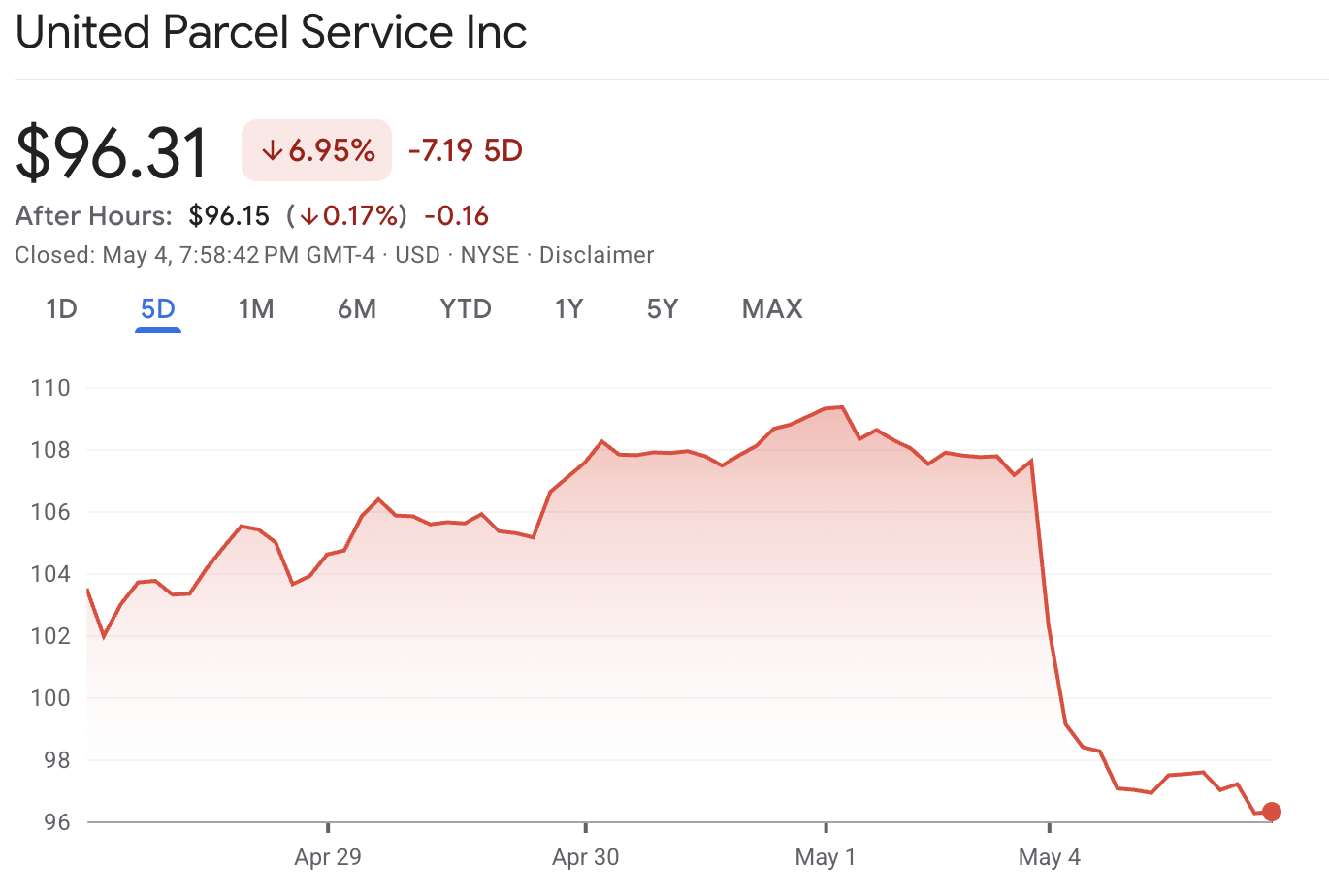
UPS Stock sank 10.5% to $96.31 on May 4 as Amazon Supply Chain Services reset the market’s risk calculus for parcel carriers.
The selloff was not just a headline reaction to Amazon’s logistics expansion. It marked a broader reassessment of UPS’s pricing power, network density, operating leverage, and 2026 margin recovery as a scaled competitor moves deeper into third-party logistics.
The decline came shortly after UPS reaffirmed full-year 2026 targets for revenue of about $89.7 billion and non-GAAP adjusted operating margin of about 9.6%. That guidance remains intact, but investors are attaching a higher risk premium to UPS’s recovery path as Amazon opens more of its logistics infrastructure to external businesses.
UPS stock closed at $96.31, down 10.5%, after trading as low as $95.98 during the session.
Trading volume reached 18.5 million shares, pointing to broad risk reduction rather than a routine low-volume pullback.
UPS reported Q1 2026 revenue of $21.2 billion, non-GAAP adjusted operating profit of $1.32 billion, and adjusted diluted EPS of $1.07.
U.S. Domestic revenue fell 2.3%, while revenue per piece rose 6.5%, showing firm pricing but weaker volume absorption.
International revenue rose 3.8%, supported by a 10.7% increase in revenue per piece, making it the cleaner segment signal.
Amazon Supply Chain Services, or ASCS, extends Amazon’s freight, distribution, fulfillment, and parcel-shipping capabilities to businesses beyond its own marketplace ecosystem. Amazon has positioned the service as a broader logistics platform for companies of different sizes and sectors, not merely an add-on for sellers already tied to its retail channel.

The reaction reflects the wider competitive implications. ASCS gives Amazon a more direct role in the shipper market that UPS, FedEx, regional carriers, and third-party logistics operators rely on for profitable volume. The risk is not limited to last-mile delivery. It reaches across freight movement, inventory positioning, warehousing, fulfillment, parcel injection, and customer-facing delivery performance.
For UPS, investors are no longer treating Amazon only as a shrinking lower-margin customer. They are also discounting Amazon as a network operator with enough scale to commercialize spare capacity and pressure incumbent carrier economics.
Parcel carriers generate earnings power through route density and asset utilization. Higher package volume improves stop efficiency, hub throughput, aircraft utilization, and truck productivity. When volume falls, fixed network costs spread across fewer packages, reducing operating leverage.
UPS is already reducing exposure to lower-yield Amazon volume while replacing it with higher-margin business. ASCS complicates that shift by competing for external shipper demand in the same lanes UPS wants to rebuild. The stock move therefore reflects a margin-risk repricing, not just a reaction to another logistics competitor.
UPS’s first-quarter results showed a business still moving through a difficult transition. Consolidated revenue declined modestly, while non-GAAP adjusted operating margin compressed to 6.2% from 8.2% a year earlier. Non-GAAP adjusted operating profit fell to $1.32 billion from $1.76 billion.
| Metric | Q1 2026 | Market Signal |
|---|---|---|
| Consolidated revenue | $21.2B | Revenue base stabilizing |
| Non-GAAP adjusted operating profit | $1.32B | Profit bridge still weak |
| Non-GAAP adjusted operating margin | 6.2% | Well below full-year target |
| U.S. Domestic revenue | $14.13B | Domestic volume pressure persists |
| U.S. revenue per piece | +6.5% | Pricing discipline intact |
| International revenue | $4.54B | Stronger segment momentum |
| International revenue per piece | +10.7% | Higher-quality yield profile |
| 2026 revenue target | $89.7B | Guidance reaffirmed |
| 2026 adjusted margin target | 9.6% | Requires sharp improvement |
The data points to a narrower recovery path. UPS has pricing power in selected lanes, but volume weakness continues to dilute the benefit. The company needs cost reductions, network reconfiguration, and mix improvement to arrive faster than revenue leakage.
U.S. Domestic Package generated $14.13 billion of Q1 revenue, down from $14.46 billion a year earlier. Adjusted operating margin was only 4.0%, compared with 7.0% in Q1 2025.
That segment carries the highest sensitivity to Amazon’s logistics push. Domestic parcel economics rely heavily on package density, route productivity, and labor efficiency. If ASCS gains traction among enterprise shippers, investors may assume a lower ceiling for UPS’s domestic margin recovery.
International Package remains the stronger part of the portfolio. Revenue rose to $4.54 billion, while revenue per piece increased 10.7%. Adjusted operating margin was 12.1%, materially above the U.S. Domestic segment.
That mix supports the investment case, but it does not fully offset domestic pressure. International shipments often carry better yield characteristics and stronger customs-related service value. The question is whether international growth can offset domestic cost absorption pressure quickly enough to support UPS’s 2026 margin target.
The trading pattern weakened sharply. UPS opened at $102.83, traded between $95.98 and $107.50, and closed near the session low at $96.31. That range suggests sellers controlled the close, with limited evidence of late-session accumulation.
Immediate support sits around $95 to $96. A sustained break below that zone would leave the stock vulnerable to a deeper retest of prior downside levels. Resistance now builds around $103 to $108, the pre-selloff area where trapped supply may reappear.
Near-term momentum remains impaired while the stock trades below the pre-news range. A recovery above $103would ease downside pressure, but a move through $108 is needed to suggest investors are looking through the Amazon-driven repricing.
Until then, upside rallies may face selling from funds reducing exposure ahead of clearer evidence on second-quarter operating margin.
UPS stock sank 10.5% because Amazon Supply Chain Services reset the competitive framework for the parcel market. The issue is not UPS’s relevance as a global logistics operator. It is whether UPS can rebuild margins while Amazon sells logistics capacity into the same shipper market UPS is targeting for higher-yield volume.
The company still has meaningful strengths: pricing discipline, international yield, healthcare logistics exposure, and cost-reduction levers. Execution now carries the burden. UPS must show that network reconfiguration can protect density, preserve yield, and lift adjusted margin toward its 2026 target.
After ASCS, valuation support depends less on the rebound narrative and more on measurable proof that UPS can defend parcel economics against a new competitive curve.