Published on: 2026-04-21
Updated on: 2026-04-21
In January 2026, the United Nations declared the world has entered 'global water bankruptcy,' a condition where depleted rivers, lakes, and aquifers will never recover to their historical levels. The damage is permanent.
The annual economic value of water and freshwater ecosystems is $58 trillion, equivalent to 60% of global GDP. By 2050, around 46% of global GDP could come from areas facing high water risk, up from 10% today.
Three billion people live in areas where total water storage is declining, and over 50% of global food is produced in those same stressed regions. The current annual cost of drought alone is $307 billion.
Three of the world’s most consequential water disputes are intensifying simultaneously: the Nile Basin (Egypt, Ethiopia, Sudan), the Indus Basin (India, Pakistan), and the Colorado River (U.S., Mexico). Each carries direct consequences for GDP, food security, and sovereign stability.
In January 2026, the United Nations University published a report that should have moved markets. It declared that the world has entered the era of “global water bankruptcy,” a condition where river basins and aquifers have been drawn down past the point of recovery. The language was borrowed deliberately from finance: humanity has been spending its water “principal,” not just its “interest,” and the account is now overdrawn in ways that cannot be reversed on human timescales.
The report landed at Davos during what the World Economic Forum called “Blue Davos.” It generated panel discussions, press releases, and concerned speeches. What it did not generate was a repricing of the assets, commodities, currencies, and sovereign bonds most exposed to the reality it described.
The numbers in the UN report, authored by Kaveh Madani at UNU-INWEH, read like a corporate balance sheet in liquidation. WWF’s landmark study estimated the annual economic value of the world’s water and freshwater ecosystems at $58 trillion, equivalent to 60% of global GDP. Of that, roughly $7.5 trillion comes from direct economic uses such as household consumption, irrigated agriculture, and industrial inputs.
The remaining $50 trillion represents ecosystem services that most economic models do not price: water purification, soil health, carbon storage, and flood protection.
Three billion people now live in areas where total water storage is declining or unstable. Over 50% of global food production is concentrated in those same regions. The annual global cost of drought alone has reached $307 billion. Research by GHD projects that droughts, floods, and storms could wipe $5.6 trillion from GDP across key economies between 2022 and 2050.
The most alarming figure may be the forward projection: by 2050, around 46% of global GDP could come from areas facing high water risk, up from roughly 10% today. That is a structural shift in where economic output concentrates relative to where water is available, and it has implications for every asset class tied to agriculture, real estate, energy, and sovereign creditworthiness.
The UN report documented losses that are not theoretical. Over the past five decades, the world has lost roughly 410 million hectares of natural wetlands, an area nearly the size of the European Union. The ecosystem services those wetlands provided, including water filtration, flood absorption, and habitat support, are valued at over $5.1 trillion, roughly equal to the combined annual GDP of the world’s 135 poorest countries.
More than half of the world’s large lakes have lost water since the early 1990s. Around 70% of the world’s major aquifers show long-term declining trends. Two-thirds of the world’s largest rivers are no longer free-flowing. Land subsidence from groundwater over-pumping now affects more than 6 million square kilometers, nearly 5% of global land area, and close to 2 billion people.
Madani put it directly: “In finance, when you spend more than you earn for too long, you go bankrupt. We have done exactly that with our water ‘checking’ and ‘savings’ accounts.”
Water scarcity on its own is a slow-moving crisis. Water scarcity combined with transboundary politics becomes a fast-moving one. Three disputes are intensifying simultaneously, each with direct financial consequences.
Egypt depends on the Nile for roughly 97% of its water supply. Agriculture accounts for about 15% of Egypt’s GDP and employs 32% of its workforce. Per capita water availability has fallen from 2,526 cubic meters per year in 1947 to under 600 today, well below the UN’s 1,000 cubic meter threshold for water scarcity.
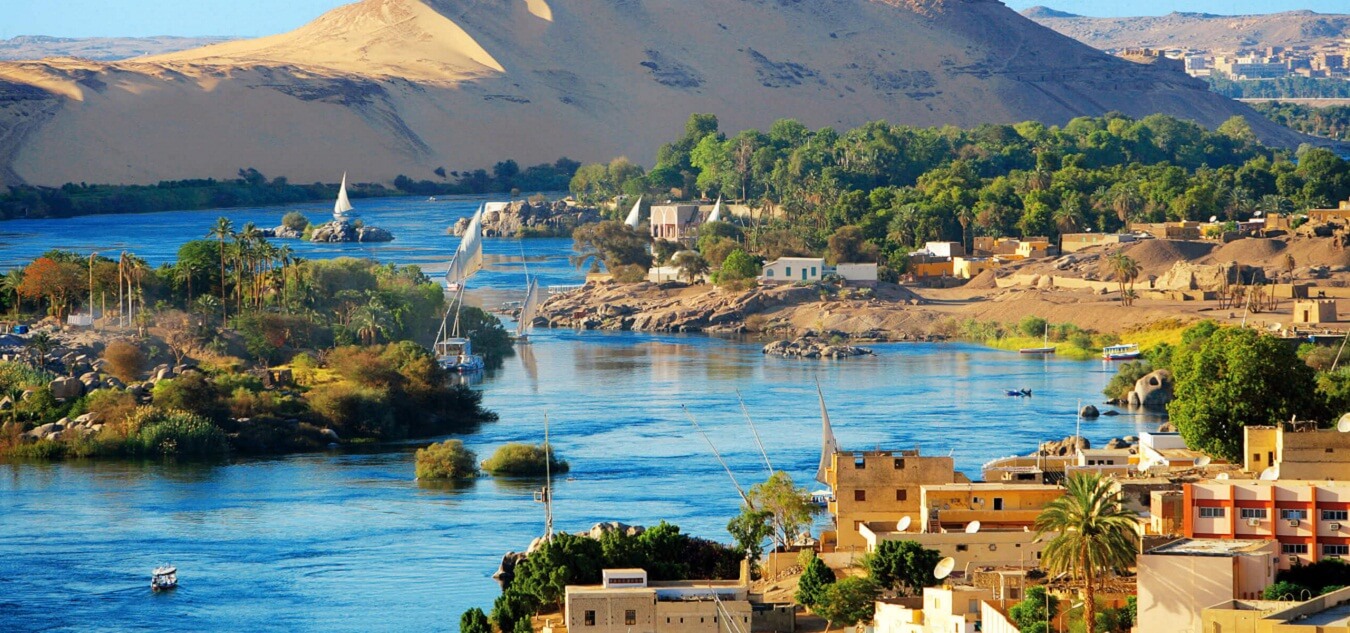
The Grand Ethiopian Renaissance Dam has changed the equation. A USC study projects that rapid filling of the dam could reduce Egypt’s water supply by more than one-third, cut arable land by up to 72%, and generate $51 billion in agricultural losses. The projected GDP impact would push unemployment to 24%. Egypt already imports roughly half its food and is the world’s largest wheat buyer.
The Atlantic Council has noted that water scarcity affecting Egypt’s agricultural economy and food prices could factor into renewed anti-government protests mirroring those that led to the 2011 revolution. For traders and sovereign debt analysts, the Nile dispute is where food security, political stability, and bond yields intersect.
India suspended the Indus Waters Treaty in April 2025 following the Pahalgam attack, placing one of the world’s most consequential water-sharing agreements in abeyance for the first time in its 65-year history. The treaty, brokered by the World Bank in 1960, governs water distribution across six rivers that support roughly 300 million people.
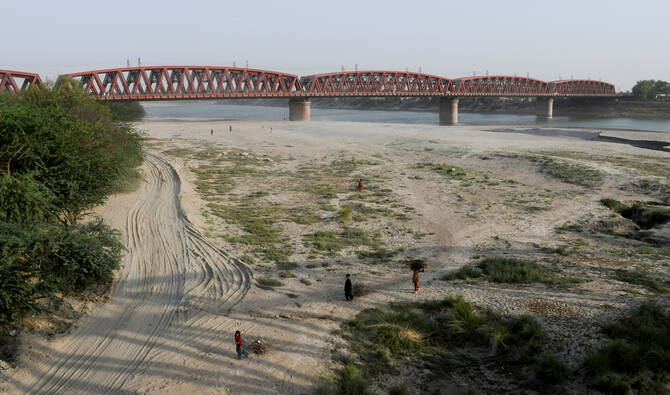
The economic exposure is concentrated in Pakistan, where the Indus Basin irrigates over 80% of arable land, agriculture represents nearly 23% of GDP, employs 37% of the workforce, and accounts for 24% of exports. Every one of Pakistan’s 21 hydroelectric plants is located in the Indus Basin, generating 28% of national electricity. CSIS analysis notes that India’s suspension also halted hydrological data sharing, depriving Pakistan of flood warnings and water management planning.
Analysts project a potential GDP decline of 1.5% to 2% for Pakistan if disruption continues. For a country already managing debt restructuring, currency instability, and food inflation, the water variable is the one that could accelerate all three.
The Colorado River, which supports $1.4 trillion in annual economic activity across seven U.S. states and northern Mexico, has been in structural deficit for over two decades. Lake Mead and Lake Powell, the river’s two largest reservoirs, hit record lows in recent years. Agriculture in California’s Imperial Valley, Arizona’s Yuma region, and northern Mexico depends on allocations that were set in 1922, when the river carried far more water than it does today.
The 2026 renegotiation of Colorado River operating guidelines is underway, and the outcome will determine water allocations for states that collectively produce a significant share of U.S. winter vegetables, cotton, alfalfa, and cattle feed. Property values, municipal bond ratings, and agricultural commodity pricing across the American Southwest are all functions of how this negotiation resolves.
Water has no globally traded futures contract. It has no liquid benchmark price. It has no standardized risk metric that flows into credit models, equity valuations, or sovereign debt assessments. The World Bank estimates that only 2-3% of global investment in water comes from private sector financing.
The result is a systematic mispricing of water risk across nearly every asset class. Agricultural land valuations in water-stressed regions do not reflect declining aquifer levels. Sovereign credit ratings for countries where 30-40% of GDP depends on irrigated agriculture do not adequately weight the probability of multi-year drought. Real estate markets in cities dependent on long-distance water transfers, from Phoenix to Chennai to Cairo, do not discount the infrastructure risk embedded in their supply.
The World Bank has flagged the investment gap. The private sector currently provides minimal capital for water infrastructure, and the pipeline of investable water projects remains thin relative to the scale of the problem. The gap between what water systems need and what they receive in capital investment is widening at exactly the moment when climate variability is accelerating the depletion of natural water storage.
Roughly 70% of global freshwater withdrawals go to agriculture. Groundwater provides over 40% of irrigation water worldwide, and 50% of domestic water. The Indus Basin alone supplies water for about 90% of Pakistan’s food production. Egypt’s Nile Delta produces 63% of the country’s agricultural output.
When aquifers decline, farmers either drill deeper at higher cost, switch to less water-intensive crops at lower revenue, or abandon production entirely. Each path raises food prices. The UN report noted that “millions of farmers are trying to grow more food from shrinking, polluted, or disappearing water sources” and warned that “without rapid transitions toward water-smart agriculture, water bankruptcy will spread rapidly.”
For commodity traders tracking wheat, rice, sugar, and cotton, the water variable is increasingly the one that determines whether a country’s harvest meets projections or falls short. Egypt’s wheat import bill, Pakistan’s rice export capacity, India’s sugar output, and California’s almond production are all directly tied to water availability that is declining on structural, not cyclical, timescales.
The $58 trillion in annual ecosystem value that water provides has no global insurance mechanism, no futures contract, and no standardized risk metric feeding into credit models. Three billion people living in areas of declining water storage overlap almost exactly with the regions producing over 50% of global food.
Egypt faces a potential $51 billion agricultural loss from the Nile dispute and is already the world's largest wheat importer. Pakistan, with 23% of GDP tied to agriculture irrigated by a river system now under treaty suspension, is simultaneously managing debt restructuring and currency instability. By 2050, 46% of global GDP could sit in high water risk zones, up from 10% today.
That is a repricing of sovereign credit, agricultural commodities, and urban real estate on a scale that no current financial model is built to capture.