Published on: 2026-04-02
Updated on: 2026-04-02
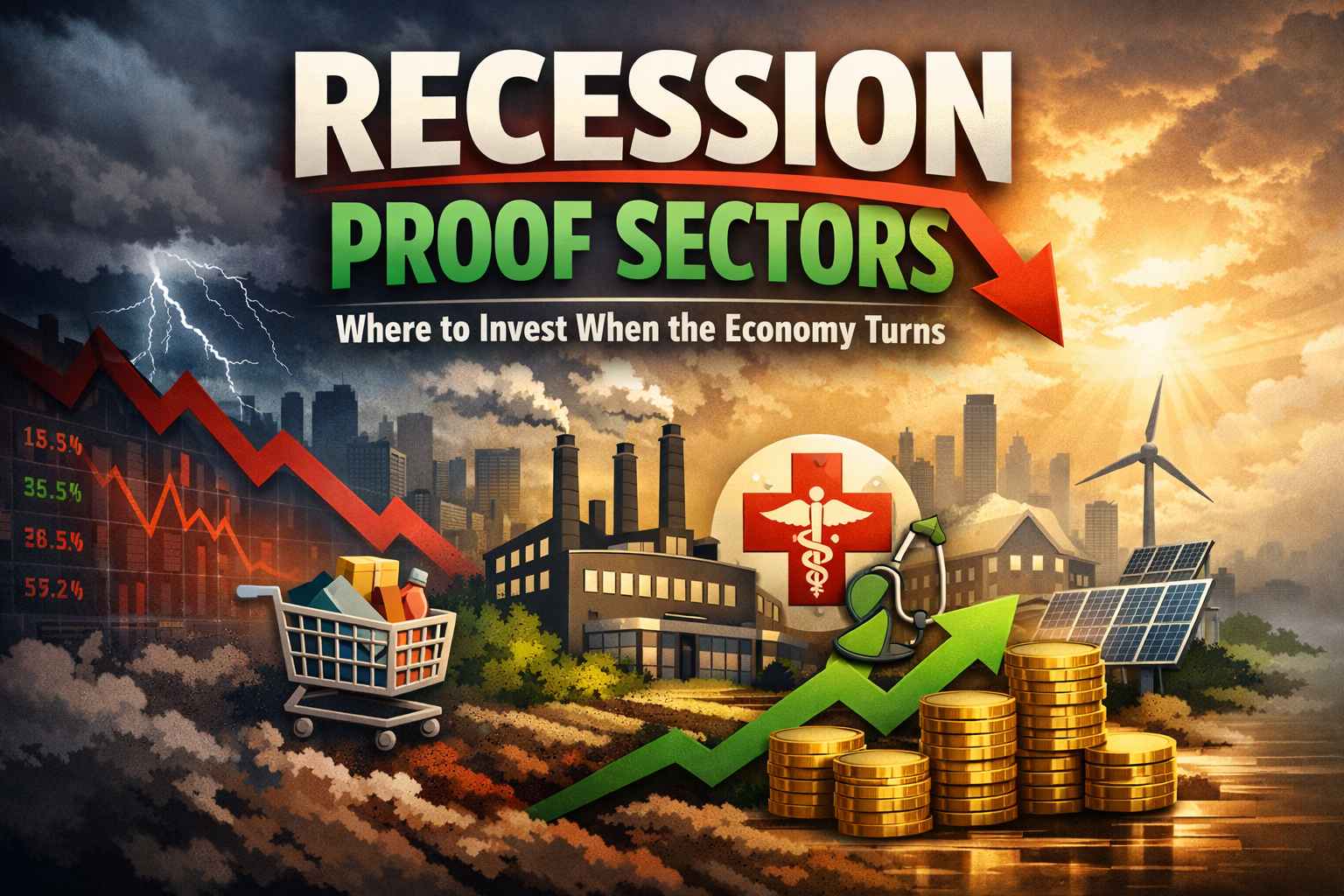
While many investors recognize the importance of adopting a defensive strategy during a recession, fewer understand which sectors consistently fulfill this role and the underlying reasons for their resilience.
Rotating blindly into anything labelled defensive just before a downturn is one of the most common and costly mistakes self-directed investors make. The timing is usually wrong, and not every defensive sector performs the same way in every recession.

Given the current outlook for 2025 and 2026, characterized by tariff-driven growth concerns, elevated interest rates, and a late-cycle economic environment, understanding recession-proof sectors provides a significant advantage.
Few investments are genuinely recession-proof; however, the term typically refers to assets, companies, or industries that demonstrate resilience in the face of a recession.
Such investments may exhibit an inverse relationship with the broader market, often performing well when other stocks underperform.
At the sector level, resilience is primarily determined by the extent to which demand remains stable even when household budgets are constrained.
The structural traits that separate a genuinely defensive sector from a merely stable-looking one are:
Demand inelasticity: Consumers cannot easily opt out of purchasing, regardless of changes in income.
Revenue stability: Earnings are predictable and not highly sensitive to fluctuations in GDP.
Regulated or contracted income: Many defensive sectors operate under government regulation or long-term contracts that insulate revenue from market disruptions.
Dividend continuity: Sustained cash flow allows companies to maintain and grow dividend payments through downturns.
 1) Consumer Staples
Consumer staples remain the classic defensive sector. Food, beverages, household goods, and personal care products are non-discretionary purchases, so demand tends to hold up even when growth slows.
That resilience supports companies such as Procter & Gamble, Coca-Cola, Walmart, and Johnson & Johnson. Strong brands also help preserve pricing power, which can protect margins when costs rise.
Healthcare is one of the most durable sectors in any downturn. Demand for medicine, treatment, and essential care does not fade with weaker consumer confidence or slower economic activity.
Its defensive profile is reinforced by demographics. An ageing population, particularly in developed markets, continues to provide a steady structural base for demand across pharmaceuticals, medical devices, and care services.
Examples: Johnson & Johnson (JNJ), Eli Lilly (LLY), and UnitedHealth Group (UNH).
Utilities benefit from one of the most stable demand profiles in equity markets. Households and businesses continue to pay for electricity, water, and gas in almost any economic environment, while regulated pricing frameworks help smooth revenue volatility.
The sector also appeals to income-focused investors because of its dividend yield. The main risk is interest-rate sensitivity, as utility valuations often come under pressure when long-term yields rise.
Examples: NextEra Energy (NEE), Duke Energy (DUK), and Southern Company (SO).
Telecommunications has become increasingly defensive as connectivity has become essential. Mobile and broadband services are among the last expenses consumers and businesses are willing to cut, which supports recurring cash flow even during recessions.
That subscription-based model gives the sector greater earnings visibility than many cyclical industries. In weaker economies, that predictability becomes especially valuable.
Examples: Verizon (VZ), AT&T (T), and T-Mobile US (TMUS).
Defence is less obvious, but often highly resilient. Large contractors operate on multi-year government agreements that are generally insulated from consumer demand and short-term economic swings.
The sector also benefits from structural support. Elevated geopolitical tension and sustained military spending commitments give defence companies a backlog profile that can remain firm even during broader market weakness.
Examples: Lockheed Martin (LMT), RTX (RTX), Northrop Grumman (NOC), and General Dynamics (GD).
| Sector | Primary Driver of Resilience | Main Risk | Dividend Profile |
|---|---|---|---|
| Consumer Staples | Non-discretionary demand | Input cost inflation | Strong, long growth streaks |
| Healthcare | Medical need persists in all cycles | Regulatory and pricing risk | Solid, growing |
| Utilities | Regulated revenues, essential services | Interest rate sensitivity | High yield, reliable |
| Telecommunications | Subscription model, essential connectivity | Competition, capex intensity | High yield |
| Defence | Government contracts, long-term visibility | Policy and budget risk | Moderate, stable |
Financials appear stable during calm periods but are highly exposed during recessions through credit losses, falling loan demand, and tightening net interest margins. They are cyclical in downturns, even when they appear stable beforehand.
Real estate carries a similar misconception. Real estate investments can be risky in a recession as troubled businesses struggle to pay rent, and homeowners risk foreclosure. Select sub-sectors, such as data centre REITs, are more resilient, but broad real estate exposure is not a reliable defensive position.
Technology exemplifies a sector that generates strong returns during bull markets but provides limited protection during downturns. Enterprise software spending is often deferred, advertising budgets are reduced, and consumer discretionary technology purchases decline. Although technology and communications stocks have performed well in recent years, these sectors remain vulnerable during recessions.
For self-directed investors, there are two primary routes to building exposure to defensive sectors.
Individual stocks allow you to precisely position within a sector and select companies with the strongest dividend track records, balance sheets, and competitive moats. The trade-off is concentration risk and the need for ongoing monitoring.
Sector ETFs offer immediate diversification within a recession proof sector. Widely used options include XLP for consumer staples, XLV for healthcare, and XLU for utilities.
EBC Financial Group provides access to a wide range of defensive sectors, and it is regulated with license from CIMA, FCA, FSCA, and ASIC.
Healthcare has the strongest structural case for resilience, as medical demand is genuinely non-deferrable. Consumer staples consistently perform well due to inelastic demand and brand loyalty.
Generally, yes. Because defensive sectors fall less during a downturn, they also tend to lag cyclical sectors in the early stages of recovery when risk appetite returns sharply. This is the accepted trade-off: lower losses in bad times, lower gains in early recoveries.
Neither is universally superior. Sector ETFs offer instant diversification and lower monitoring requirements. Individual stocks allow you to select only the highest-quality names within a sector.
Gold is an asset class rather than a sector, and it behaves differently. It tends to perform well during severe uncertainty but does not generate income. A small strategic allocation of roughly 5% to 10% can complement a defensive sector portfolio without replacing it.
Recession proof sectors exist because certain areas of the economy serve needs that consumers simply cannot defer, regardless of what is happening with growth, employment, or confidence.
Healthcare, consumer staples, utilities, telecommunications, and defence each have structural reasons for their resilience, and understanding the mechanics behind each one allows you to allocate with conviction rather than just rotating defensively out of instinct.
The practical takeaway is straightforward: building a deliberate allocation to recession proof sectors before a downturn, rather than after, is what separates a reactive portfolio from a genuinely resilient one.
Disclaimer: This material is for general information purposes only and is not intended as (and should not be considered to be) financial, investment or other advice on which reliance should be placed. No opinion given in the material constitutes a recommendation by EBC or the author that any particular investment, security, transaction or investment strategy is suitable for any specific person.