Arista Networks will report its Q1 2026 earnings after the U.S. market close on Tuesday, May 5, 2026, with management scheduled to host the earnings call at 4:30 p.m. ET.
Wall Street expects adjusted earnings of about $0.81 per share on revenue of roughly $2.615 billion, placing consensus slightly above management’s own revenue guide of approximately $2.6 billion.
For ANET, the earnings bar is no longer defined by AI demand alone. Investors already understand Arista’s role in cloud networking, AI clusters, and hyperscaler data center expansion. The more important question is whether the company can turn that demand into another clean quarter, with gross margin holding near the guided range of 62% to 63% and operating margin staying close to 46%. After a strong Q4 2025, the market will be watching whether Arista can defend both its growth profile and its premium valuation.
Wall Street expects Q1 2026 adjusted EPS of $0.81 on revenue of about $2.615 billion, slightly above management’s own revenue guide of approximately $2.6 billion.
Arista’s Q4 2025 revenue reached $2.488 billion, up 28.9% year over year, giving the company a strong exit rate into 2026.
Non-GAAP gross margin fell to 63.4% in Q4 from 65.2% in Q3, making margin mix one of the clearest signals to watch in Q1.
Full-year 2025 revenue rose 28.6% to $9.006 billion, while non-GAAP net income reached $3.806 billion, or $2.98 per diluted share.
Two major customers represented 26% and 16% of 2025 revenue, keeping customer concentration at the center of the ANET investment case.
The Q1 setup is straightforward but demanding. Analysts expect Arista to deliver about $2.615 billion in revenue and $0.81 in EPS. Management’s prior outlook called for revenue of approximately $2.6 billion, non-GAAP gross margin of 62% to 63%, and non-GAAP operating margin near 46%.
That leaves a narrow reporting window. A clean quarter would likely require revenue above consensus, gross margin near or above the high end of guidance, and operating margin that confirms Arista can absorb AI-scale cloud demand without sacrificing too much profitability.
| Metric | Q1 2026 Benchmark | What Investors Will Read From It |
|---|---|---|
| Adjusted EPS consensus | $0.81 | Earnings leverage and cost discipline |
| Revenue consensus | $2.615 billion | Demand conversion versus guidance |
| Management revenue guide | About $2.6 billion | Baseline for beat quality |
| Non-GAAP gross margin guide | 62% to 63% | Product mix and hyperscaler pricing power |
| Non-GAAP operating margin guide | About 46% | Scale efficiency despite margin pressure |
A strong report would likely show revenue meaningfully above the $2.6 billion guide, with gross margin holding at least near 63%. That would suggest AI and cloud orders are scaling without a sharp deterioration in product economics. A weak report could still include headline growth if gross margin slips below guidance or if management signals slower order timing from large cloud customers.
Arista’s Q4 performance created the elevated benchmark for this report. Revenue rose 28.9% year over year to $2.488 billion, while non-GAAP net income reached $1.047 billion, or $0.82 per diluted share. The company also crossed a symbolic threshold, with quarterly non-GAAP net income above $1 billion.
The full-year picture was equally strong. Revenue reached $9.006 billion, up 28.6% from 2024. Non-GAAP gross margin held at 64.6%, unchanged from the prior year, while non-GAAP net income climbed to $3.806 billion.
The quality of that growth came from operating leverage, not simply AI-related momentum. Arista paired high revenue growth with a Q4 non-GAAP operating margin of 47.5%, showing that the company’s model still generated substantial earnings power even as cloud and AI demand became a larger part of the revenue base.
The market already accepts that AI is a demand driver for Arista. The less examined question is whether the next leg of AI networking revenue will carry the same margin profile investors associate with ANET.
Cloud and AI deployments can bring large order volumes, but large customers often negotiate from a position of scale. That is why Q1 gross margin deserves close attention. The Q4 non-GAAP gross margin of 63.4% was down from 65.2% in Q3, while Q1 guidance implies another step lower to 62% to 63%.
That does not automatically signal weakness. If revenue growth accelerates and operating margin remains near 46%, the market may tolerate some gross margin compression as the cost of capturing AI cluster demand. But if lower margin coincides with cautious guidance, investors may question whether AI networking growth is becoming less profitable than the valuation assumes.
A good report would need more than a small EPS beat. Investors will likely focus on whether revenue, margins, and guidance justify ANET’s premium valuation.
Good report: Revenue clears consensus by a meaningful margin, gross margin lands near or above the 62% to 63% guided range, and guidance supports full-year growth momentum.
Bad report: Revenue merely matches consensus, gross margin slips below guidance, or management signals uneven order timing from hyperscale customers.
Key swing factor: Arista’s two largest customers represented 26% and 16% of 2025 revenue. That supports rapid scaling when AI capex is strong, but it also raises sensitivity to deployment pauses and procurement shifts.
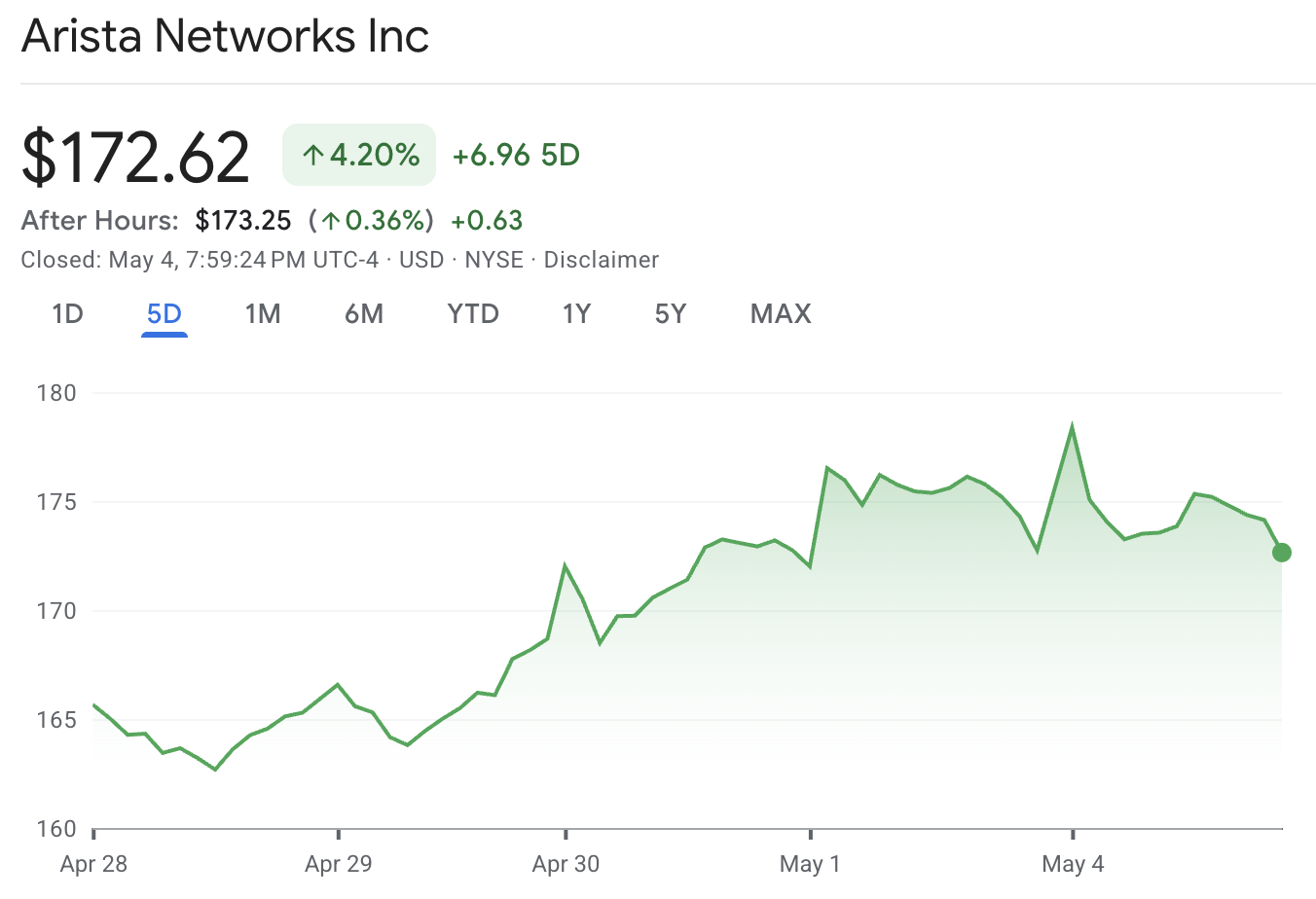
ANET recently traded near $172.62, implying a market capitalization of about $220.4 billion and a trailing P/E near 64.7x. Those numbers reflect confidence in Arista’s role as an AI networking compounder, but they also raise the cost of a merely in-line result.
The stock does not need proof that AI demand exists. It needs evidence that Arista can convert that demand into durable revenue, defensible margins, and broader customer traction beyond a small group of hyperscale buyers.
Arista enters Q1 2026 earnings with strong momentum, but the earnings hurdle has moved higher. Q4 showed exceptional revenue growth, high operating leverage, and a clear AI networking tailwind. The next report must show that this strength is not coming at the expense of margin quality or customer balance.
For investors, the headline EPS figure is only the first layer. The more important signals will come from gross margin, operating leverage, guidance, and hyperscaler commentary. Arista has already earned credibility as an AI infrastructure leader. This earnings report must prove that the economics behind that leadership remain as compelling as the growth story.