Published on: 2026-03-05
Forex market hours are not just a clock; they are a liquidity map that determines whether Asia-based traders pay tight institutional spreads or get chopped up by slippage and false breakouts.
This difference is even bigger in 2026. Global FX turnover is higher, faster, and more event-driven. In April 2025, average daily trading hit $9.6 trillion, and options activity has more than doubled since 2022.

| Country (TZ) | Key Pairs | Best Trading Windows (Local Time) | Why These Hours Work | Watch Outs |
|---|---|---|---|---|
| Japan (JST, UTC+9) | USD/JPY, JPY crosses | 09:00–11:30 (Tokyo price discovery) | Deep domestic flow from banks, exporters, real-money; JPY reacts fastest to Japan-specific catalysts | Tokyo Fix (~09:55) can create short-lived spikes and reversals |
| Japan (JST, UTC+9) | USD/JPY, JPY crosses | 22:00–02:00 (London–New York overlap) | Peak global liquidity; yield-driven USD/JPY moves tend to trend with better execution | Volatility can spike on US data, Fed headlines |
| Korea (KST, UTC+9) | USD/KRW | 09:00–15:30 (Core onshore hours) | Tightest spreads and most reliable levels due to highest onshore participation | Less follow-through on global themes if local flow dominates |
| Korea (KST, UTC+9) | USD/KRW | 15:30–02:00 (Extended hours) | Better access to global events, partial alignment with Europe | Thinner depth, wider spreads, higher slippage risk; reduce size |
| India (IST, UTC+5:30) | USD/INR | 09:00–11:30 (Morning set-up) | Concentrated importer/exporter hedging and bank positioning | Moves can be flow-driven and fade without a macro catalyst |
| India (IST, UTC+5:30) | USD/INR | 13:30–16:30 (Europe enters) | Global macro begins to influence INR more strongly | More sensitive to oil and risk sentiment shifts |
| India (IST, UTC+5:30) | USD/INR | 18:30–22:30 (Overlap liquidity) | Cleanest offshore liquidity window for USD-driven moves | Event risk from US releases can raise intraday volatility |
| Australia (Sydney time) | AUD/USD, AUD/JPY | 08:00–10:30 (Sydney open) | First true AUD price discovery after NY close; gaps fill, risk tone resets | Can be choppy on thin liquidity if no catalyst |
| Australia (Sydney time) | AUD/USD, AUD/JPY | Late night (overlap window) | USD repriced most efficiently; better trend quality in AUD/USD when macro-driven | Less convenient hours; higher volatility on US data |
| Risk shock regimes (event-driven) | — | — | Geopolitics and oil shocks can create strong directional moves | Spreads and volatility can jump; avoid overleveraging |
Scalping: Focus on overlap liquidity. Tight spreads and steady depth matter more than raw volatility. For Japan and Korea, that is typically late evening; for India, early night; for Australia, midnight to early morning during overlap windows.
Day Trading: Trade during Tokyo’s main hours for yen and regional moves, then avoid the mid-session 'dead zone' when prices drift and spreads widen. Get back in as London opens, especially if there’s a big news event.
Swing Trading: Enter during liquid windows, hold through quieter hours. The entry price is often the edge. In thinner hours, even a correct direction can trigger a painful drawdown because stops cluster in obvious places.
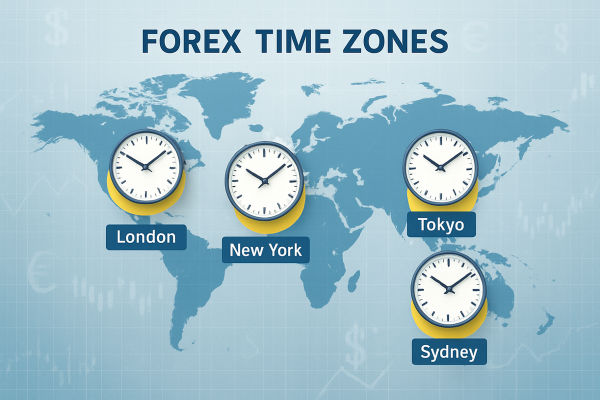
The FX market runs 24 hours a day on weekdays, but trading activity shifts across four main sessions: Sydney, Tokyo, London, and New York. When these sessions overlap, spreads usually tighten and trends are more likely to persist.
| Window | Japan (JST) | Korea (KST) | India (IST) | Australia (Sydney AEDT/AEST) | What It Is Good For |
|---|---|---|---|---|---|
| Sydney Open & Early Asia | 06:00–10:00 | 06:00–10:00 | 02:30–06:30 | 08:00–12:00 | AUD moves, risk tone, gap fills |
| Tokyo Core Hours | 09:00–15:00 | 09:00–15:00 | 05:30–11:30 | 11:00–17:00 | JPY pairs, Asia equity linkages, fix flows |
| Tokyo–London Hand-Off | 17:00–18:00 | 17:00–18:00 | 13:30–14:30 | 19:00–20:00 | Breakouts that can hold into Europe |
| London Core Hours | 17:00–01:00 | 17:00–01:00 | 13:30–21:30 | 19:00–03:00 | EUR, GBP, broad USD repricing |
| London–New York Overlap | 22:00–02:00* | 22:00–02:00* | 18:30–22:30* | 00:00–04:00* | Peak liquidity, best execution quality |
*These overlap times shift by one hour during daylight saving transitions.
Asia-based traders can lose out if they ignore the calendar. Since Japan doesn’t use daylight saving time, the best trading windows shift when the US, UK, and Australia change their clocks.
US Daylight Saving Time begins on March 8, 2026, meaning the New York session starts 1 hour earlier for traders in Asia.
UK Daylight Saving Time starts on March 29, 2026, moving the London session one hour later compared to UTC. However, in Asia, the overlap with London often remains similar because both regions adjust clocks in the same month.
Sydney Daylight Saving Time ends on April 5, 2026, so key overlap windows for traders in Australia start 1 hour earlier.
Intraday FX volatility in Asia is increasingly a story of rate differentials and policy credibility. When markets believe policy is still shifting, currencies react faster to data, headlines, and yield moves.
When policy is viewed as stable or managed, volatility compresses, but it also becomes more event-clustered, with sharper moves around decision windows and key liquidity points.
Rate gaps also determine when the market cares. USD-based pairs tend to do their most meaningful repricing when US rates are being actively re-judged.
As of March 2026, the Fed funds target range upper limit is 3.75%, which still places the US yield curve at the center of global FX pricing.
| Central Bank | Policy Rate (latest available) | What It Does to Intraday Pricing in Asia |
|---|---|---|
| Bank of Japan (BoJ) | 0.75% (short-term policy level / around the overnight rate) | Keeps JPY highly sensitive to yield shocks and policy headlines |
| Bank of Korea (BoK) | 2.50% (Base Rate) | Leaves KRW responsive to global risk and USD carry conditions |
| Reserve Bank of India (RBI) | 5.25% (Policy Repo Rate) | Anchors INR, but intervention and liquidity management shape the path |
| Reserve Bank of Australia (RBA) | 3.85% (Cash Rate Target; effective 4 Feb 2026) | Makes AUD more rate-sensitive and more reactive to inflation surprises |
| US Federal Reserve (Fed) | 3.75% (Fed Funds Target Range upper limit; range 3.50%–3.75%) | Sets the benchmark for USD repricing across all Asia sessions |

The modern FX market rewards traders who treat time as a filter for market regimes. The BIS turnover survey shows the structure of trading has shifted toward instruments and participants that move quickly when liquidity is available.
This is important for Asia because the best trading chances usually come when the market is deep enough to handle large trades without moving the price too much.
When the market is thin, prices can still move, but often for the wrong reasons. This can happen because there isn’t enough depth, brokers widen spreads at rollover, or one large order moves the market.
Some trading windows are always risky, no matter your market outlook:
Rollover Around 5:00 PM New York Time: Many brokers book rollover then, and spreads can widen. In Asia, this often falls in the early morning, so “one last trade before bed” is frequently a bad habit.
Fixing Windows: Tokyo (around 9:55 AM JST) and London (the 4:00 PM London fix) can produce short-lived bursts that reverse once orders are completed.
Holiday Liquidity: Local holidays in Japan, Korea, India, or Australia can reduce market depth, even if global markets are open. Prices may still move, but these moves are often less stable.
The London-New York overlap is the most reliable trading window. It happens late evening in Japan and Korea, early night in India, and after midnight in Australia. Tokyo mornings are also good for trading JPY pairs and managing regional risk.
The worst time to trade is usually around the New York close and rollover, when liquidity providers reset their books and spreads can widen. Another weak period is after Tokyo’s midday, before London opens, when markets often drift.
They matter even more. Major pairs trade all day, but the best prices and most reliable moves usually happen when the biggest trading centers overlap. Even for EUR/USD, Asian hours can be smooth some days and illiquid on others, depending on the news.
For traders in Asia, the best forex market hours are when your currency pair is priced by the deepest pool of liquidity, not just when it’s convenient for you.
Tokyo mornings are still the most reliable time for yen trading and regional risk. The London-New York overlap is the global center for the best execution and strong trends.
With ongoing differences in economic trends across Japan, Korea, India, and Australia, plus rising geopolitical risks, timing your trades has become a real advantage. It affects spreads, slippage, and whether a price move is genuine or just noise from a thin market.
Disclaimer: This material is for general information purposes only and is not intended as (and should not be considered to be) financial, investment or other advice on which reliance should be placed. No opinion given in the material constitutes a recommendation by EBC or the author that any particular investment, security, transaction or investment strategy is suitable for any specific person.