Published on: 2026-03-05
Updated on: 2026-03-05
Quantum computing is still in its early stages, but 2026 is shaping up to be a "proof year" for the industry. The conversation has shifted from "Is it real?" to Who gets paid first, and who can survive long enough to matter?
For investors, that creates a tough setup. The upside can be large if the technology breaks through. The downside can also be severe, because many quantum firms are still loss-making and depend on steady funding.
Nevertheless, the six stocks we listed below are notable for two main reasons:
They are central to the future of quantum money
They have active analyst coverage with published price targets that exceed recent trading levels.
There are two groups in this list:
Diversified leaders using quantum as a long-term option inside a larger business (IBM, Alphabet, Microsoft).
Pure-play specialists whose main story is quantum hardware and services (IonQ, Rigetti, D-Wave).
The table below combines recent trading prices from market data feeds and average analyst price targets. Prices and targets can change quickly, especially in this sector, so treat the numbers as a snapshot rather than a promise.
| Stock | Ticker | Quantum exposure | Recent price | Avg. analyst target | Implied upside* |
|---|---|---|---|---|---|
| IonQ | IONQ | Trapped-ion quantum systems, platform model | $37.13 | $67.92 | ~82.9% |
| IBM | IBM | Quantum hardware and software ecosystem | $250.06 | $317.67 | ~27.0% |
| Rigetti | RGTI | Superconducting quantum systems and services | $17.76 | $40.30 | ~126.9% |
| D-Wave | QBTS | Quantum annealing plus gate-model roadmap | $18.91 | $38.50 | ~103.6% |
| Microsoft | MSFT | Azure Quantum platform and tools | $405.20 | $595.60 | ~47.0% |
| Alphabet | GOOGL | Google Quantum AI research and milestones | $303.13 | $379.11 | ~25.1% |
*Implied upside is a simple comparison between the average target and the recent price. It is not a forecast of what will happen.
IONQ is one of the clearest "pure play" quantum equities, and it is also one of the most headline-sensitive.
In late February, IonQ's earnings exceeded expectations, and their 2026 revenue guidance of $235 million contributed to a significant jump in stock price. The management also highlighted an important system milestone expected in 2026.
Analyst commentary around the print leaned into revenue momentum and roadmap credibility.
What to watch in 2026
Updates tied to the planned 256-qubit demonstration timeline.
Contract announcements and enterprise partnerships, because near-term revenue is still contract-led.
Key risk
Like most pure-plays, IonQ can be volatile, and its losses can widen as it invests.
IBM is not a pure-play quantum company, but it is one of the most credible quantum platform builders because it publishes a detailed quantum roadmap that includes 2026 milestones. In quantum contexts, roadmaps symbolize trust, and trust functions as a form of capital.
IBM also has broad Wall Street coverage, and aggregated analyst data shows a "Moderate Buy" consensus in 2026.
What to watch in 2026
Progress updates tied to IBM's 2026 roadmap checkpoints.
Key risk
Quantum is still a small part of IBM's overall financial picture, so the stock usually trades more on core software, consulting, and enterprise spending trends than on quantum headlines.
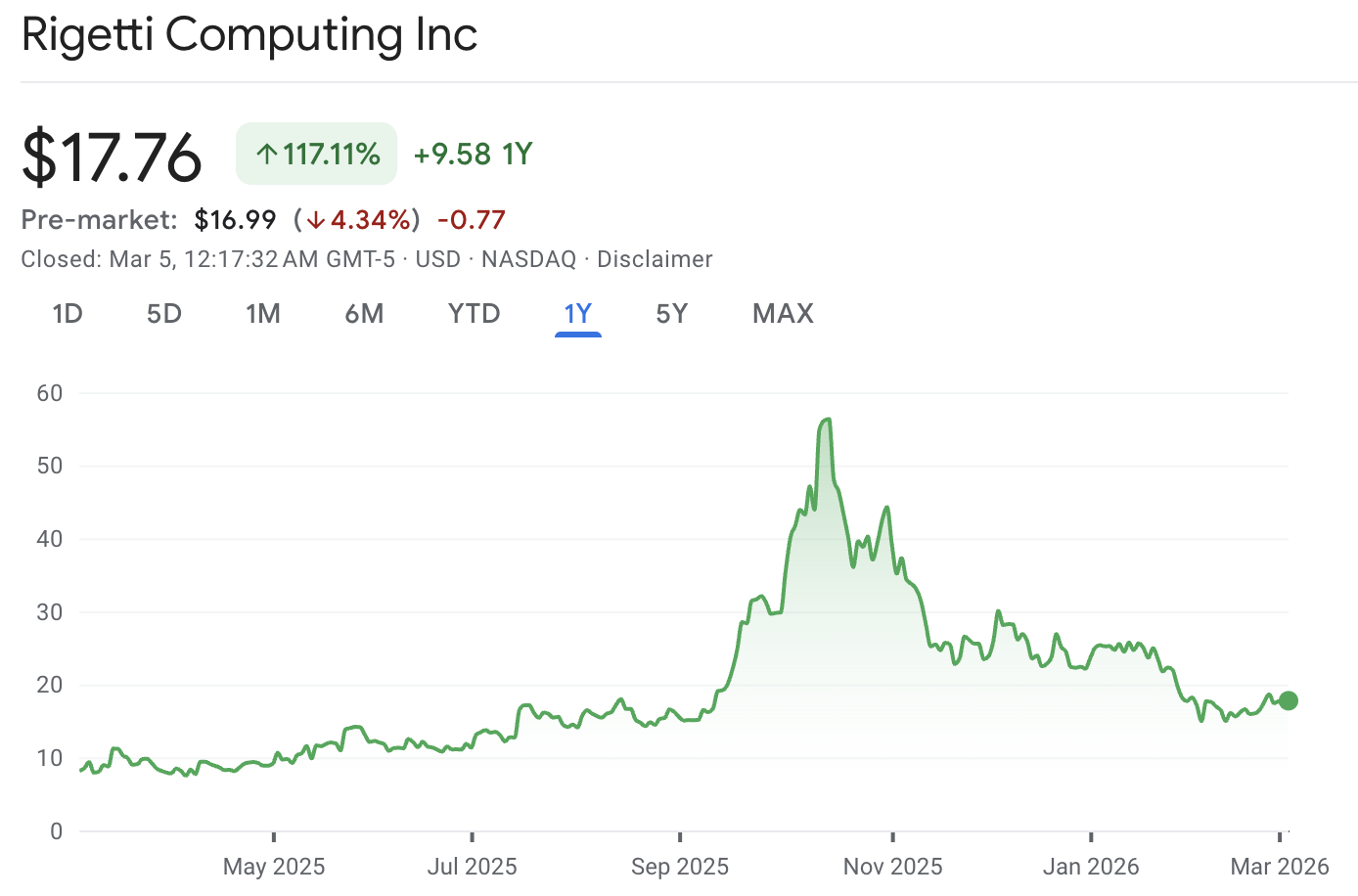
Rigetti is a pure-play built around superconducting qubits and full-stack development. In its March 4, 2026, results release, the company reported quarterly revenue of about $1.9 million, and it discussed demand for on-premises systems from government and research institutions.
The same release also described an approximately $8.4 million purchase order from India's Centre for Development of Advanced Computing, with expected deployment in the second half of 2026.
That is the core Rigetti setup: customer wins can be meaningful, but the business can still swing sharply with timing, delays, and funding conditions.
What to watch in 2026
Delivery progress tied to on-premises orders and second-half deployment targets.
Key risk
Revenue can be lumpy, and the company remains dependent on steady execution and continued funding demand from institutions.
QBTS occupies a unique position in the quantum landscape, renowned for its quantum annealing capabilities and for providing enterprises with practical solutions for testing quantum access today.
In its latest coverage cycle, the company reported improving loss trends but still missed revenue expectations, while also disclosing meaningful year-to-date bookings.
Analyst consensus tracking services still show broad coverage and a bullish skew, which is one reason QBTS remains a frequent "quantum tape" driver when the theme catches a bid.
What to watch in 2026
Commercial traction and bookings signals after the 2025 results period.
Roadmap updates on gate-model progress, because that is a key credibility lever for investors.
Key risk
The stock can react sharply to revenue timing and sentiment swings around the how soon is quantum useful debate.
Microsoft's angle is practical. Azure Quantum is designed to help developers learn, build, and submit quantum workloads using tools such as the Quantum Development Kit and supported languages and workflows.
That matters because most quantum use today is hybrid. It mixes classical computing with quantum trials. Microsoft is in a strong position when the buyer is an enterprise already utilizing Azure.
What to watch in 2026
Adoption signals for Azure Quantum tooling and partner access, because platform usage often grows before hardware becomes mainstream.
Key risk
Quantum remains a long-cycle theme, so the stock will primarily trade based on cloud growth, AI spending, and overall earnings.
Alphabet's quantum initiative is primarily centered in Google Quantum AI, with an emphasis on developing error-corrected systems. Google has published milestone material around quantum error correction and its roadmap for building a useful error-corrected quantum computer.
Alphabet is not a pure quantum stock, but it is one of the most credible owners of "quantum capability" in public markets. For investors, that is the point. You are paying for a broad tech platform, while quantum remains a high-upside option.
What to watch in 2026
Technical updates that show error correction scaling, because reliability is the bottleneck.
Key risk
Quantum progress can be real, but it may not change Alphabet's near-term earnings power.
Quantum investing in 2026 is not like buying a mature tech platform. It resembles the support of a lengthy R&D cycle with unpredictable outcomes. It is why the "two-bucket" strategy is important.
Diversified leaders (IBM, Alphabet, Microsoft)
Lower single-theme risk because quantum is only one part of the business.
Slower payoff from quantum, because many other factors drive the stock price.
Pure-plays (IonQ, Rigetti, D-Wave)
Higher upside if one platform becomes a standard.
Higher downside risk because companies may face funding pressure, delays, and dilution.
Quantum computing remains a speculative arena, but the market is responding to more visible government support and clearer product roadmaps from the largest research platforms.
In the United States, policymakers are actively pushing to extend and refresh the National Quantum Initiative framework, which signals that quantum remains a strategic priority rather than a short-lived science project.
In Europe, the Commission's 2026 work programme includes a proposed "Quantum Act," highlighting the continued role of public funding and industrial policy.
Markets do not need quantum to be fully mature for quantum equities to move. Markets only need a credible path for early revenue, defensible differentiation, and enough funding to reach the next milestone without destructive dilution.
Yes. Many quantum pure plays still have small revenue bases and ongoing losses, so dilution risk and milestone risk remain high.
Quantum is still early. Some companies are making real technical progress, but many pure-plays remain loss-making and highly volatile. The risk profile is closer to early-stage technology than to mature software.
IonQ has referenced 256-qubit system demonstrations in 2026, Rigetti has discussed system deployments expected in the second half of 2026, and D-Wave continues to build around its dual-platform roadmap.
Targets can be wide when the market is small, the path is uncertain, and sentiment shifts quickly. In early-stage sectors, analyst models can change sharply after one contract, one milestone, or one capital raise.
In conclusion, quantum computing in 2026 is still in its early stages, but analyst interest is growing as public funding remains supportive and leading platforms provide clearer roadmaps.
The best way to engage with this theme is to understand the stack and select exposures that align with your risk tolerance.
Disclaimer: This material is for general information purposes only and is not intended as (and should not be considered to be) financial, investment or other advice on which reliance should be placed. No opinion given in the material constitutes a recommendation by EBC or the author that any particular investment, security, transaction or investment strategy is suitable for any specific person.