Published on: 2026-03-06
Updated on: 2026-03-06
Yes, the euro is worth more than the dollar right now in the simplest, headline sense. The current EUR/USD exchange rate is about $1.1620 per €1, which means one euro buys more than one unit of the dollar today.
That answer is straightforward, but the "why" matters because the euro only stays above $1.00 when the market believes the eurozone's policy path, growth outlook, and risk backdrop can compete with the U.S. rate advantage.
In 2026, the debate has remained active, and the EUR/USD has traded with noticeable swings as the market recalibrates expectations for both the Federal Reserve and the European Central Bank.
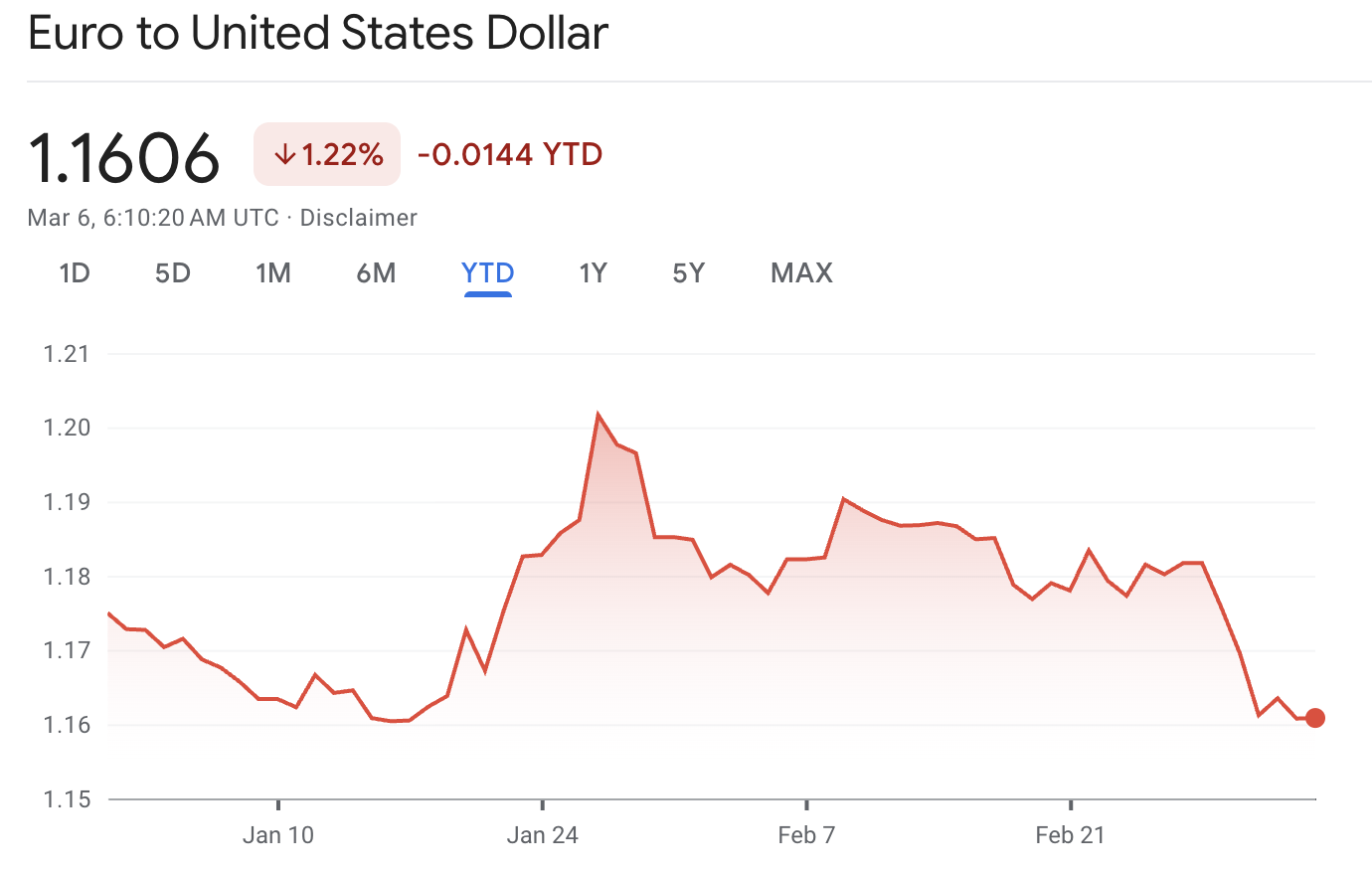
The current EUR/USD exchange rate stands at $1.1620 per €1, with a prior close of $1.1608, and a daily range of roughly $1.1603 to $1.1621.
It also shows the past-year context: EUR/USD is up about 7.27% over the last 12 months, with a 52-week range of $1.0732 to $1.2079 per €1.
| Metric | Latest reading |
|---|---|
| Current EUR/$ | ~$1.1620 per €1 |
| Today’s range | ~$1.1603 to ~$1.1621 per €1 |
| 52-week range | ~$1.0732 to ~$1.2079 per €1 |
| Past-year change | +7.27% |
EUR/USD has recorded its highest year-to-date close at $1.2016 per €1 in late January, with an average of $1.1769 per €1 so far in 2026.
| 2026 metric | Reading | What it signals |
|---|---|---|
| Best close (2026 so far) | ~$1.2016 per €1 | The market has already tested the low $1.20s. |
| Average (2026 so far) | ~$1.1769 per €1 | The year has traded above $1.15 on average. |
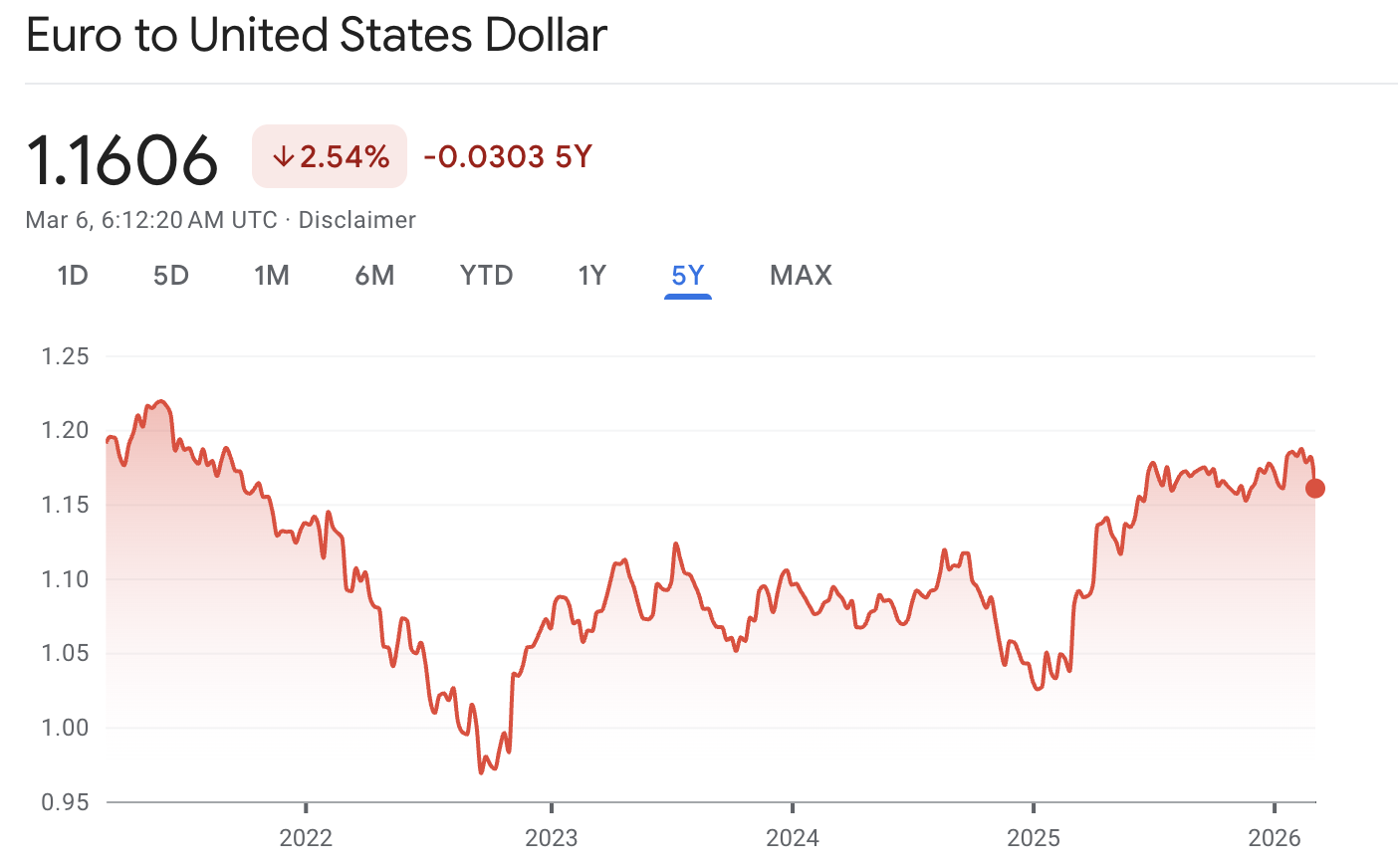
The euro has traded above and below parity at various points since its launch.
At various points in 2022, EUR/USD fell below 1.00, including to 0.9936 (22 August 2022) and 0.9623 (26 September 2022) in the Federal Reserve's historical series.
That history shows that parity is not a permanent "floor" or a permanent "ceiling". Parity is a psychological level that markets often test when the economic story swings sharply.
The best way to understand EUR/USD is to start with interest rate differentials, because the currency market constantly reprices "who pays you more to hold their cash."
The Federal Reserve's policy rate remains higher than the European Central Bank's deposit rate, which normally supports the dollar through a yield advantage.
As of early March, the Fed's target range upper limit is 3.75%.
The ECB deposit facility rate was 2.00% on 5 March 2026.
That leaves an interest-rate gap of about 1.75 percentage points in favour of the United States, based on those two benchmarks.
So, why is the EUR/USD still above $1.00 despite higher U.S. short-term rates?
The answer is that FX prices the direction of travel, not only today's spread. If market participants believe the Fed is closer to easing than the ECB, the future rate gap could narrow, potentially supporting EUR/USD despite its current carry disadvantage.
Eurostat's "Inflation in the euro area" page states that euro area annual inflation is expected to be 1.9% in February 2026, up from 1.7% in January 2026.
On the U.S. side, the Bureau of Labor Statistics CPI page indicates that the all-items CPI rose by 2.4% over the 12 months ending in January 2026, down from the 2.7% increase in the year ending in December 2025.
What markets do with this:
When inflation eases, investors often debate when rates might decrease. That debate is often more important for EUR/USD than the inflation print itself.
Eurostat's preliminary estimate indicates that the euro area GDP grew by 0.3% from the previous quarter in Q4 2025 and increased by 1.3% compared to Q4 2024.
This matters because a currency rarely strengthens sustainably if the market sees growth as structurally weaker. In 2026, the euro's support has been helped by the idea that growth is holding up, even if it is not accelerating sharply.
No single forecast is clean in FX, because currencies respond to relative surprises. A clearer framework maps conditions that influence EUR/USD fluctuations.
EUR/USD tends to push higher when:
U.S. interest rates are anticipated to decrease more rapidly than those in the euro area.
Economic growth in the euro area remains stable, and inflation is close to the target level.
The global risk appetite remains stable, indicating that the market does not require maximum liquidity at this time.
A retest of the $1.20 per €1 area is not a prediction, but it is a level the market has already reached this year, which keeps it relevant as a reference point.
EUR/USD tends to chop when:
The Fed and ECB both signal patience.
Inflation continues to cool gradually on both sides.
Growth differentials do not widen meaningfully.
This scenario aligns with today's technical clustering near $1.16 per €1, where moving averages and pivots are in proximity.
EUR/USD tends to slip when:
The U.S. interest rate trajectory is expected to remain elevated for an extended period, whereas the European interest rate is seen as having limited room for further increases.
Risk-off conditions appear, and investors prioritize liquidity.
The euro area data flow disappoints relative to expectations.
The point is not that this outcome is "likely." The point is that the Fed-ECB spread still gives the market a logical path to $ strength if the policy narrative shifts.
Yes. EUR/USD is around $1.1620 per €1, which means €1 buys more than $1 at the moment. The exact quote moves intraday, but the current level is clearly above $1.00, so the euro is nominally "worth more" today.
No. The exchange rate reflects the value of one currency relative to another and can fluctuate due to changes in interest rates, investor sentiment, and capital flows, even amid mixed growth.
It can, but parity usually requires a sustained shift toward $ strength, such as a higher-for-longer U.S. rate path, a risk-off shock, or weaker euro area data. The current policy rate gap continues to favor the U.S., so the possibility of parity remains if expectations shift.
Currently, the euro is trading at a higher value than the dollar, with an exchange rate of approximately $1.1620 per €1, well above parity.
The bigger question in 2026 is not whether the euro is above $1.00 today; it is whether the market continues to price in a narrowing policy gap between the Fed and the ECB, given that the current rate spread still favors the U.S. side.
With euro area inflation at nearly 1.9% and U.S. CPI at around 2.4% based on recent readings, traders must remain focused on which region will ease monetary policy first and which can maintain rates without causing a growth scare.
Disclaimer: This material is for general information purposes only and is not intended as (and should not be considered to be) financial, investment or other advice on which reliance should be placed. No opinion given in the material constitutes a recommendation by EBC or the author that any particular investment, security, transaction or investment strategy is suitable for any specific person.