Published on: 2026-02-09
Updated on: 2026-02-09
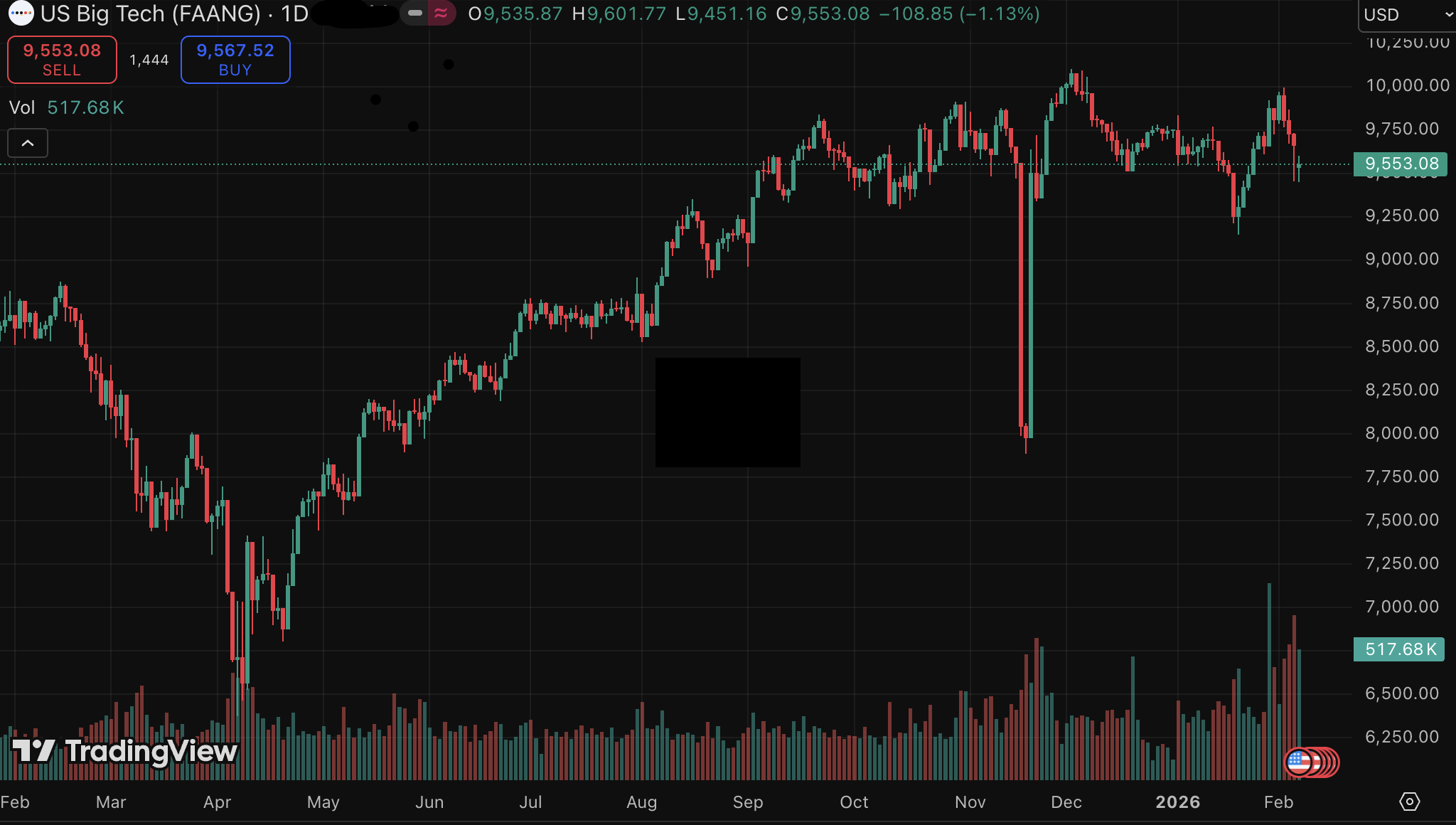
FAANG stocks are being repriced as artificial intelligence (AI) spending turns parts of Big Tech into more capital-intensive businesses. The market focus has shifted from earnings surprises to payback: capital expenditure (capex) plans, free cash flow (FCF) stability, and the funding mix behind that spending. This shift is one reason performance is diverging within the FAANG group.
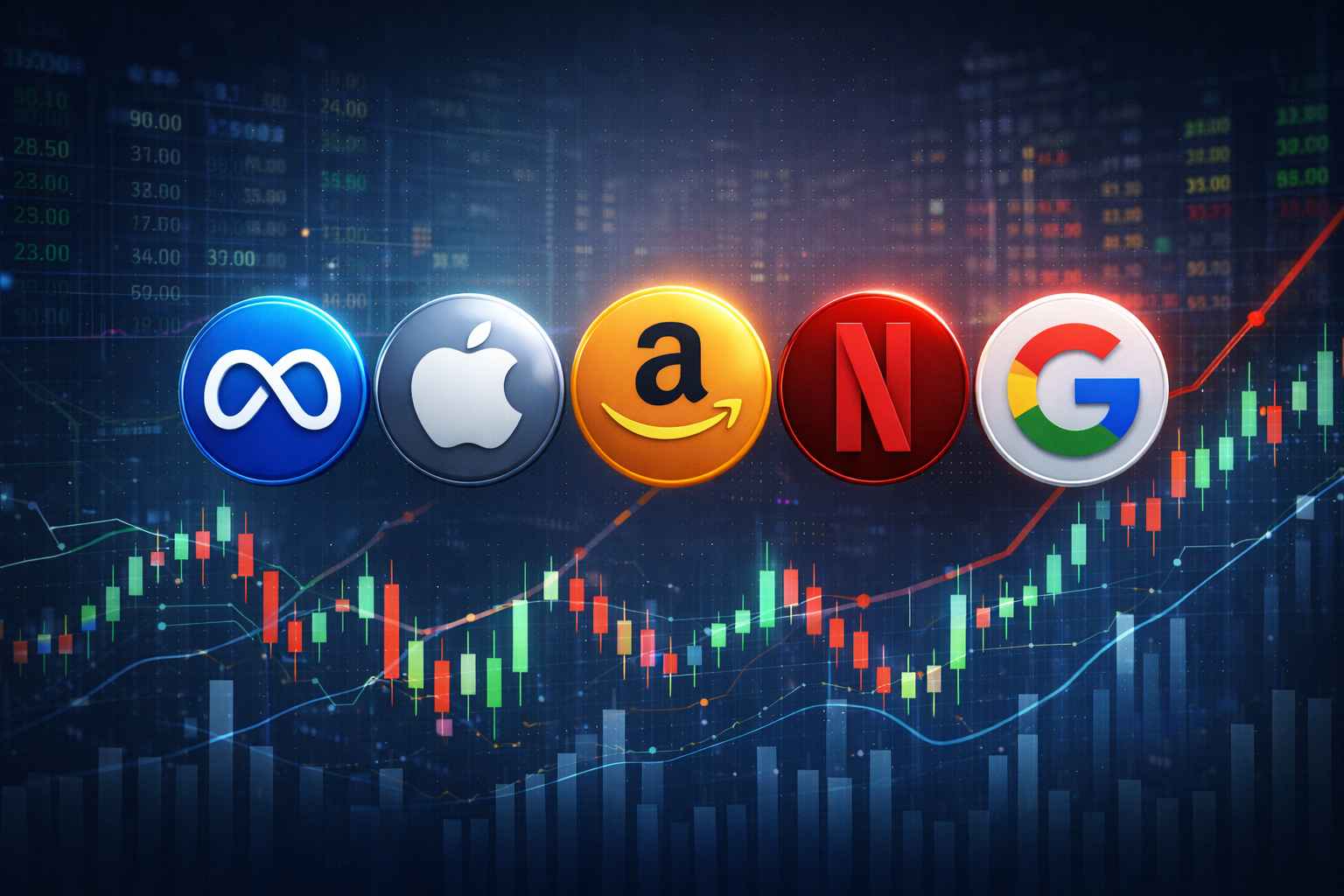
Projected artificial intelligence capital expenditures for Big Tech in 2026 are estimated to reach several hundred billion US dollars. As a result, investors are prioritizing payback periods and financing requirements over model capabilities.
FAANG is a market shorthand for five US-listed technology and internet leaders:
Meta Platforms (META) (originally “Facebook” in the acronym)
Apple (AAPL)
Amazon (AMZN)
Netflix (NFLX)
Alphabet (GOOGL) (Google’s parent company)
Although the FAANG label remains common in media coverage, its analytical relevance has declined due to the divergence of underlying business models. Apple primarily operates as a hardware and services provider, Amazon integrates retail and cloud services, Alphabet and Meta serve as advertising platforms with cloud and AI components, and Netflix delivers subscription-based media with an ad-supported tier. This divergence contributes to the uneven nature of the current market pullback.
The table below is a short-term snapshot: 1D uses the latest US session, 1W uses a 5-trading-day window, and 1M uses a one-month window.
| Company | Ticker | 1Day | 1Week (5D) | 1Month |
|---|---|---|---|---|
| Apple | AAPL | +0.78% | +7.18% | +6.01% |
| Amazon | AMZN | -5.58% | -12.11% | -12.70% |
| Alphabet | GOOGL | -2.54% | -4.48% | +2.71% |
| Meta Platforms | META | -1.31% | -7.68% | +0.13% |
| Netflix | NFLX | +1.61% | -1.55% | -9.32% |
These performance metrics are significant because they reflect current market decision-making. Short-term momentum is influenced by company guidance and investor positioning, whereas the one-month perspective reveals whether optimism regarding artificial intelligence is sustaining investor demand.
AI demand is not the main debate. The market question is whether the scale and timing of 2026 capex will reduce near-term free cash flow enough to justify lower valuation multiples.
Recent reports estimate 2026 AI capital expenditures at approximately $660 billion across major firms, a scale that exceeds near-term cash flow and necessitates trade-offs among buybacks, borrowing, and reinvestment. Investor concerns now center on funding requirements and the transition from asset-light economics to industrial-style infrastructure cycles.
Amazon’s capex plan has been explicitly tied to a sharp selloff as investors digested the size of the buildout and near-term profit guidance.
Alphabet faces a similar reaction, with the market weighing strong operating momentum against much higher spending plans.
Previously, FAANG stocks were valued as long-duration growth assets. Currently, segments of the group are being assessed more like 'AI utilities,' with returns evaluated based on utilization rates, pricing power, and depreciation schedules.
When capex surges, investors look for leading indicators of payback:
Cloud acceleration that persists across quarters (not just one print)
AI attach rates in enterprise contracts
Operating margin protection despite higher depreciation and energy costs
Amazon’s recent performance underscores this dynamic. Despite positive indicators for cloud demand, the market penalized the stock due to a revised spending trajectory that negatively affected the near-term free cash flow outlook.
Netflix demonstrates a similar phenomenon outside the cloud sector. Market analysis suggests that strong operational results can be overshadowed by elevated spending plans and increased sensitivity to near-term margins, particularly as advertising revenue grows more slowly than expected.
Regulatory risk for FAANG companies is longstanding, but it becomes more influential on valuations when market multiples are already experiencing downward pressure.
Google/Alphabet: The US Justice Department has pursued significant remedies in the search monopolization case, including restrictions on certain exclusive arrangements and requirements to make certain data available, while litigation continues. Separately, the EU has launched a major antitrust action in ad tech, adding another overhang to the profit pool that funds AI investment.
Apple: EU Digital Markets Act compliance continues to force App Store rule and fee changes, creating uncertainty around platform take rates and services monetization in Europe.
Amazon: Beyond capex, the company remains in the orbit of US regulatory scrutiny, with major FTC-related actions and litigation timelines influencing sentiment.
FAANG’s AI roadmap depends on advanced chips, networking gear, and data center deployment. US policy on semiconductor exports to China is still evolving, with case-by-case licensing frameworks and ongoing review processes.
This is significant for FAANG companies because stricter export and compliance requirements may increase operational costs, delay deployment schedules, and fragment demand. Even if direct revenue exposure is limited, secondary effects on the timing of AI infrastructure development can influence market expectations.
A recovery in FAANG stock prices is plausible; however, it will likely require tangible evidence rather than optimistic projections. The market currently rewards AI leadership only when a credible and observable path exists from capital expenditures to positive cash flow.

| Swing factor | What supports a rebound | What prolongs the drawdown |
|---|---|---|
| AI capex | Spending is paired with clear utilization and pricing | Capex rises faster than revenue and margins compress |
| Cloud | Multi-quarter acceleration and AI contract visibility | Price competition and margin dilution |
| Ads | Measurable lift from AI targeting and automation tools | Regulatory constraints and weaker ad cycles |
| Regulation | Settlements or clarity on remedies | Escalation of structural remedies and fines |
| Geopolitics | Stable export rules and predictable supply | Policy shocks, tighter controls, supply disruptions |
Amazon: The most effective recovery strategy is to demonstrate that capital expenditures drive growth in Amazon Web Services and improve operating leverage within a defined timeframe. The recent decline was directly linked to unexpected spending; therefore, a rebound will depend on clear evidence of returns.
Alphabet: Market responses have focused on the scale of 2026 capital expenditure plans. A sustained recovery will likely require both AI-driven cloud growth and assurance that search-related revenues remain robust despite regulatory challenges.
Meta: The critical factor is whether artificial intelligence can enhance advertising performance and measurement sufficiently to counterbalance increased infrastructure spending, and whether compliance changes in the European Union do not negatively impact monetization beyond expectations.
Netflix: Current pressures stem from valuation sensitivity to spending and decelerating growth. Upward re-rating typically follows demonstrated success in scaling advertising and maintaining margin stability, rather than increases in subscriber numbers alone.
Apple: The company’s relative strength suggests that investors regard it as the 'quality anchor' within the FAANG group. However, ongoing European platform regulations continue to challenge the profitability of its services segment.
| Stock | Last Price | RSI (14) | Nearest Support (Classic S1) | Nearest Resistance (Classic R1) | Trend | Momentum |
|---|---|---|---|---|---|---|
| Apple (AAPL) | $278.12 | 61.515 | 277.52 | 279.14 | Bullish bias | Positive (RSI > 50) |
| Amazon (AMZN) | $210.32 | 35.374 | 204.89 | 207.02 | Bearish bias | Weak / oversold-lean (RSI |
| Alphabet (GOOGL) | $322.86 | 41.517 | 320.50 | 324.06 | Bearish/weak | Negative (RSI |
| Meta (META) | $661.46 | 40.189 | 653.10 | 659.78 | Bearish/weak | Negative (RSI |
| Netflix (NFLX) | $82.20 | 56.44 | 80.95 | 81.79 | Mixed (rangebound bias) | Moderately positive (RSI > 50) |
Key Overview: Apple (AAPL) is the clear technical leader, with a relative strength index (RSI) above 60 and price approaching resistance. Amazon (AMZN) is the weakest, with an oversold RSI near the mid-30s and support levels in focus. Alphabet (GOOGL) and Meta (META) remain technically fragile below 50 on the RSI, while Netflix (NFLX) appears comparatively steadier, with the RSI above 50 but lacking a decisive trend signal.
Yes. FAANG stocks include Meta, Apple, Amazon, Netflix, and Alphabet. However, many market strategists now reference alternative groupings such as the 'Magnificent Seven' or broader mega-cap indices, reflecting the expansion of market leadership beyond the original five companies.
This is because financial markets prioritize discounted cash flows over narrative-driven optimism. When artificial intelligence initiatives necessitate substantial capital expenditures in 2026, near-term free cash flow may deteriorate, even if long-term demand remains strong. As a result, valuation multiples decline until a clear payback is evident.
Amazon and Alphabet have been most closely associated in recent analyses with market movements influenced by 2026 spending plans. The central issue is not technological capability, but whether returns will materialize rapidly enough to sustain current valuations.
Regulatory actions can diminish platform pricing power or necessitate costly corrective measures, while geopolitical developments may disrupt semiconductor supply and hinder data centre expansion. Both factors contribute to increased uncertainty, leading investors to demand a higher risk premium.
A sustained rebound is probable if two conditions are met: artificial intelligence investments generate quantifiable revenue and margin improvements, and policy-related risks become more predictable. Without these factors, any rallies are likely to be short-lived, with market leadership shifting toward companies demonstrating the most transparent cash returns.
FAANG stocks are not declining due to failures in artificial intelligence, but rather because the market is repricing the cost of achieving AI leadership. In 2026, leadership in cloud and foundation models increasingly resembles an infrastructure race, temporarily reducing equity certainty. Amazon’s plan to invest approximately $200 billion in 2026 capital expenditures, Alphabet’s $175-$185 billion range, and Meta’s $115-$135 billion guidance collectively shift the narrative from growth to payback.
A recovery is most likely when the market can underwrite three conditions at the same time: incremental AI spend translates into persistent contract wins and usage, margins and free cash flow stabilise despite rising depreciation, and funding remains primarily internal rather than structurally dependent on debt.
Disclaimer: This material is for general information purposes only and is not intended as (and should not be considered to be) financial, investment or other advice on which reliance should be placed. No opinion given in the material constitutes a recommendation by EBC or the author that any particular investment, security, transaction or investment strategy is suitable for any specific person.