Published on: 2026-04-06
Updated on: 2026-04-06
The new financing strengthens the bull case around CoreWeave stock.
Lower funding costs improve the quality of the growth story.
Heavy debt and capital intensity still limit financial flexibility.
Strong demand visibility does not remove customer concentration risk.
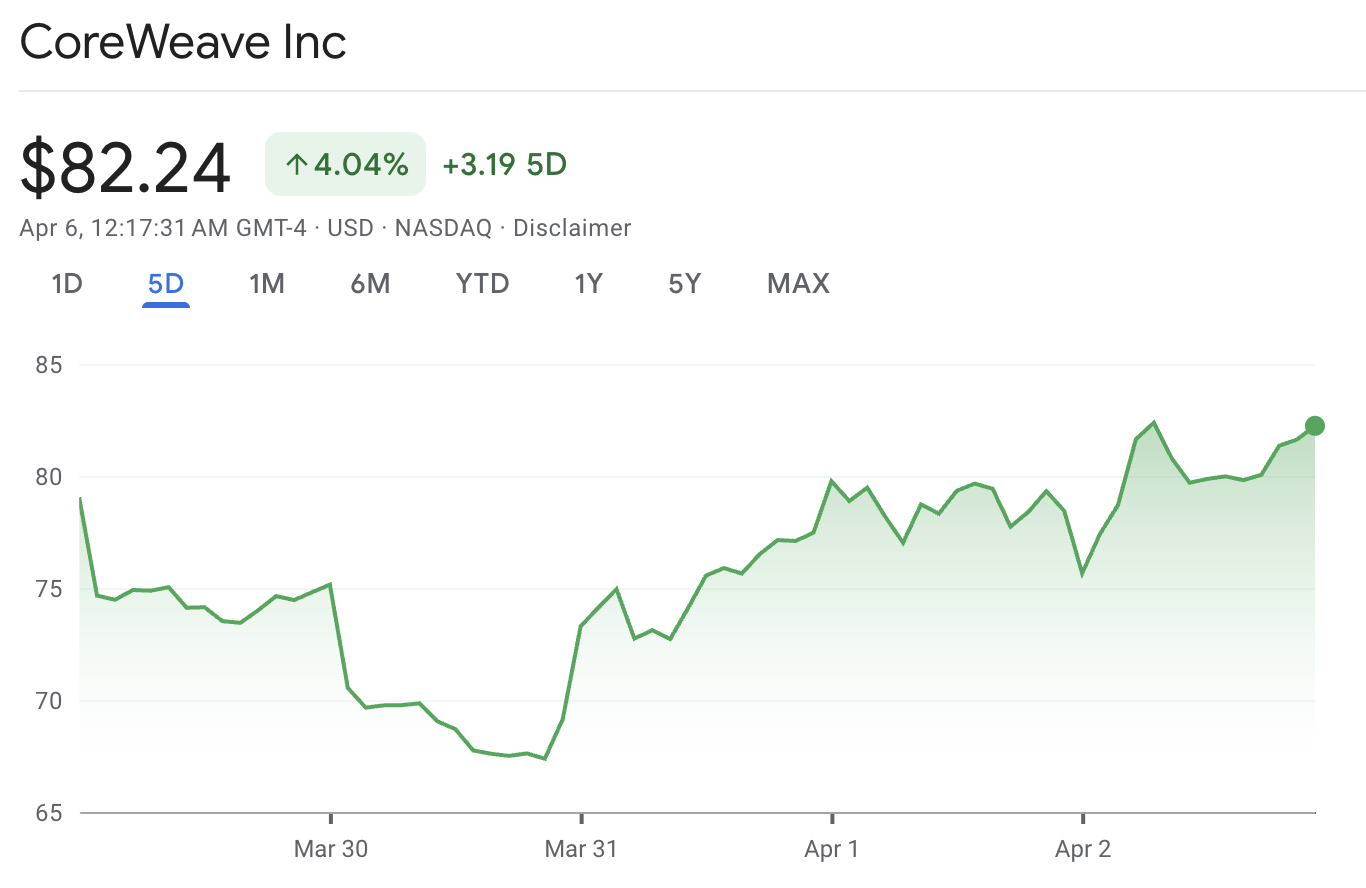
CoreWeave stock has a fresh catalyst, and it goes deeper than another AI headline. The company’s new $8.5 billion GPU-backed loan has revived the rerating debate because it suggests Wall Street is beginning to treat contracted AI infrastructure as financeable collateral rather than speculative growth.

That is why the latest move matters. On March 31, CoreWeave closed a non-recourse delayed draw term loan facility with investment-grade ratings of A3 from Moody’s and A (low) from DBRS.
Shares rose sharply on the news, but the bigger question is whether cheaper capital changes the stock’s long-term profile or simply adds another layer to an already leveraged expansion model.
The new facility is important because it is not a routine corporate borrowing. CoreWeave said it is the first investment-grade rated financing secured by high performance computing infrastructure and an associated customer contract.
The structure allows an initial borrowing capacity of about $7.5 billion, rising to $8.5 billion as assets stabilize.
The terms also matter. The facility includes a floating tranche at SOFR + 2.25% and a fixed tranche at about 5.9%, with maturity in March 2032. That is a meaningful signal that lenders are becoming more comfortable underwriting GPU fleets and contract-backed AI capacity.
This is the clearest case for a rerating. Equity investors had worried that CoreWeave’s growth story depended on ever-increasing borrowing costs.
A facility like this does not remove funding risk, but it does show the company can access deeper pools of capital on better terms than a distressed borrower would command.
CoreWeave’s operating scale has expanded fast enough to support the idea that demand is real.
Revenue reached $5.1 billion in 2025, up from $1.9 billion in 2024, while remaining performance obligations climbed to $60.7 billion with a weighted average contract duration of about five years.
By the end of 2025, the company operated 43 data centers with more than 850 MW of active power and about 3.1 GW of total contracted power capacity.
| Metric | Latest disclosed figure | Why it matters |
|---|---|---|
| Revenue | $5.1 billion | Demand is scaling quickly |
| Net loss | $1.2 billion | Profitability is still distant |
| Remaining performance obligations | $60.7 billion | Backlog supports future revenue visibility |
| Total indebtedness | $21.6 billion | Leverage remains high |
| Interest expense | $1.229 billion | Funding costs are material |
| Operating cash flow | $3.1 billion | Cash generation is improving |
| Investing cash outflow | $10.3 billion | Expansion remains capital-intensive |
| Top customer share | 67% from Microsoft | Concentration risk is substantial |
That backlog is the strongest argument for the stock’s rerating case. CoreWeave is not trying to raise money ahead of visible demand. It already has long-dated commitments that give lenders a clearer line of sight into future cash flows than many early-cycle AI names can offer.
The stock market initially treated the financing that way. MarketWatch reported that CoreWeave shares rose about 8%after the announcement, while other neocloud names also moved higher.
That response suggests investors saw the deal as validation of the broader AI infrastructure model, not just a balance sheet patch.
The counterargument is just as strong. CoreWeave ended 2025 with $21.6 billion of total indebtedness, $9.7 billionoutstanding under delayed draw term loan facilities, and $5.2 billion of OEM and software financing arrangements.
This is not a light balance sheet, even by high-growth infrastructure standards.
The income statement shows the pressure. Interest expense reached $1.229 billion in 2025, up 240% from the prior year, while net loss widened to about $1.2 billion.
The company generated $3.1 billion in operating cash flow, but that was helped by upfront payments under committed contracts rather than a mature, self-funding model.
The cash flow statement makes the leverage question harder to dismiss. CoreWeave used about $10.3 billion in investing activities in 2025, mostly for infrastructure expansion, while financing activities provided $9.3 billion.
That tells investors the business still relies heavily on external capital to sustain growth.
A rerating only goes so far if the revenue base stays narrow. CoreWeave said Microsoft accounted for about 67% of 2025 revenue.
It also disclosed that OpenAI has committed up to about $6.5 billion through May 2031, while Meta initially committed up to about $14.2 billion through December 2031.
Those commitments are valuable, but they cut both ways. Large counterparties improve credit quality and help support asset-backed borrowing.
At the same time, they leave the equity story exposed to customer concentration, pricing power shifts, contract timing, and any slowdown in demand from a small handful of frontier AI buyers.
The answer, for now, is both. The new GPU-backed loan is a genuine positive because it lowers CoreWeave’s cost of capital, broadens lender confidence, and gives the market a stronger basis for valuing backlog and infrastructure together.
But it is not a clean escape from leverage risk. CoreWeave stock still sits on top of a model that requires vast capital spending, significant debt service, and continued execution against a concentrated customer base.
The financing improves the quality of the bull case. It does not eliminate the bear case.
It is financing secured by graphics processing units and related contracted cash flows. In CoreWeave’s case, lenders also underwrote the associated customer contract, which helped the facility achieve investment-grade ratings.
Not yet. CoreWeave reported a net loss of about $1.2 billion in 2025 despite strong revenue growth, showing that scale has improved faster than profitability.
Because a large share of revenue still comes from a small number of customers. That can support financing, but it also raises risk if spending patterns or contract terms change.
It improves revenue visibility, but it does not remove execution risk. CoreWeave still needs to build capacity, fund that buildout, and convert commitments into durable cash flow.
The next key signals are funding costs, debt growth, customer mix, and how quickly backlog converts into recognized revenue without another sharp rise in interest expense.
CoreWeave stock deserves renewed attention following the $8.5 billion GPU-backed loan, as the deal changes the market’s perception of its financing model. Investment-grade, contract-backed borrowing is a real milestone for an AI infrastructure company.
Still, the stock has not escaped its core tension. CoreWeave has huge demand visibility and a stronger credit profile, but it also carries heavy debt, large capital commitments, and meaningful customer concentration.
That leaves the shares caught between two truths: the business is becoming more financeable, and it is still highly leveraged.
Disclaimer: This material is for general information purposes only and is not intended as (and should not be considered to be) financial, investment or other advice on which reliance should be placed. No opinion given in the material constitutes a recommendation by EBC or the author that any particular investment, security, transaction or investment strategy is suitable for any specific person.