Published on: 2026-05-06
Updated on: 2026-05-06
Shopify’s GMV rose 35% year over year to $100.74 billion, crossing $100 billion in a quarter for the first time.
Revenue increased 34% year over year to $3.17 billion, while operating income rose 88% to $382 million.
Q2 guidance called for high-twenties revenue growth and mid-teens cash conversion, lower than the pace implied by Q1.
Merchant solutions accounted for 76% of total revenue, up from 74% a year earlier, shifting the valuation debate away from pure SaaS.
Transaction and loan losses rose 55% to $116 million, a less-discussed sign that merchant finance is becoming more material.
Shopify stock tumbled after a strong first quarter because Wall Street looked past the $100 billion GMV milestone and focused on a harder question: how much should a commerce platform be worth when its fastest growth is coming from payments, merchant services, and lending rather than pure software subscriptions?
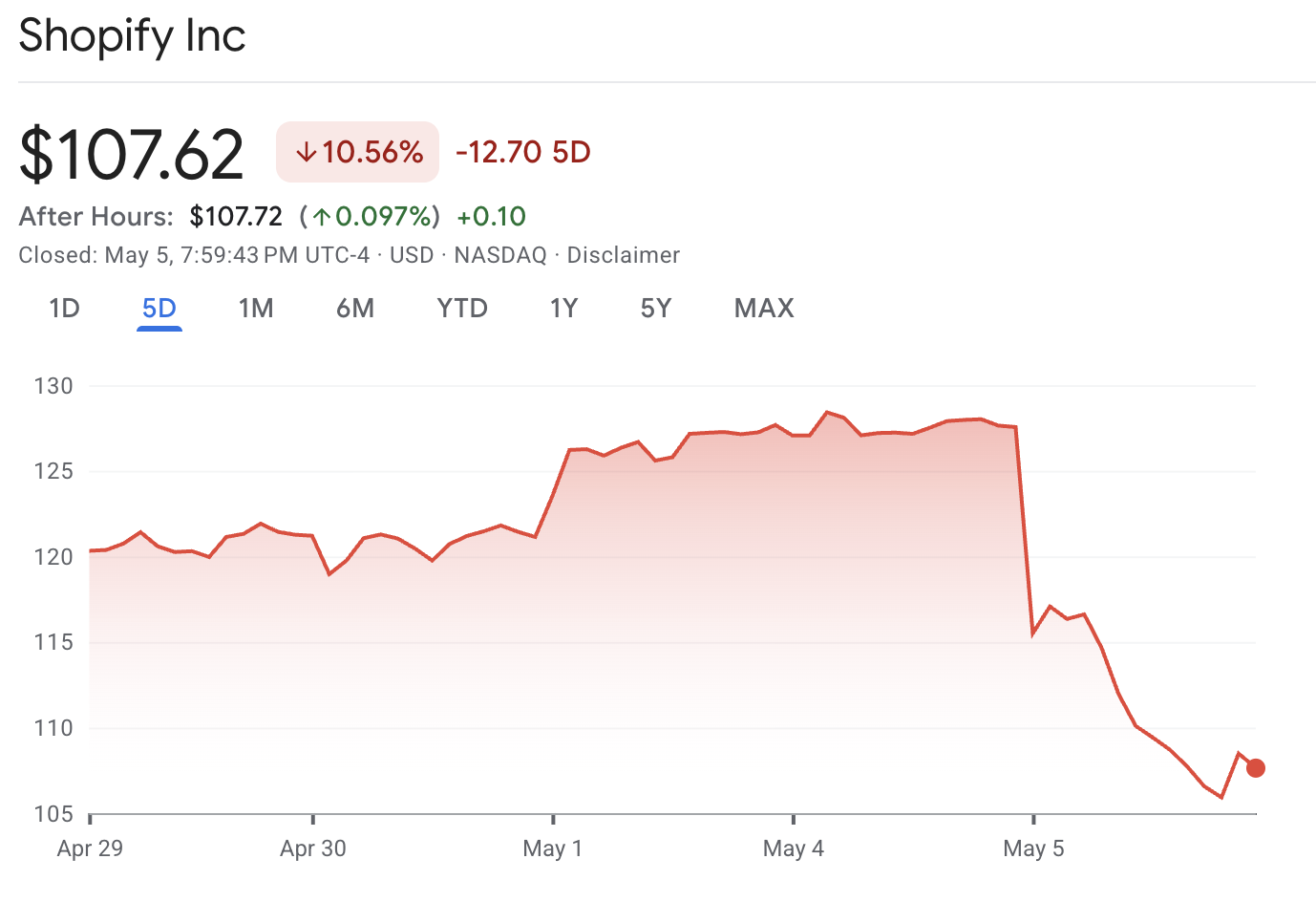
The selloff was sharp. Shopify Inc. shares traded at $107.63 as of the latest market data on May 6, 2026, down 15.6% on the session, after touching an intraday high of $133.00 and an intraday low of $105.61. The move erased enthusiasm around a quarter that showed almost everything a growth company would want: higher revenue, stronger gross merchandise volume, positive operating income, and steady free cash flow conversion.
| Metric | Detail as of May 2026 |
|---|---|
| Current Price | $107.63 following the recent drop |
| YTD Performance | Down approximately 19% |
| 52-Week Range | $88.14 to $182.19 |
| 2025 Revenue | $11.56 billion |
| 2025 Net Income | $1.23 billion |
Shopify reported $3.17 billion in Q1 revenue, up from $2.36 billion a year earlier. Gross profit climbed to $1.55 billion, and free cash flow reached $476 million, equal to 15% of revenue. Monthly recurring revenue rose to $212 million from $182 million.

| Metric | Q1 2026 | Q1 2025 | Change |
|---|---|---|---|
| GMV | $100.74B | $74.75B | +35% |
| Revenue | $3.17B | $2.36B | +34% |
| Subscription solutions revenue | $750M | $620M | +21% |
| Merchant solutions revenue | $2.42B | $1.74B | +39% |
| Gross profit | $1.55B | $1.17B | +32% |
| Operating income | $382M | $203M | +88% |
| Free cash flow | $476M | $363M | +31% |
| Free cash flow margin | 15% | 15% | Flat |
Shopify’s platform continued to expand across online stores, point of sale, payments, enterprise commerce, and cross-border selling. The company also benefited from a resilient retail backdrop. U.S. retail ecommerce sales reached $316.1 billion in Q4 2025 on a seasonally adjusted basis, up 5.3% year over year, while ecommerce accounted for 16.6% of total retail sales.
Yet the market reaction showed the danger of a premium multiple. Barron’s reported that Shopify had been trading near 63 times projected earnings, leaving little room for guidance that looked solid but not exceptional. The same report noted that the stock fell sharply despite the revenue beat and strong GMV growth.
The immediate pressure came from the Q2 outlook. Shopify expects revenue to grow at a high-twenties percentage rate, gross profit dollars to grow at a mid-twenties percentage rate, operating expenses to equal 35% to 36% of revenue, stock-based compensation of $145 million, and cash generation to remain in the mid-teens as a share of revenue.
That detail gives the AI story a more balanced frame. AI may improve merchant tools, checkout, automation, and commerce discovery. It also raises infrastructure demands before the full revenue benefit is visible. For a stock already facing questions on operating leverage, AI cost absorption is part of the 2026 debate.
The Wall Street Journal reported that concerns centered on weaker second-quarter profitability, higher operating expenses, and a continued shift toward lower-margin merchant services.
The deeper issue is business mix. Subscription solutions revenue rose 21% to $750 million, while merchant solutions revenue rose 39% to $2.42 billion. Merchant solutions now generate more than three-quarters of Shopify’s total revenue.
That changes the stock’s valuation framework. Shopify built its public-market reputation on software-like economics: recurring revenue, scalable infrastructure, and high gross margins. Its next growth layer increasingly depends on payments, currency conversion, lending services, partner referral fees, shipping labels, point-of-sale hardware, advertising, and buyer acquisition products.
Shopify Payments is the clearest example. Payment penetration reached 67% in Q1, up from 64% a year earlier. The company processed $67.1 billion of GMV through Shopify Payments, up from $47.5 billion, adding $19.5 billion in facilitated payments volume.

This is powerful platform economics, but not classic high-margin software economics. Shopify states that Shopify Payments, the biggest driver of merchant solutions revenue, typically carries lower gross profit margins than subscription solutions because of third-party costs. It also notes that the product requires less sales, marketing, and research spending than the core subscription business.
The tension is simple: payments can expand revenue, deepen merchant relationships, and support operating scale, but they can also compress reported gross margin. Shopify’s gross profit margin slipped to 49% of revenue from 50% a year earlier.
Shopify reported a net loss of $581 million, but that headline figure was distorted by equity-investment mark-to-market losses. Excluding the impact of equity investments, Shopify generated $360 million of net income, up from $226 million a year earlier.
This is one of the least appreciated elements of the quarter. The stock did not fall because the operating business collapsed. Operating income nearly doubled, and operating cash flow rose to $481 million from $367 million.
The selloff was a valuation reset, not a verdict on immediate operating failure.
Shopify ended Q1 with $2.10 billion in loans and merchant cash advances, up from $1.78 billion at the end of 2025. During the quarter, purchases and originations of loans reached $1.35 billion, while repayments and sales of loans totaled $1.04 billion.
Merchant finance can strengthen Shopify’s ecosystem by giving businesses working capital inside the platform. It can also add credit-cycle exposure. Transaction and loan losses climbed 55% to $116 million, driven by higher losses from lending services and Shopify Payments volume.
This does not make Shopify a bank. It does mean part of the growth story now carries financial-services risk alongside software risk.
Shopify is also investing through the AI cycle. The company’s 10-Q noted that cost of subscription solutions rose partly because of a $22 million increase in cloud and infrastructure costs, including AI-related usage.
That detail gives the AI story a more balanced frame. AI may improve merchant tools, checkout, automation, and commerce discovery. It also raises infrastructure demands before the full revenue benefit is visible. For a stock already facing questions on operating leverage, AI cost absorption is part of the 2026 debate.
Shopify remains one of the strongest commerce platforms in public markets. The company is still growing far faster than the broader ecommerce market, and its payments penetration gives it a larger share of merchant economics. The balance sheet also remains liquid, with $1.85 billion in cash and $3.90 billion in marketable securities at quarter-end.
The stock, however, now needs a cleaner answer on profitability. A rebound in Shopify stock likely requires one of three signals: Q2 guidance proving conservative, cash conversion improving beyond the mid-teens, or merchant solutions growth translating into stronger operating leverage despite lower gross margins.
Until then, the $100 billion GMV milestone may be remembered less as a celebration point and more as the moment Wall Street began valuing Shopify as a broader commerce-fintech infrastructure company rather than a pure software platform.