Published on: 2026-05-06
Updated on: 2026-05-06
May 6, 2026, marks United Therapeutics’ first-quarter earnings release, with Tyvaso growth set to drive the market’s reaction. The company reports before the opening bell, and the key question is whether Tyvaso DPI can keep expanding fast enough to support UTHR stock after a strong run.
United Therapeutics (UTHR) enters the report with one of biotechnology’s strongest profitability profiles. Full-year 2025 revenue reached $3.18 billion, up 11%, while net income rose to $1.33 billion and diluted EPS climbed to $27.86.
The next test is whether Tyvaso can carry current earnings strength into a new growth cycle, supported by ralinepag in pulmonary arterial hypertension and Tyvaso’s potential expansion into idiopathic pulmonary fibrosis.
United Therapeutics is expected to report Q1 2026 revenue of about $797.4 million.
Consensus EPS is around $7.00, while GAAP EPS is estimated near $6.86.
Tyvaso generated $1.88 billion in 2025 sales, nearly 59% of total revenue.
Tyvaso DPI revenue rose 25% in 2025 to $1.29 billion.
Ralinepag reduced the risk of clinical worsening by 55% in a phase 3 PAH study.
Tyvaso’s IPF data could become the larger long-term growth catalyst.
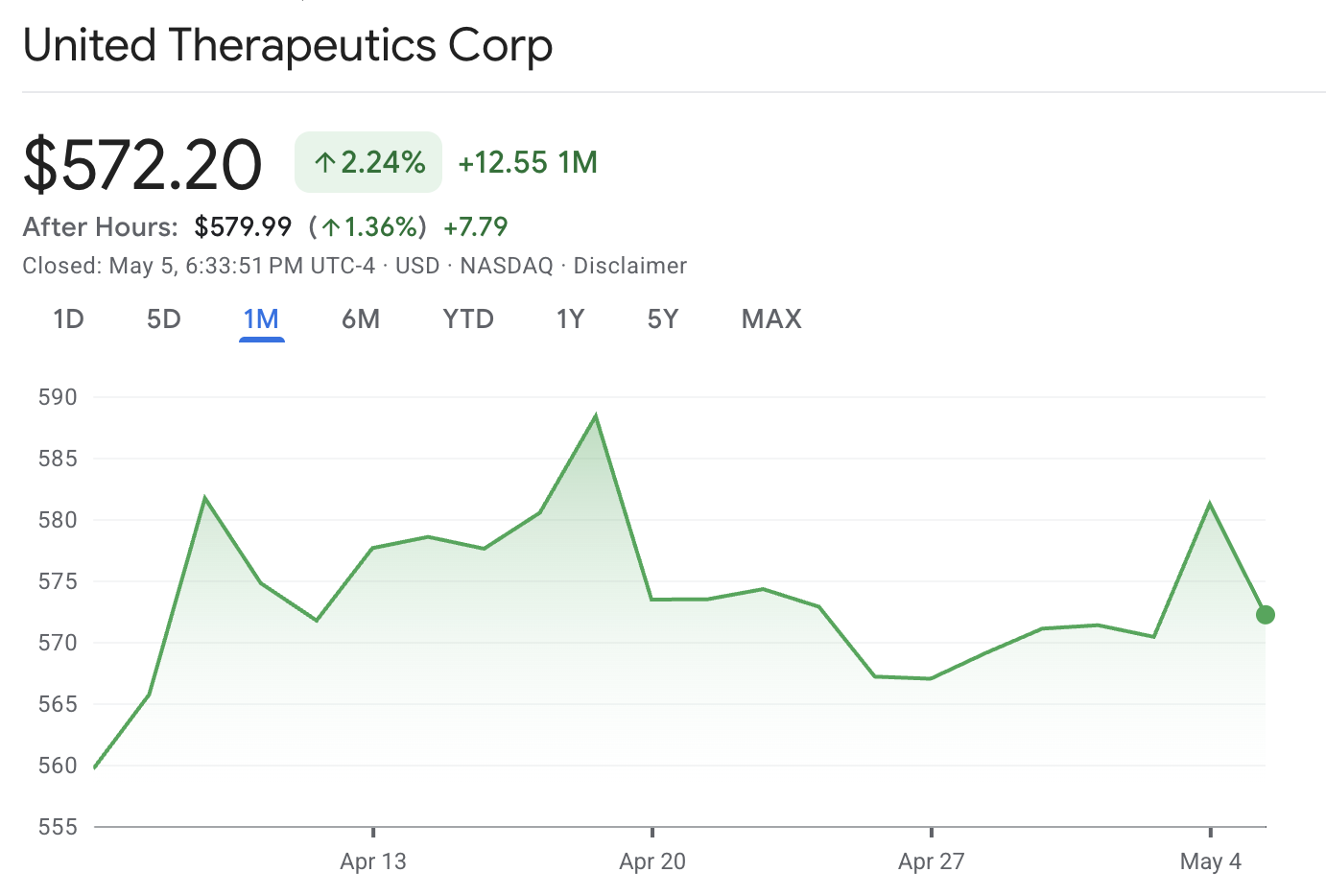
United Therapeutics is expected to report Q1 2026 revenue of about $797.4 million, only slightly above Q1 2025 revenue of $794.4 million. That modest growth forecast puts more weight on product mix, pricing quality, and expense control than on the headline sales figure alone.
| Earnings Metric | Q1 2026 Expectation | Q1 2025 Actual | What It Means |
|---|---|---|---|
| Revenue | $797.4mn | $794.4mn | Limited expected growth puts focus on sales quality. |
| Consensus EPS | About $7.00 | $6.63 diluted EPS | A beat would support the operating leverage story. |
| Normalized EPS | $7.04 | Not directly comparable | Gives a cleaner view of core earnings expectations. |
| GAAP EPS | $6.86 | $6.63 diluted EPS | Shows how revenue converts into reported profit. |
| Net income | Not separately estimated | $322.2mn | Profit quality remains central to the earnings reaction. |
| R&D spending | Not separately estimated | Full-year 2025: $550mn | Expense control is important as pipeline spending grows. |
A small revenue beat may not be enough. The stronger result would show Tyvaso DPI growth driven by volume, stable gross-to-net deductions, and controlled spending before larger regulatory opportunities.
Tyvaso is the center of United Therapeutics’ commercial story. In 2025, total Tyvaso sales rose 16% to $1.88 billion, making it the company’s largest revenue contributor. The franchise now shapes growth, margins, valuation confidence, and expectations for future expansion.
Tyvaso DPI is the clearest demand signal. The dry powder inhalation version generated $1.29 billion in 2025 revenue, up 25% from 2024. Growth was supported mainly by higher quantities sold, suggesting continued patient adoption rather than reliance on price.
Nebulized Tyvaso has a different role. Its 2025 sales were broadly flat at $585.7 million, but the product could become more important if it wins approval in idiopathic pulmonary fibrosis. DPI supports current earnings, while nebulized Tyvaso may carry the next addressable-market expansion.
United Therapeutics has several meaningful products, but the earnings story is increasingly concentrated around Tyvaso. The broader portfolio still supports cash flow, although some products are mature or more exposed to competition.
| Product | 2025 Revenue | YoY Change | Earnings Signal |
|---|---|---|---|
| Tyvaso DPI | $1.29bn | +25% | Main growth engine |
| Nebulized Tyvaso | $585.7mn | Flat | Mature base with IPF upside |
| Total Tyvaso | $1.88bn | +16% | Core franchise |
| Remodulin | $526.8mn | -2% | Mature PAH product |
| Orenitram | $496.9mn | +14% | Solid oral prostacyclin demand |
| Unituxin | $226.8mn | -5% | Smaller oncology contributor |
Orenitram’s 14% growth gives United Therapeutics a useful second PAH contributor. Remodulin remains meaningful but faces maturity in a more competitive treatment landscape. Unituxin adds diversification, though it does not alter the main earnings debate.
Specialty drug sales can rise at the prescription level while reported revenue grows more slowly because of rebates, payer mix, patient assistance, and Medicare Part D design.
This is especially relevant for Tyvaso DPI and Orenitram, where patient demand and payer effects may not move together. A strong quarter would show that volume growth is flowing through to net revenue. Higher deductions or weaker payer mix could reduce the quality of any sales beat.
Ralinepag is one of United Therapeutics’ most important late-stage assets. The oral prostacyclin receptor agonist is being developed for pulmonary arterial hypertension, a market where the company already has deep commercial infrastructure.
In the phase 3 ADVANCE OUTCOMES study, ralinepag reduced the risk of clinical worsening by 55% compared with placebo. It also showed improvement in six-minute walk distance and NT-proBNP, two closely followed PAH indicators.
If approved, ralinepag could broaden United Therapeutics’ PAH portfolio and help offset future pressure on older products such as Remodulin.
Tyvaso’s potential expansion into idiopathic pulmonary fibrosis may be the bigger long-term catalyst. IPF is a progressive lung disease with limited treatment options, and positive late-stage data has raised expectations for a supplemental filing.
The TETON-1 study showed nebulized Tyvaso delivered a 130.1 mL benefit in absolute forced vital capacity versus placebo at week 52. Integrated analysis from TETON-1 and TETON-2 showed a treatment effect of 111.8 mL.
An IPF approval would extend nebulized Tyvaso’s commercial life, reduce dependence on existing PAH indications, and move United Therapeutics into a larger respiratory disease opportunity.
United Therapeutics ended 2025 with $4.70 billion in cash, cash equivalents, and marketable investments. That liquidity gives the company room to fund research, prepare for launches, and return capital.
The company also announced a $2 billion share repurchase authorization in March 2026, including a $1.5 billionaccelerated share repurchase program. The buyback can support EPS, but it also raises the earnings bar.
United Therapeutics enters its May 6 earnings report with record annual revenue, high margins, significant cash, and two major pipeline catalysts. Tyvaso growth remains the main test.
Tyvaso DPI must keep proving commercial momentum, while nebulized Tyvaso carries the possibility of a larger IPF opportunity. Ralinepag adds another growth channel in pulmonary arterial hypertension.
The quarter will not settle the long-term outlook on its own. It can, however, show whether United Therapeutics has enough Tyvaso strength, margin discipline, and regulatory momentum to support its next phase of growth.